





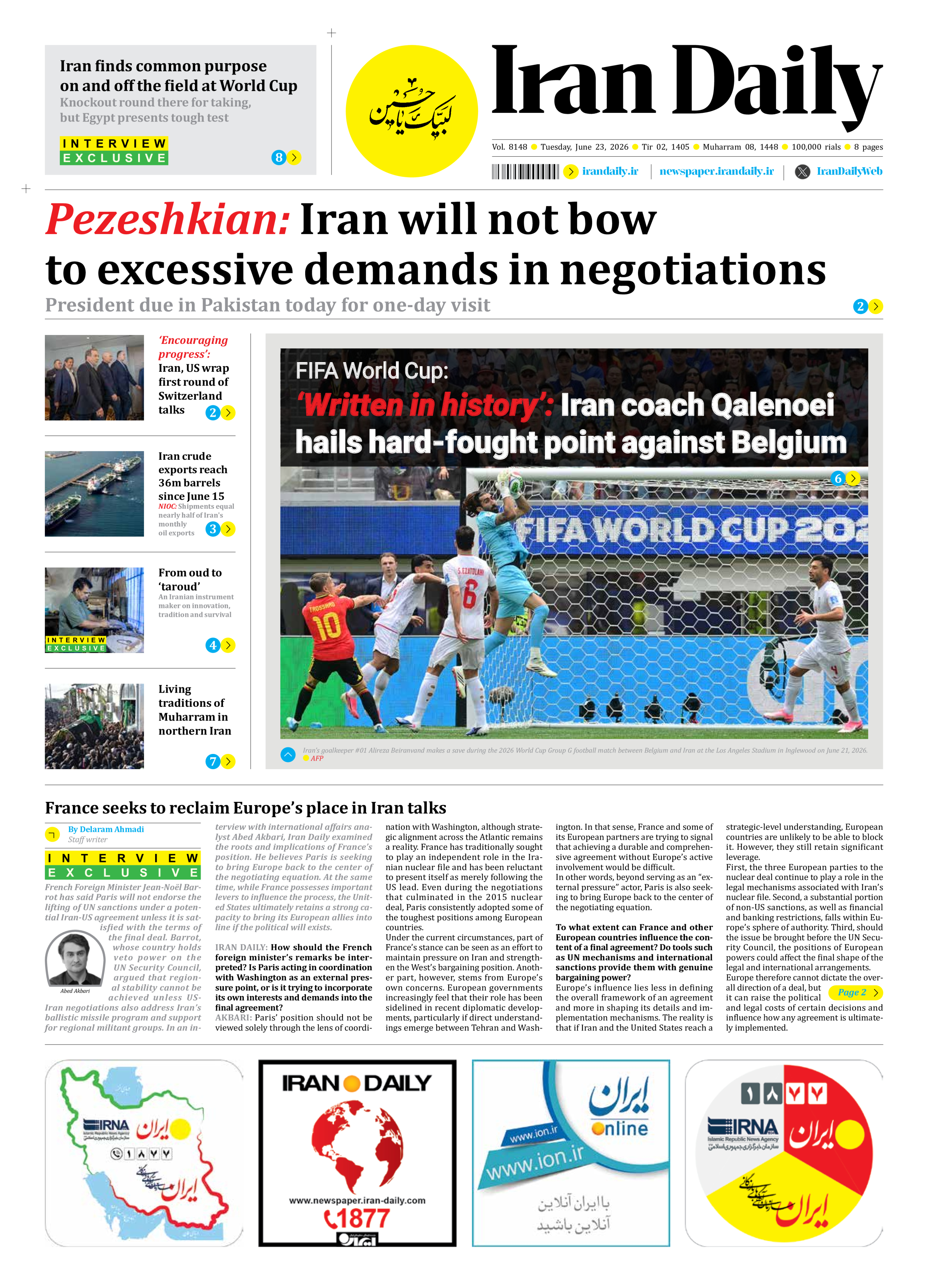


France seeks to reclaim Europe’s place in Iran talks
By Delaram Ahmadi
Staff writer
French Foreign Minister Jean-Noël Barrot has said Paris will not endorse the lifting of UN sanctions under a potential Iran-US agreement unless it is satisfied with the terms of the final deal. Barrot, whose country holds veto power on the UN Security Council, argued that regional stability cannot be achieved unless US-Iran negotiations also address Iran’s ballistic missile program and support for regional militant groups. In an interview with international affairs analyst Abed Akbari, Iran Daily examined the roots and implications of France’s position. He believes Paris is seeking to bring Europe back to the center of the negotiating equation. At the same time, while France possesses important levers to influence the process, the United States ultimately retains a strong capacity to bring its European allies into line if the political will exists.
IRAN DAILY: How should the French foreign minister’s remarks be interpreted? Is Paris acting in coordination with Washington as an external pressure point, or is it trying to incorporate its own interests and demands into the final agreement?
AKBARI: Paris’ position should not be viewed solely through the lens of coordination with Washington, although strategic alignment across the Atlantic remains a reality. France has traditionally sought to play an independent role in the Iranian nuclear file and has been reluctant to present itself as merely following the US lead. Even during the negotiations that culminated in the 2015 nuclear deal, Paris consistently adopted some of the toughest positions among European countries.
Under the current circumstances, part of France’s stance can be seen as an effort to maintain pressure on Iran and strengthen the West’s bargaining position. Another part, however, stems from Europe’s own concerns. European governments increasingly feel that their role has been sidelined in recent diplomatic developments, particularly if direct understandings emerge between Tehran and Washington. In that sense, France and some of its European partners are trying to signal that achieving a durable and comprehensive agreement without Europe’s active involvement would be difficult.
In other words, beyond serving as an “external pressure” actor, Paris is also seeking to bring Europe back to the center of the negotiating equation.
To what extent can France and other European countries influence the content of a final agreement? Do tools such as UN mechanisms and international sanctions provide them with genuine bargaining power?
Europe’s influence lies less in defining the overall framework of an agreement and more in shaping its details and implementation mechanisms. The reality is that if Iran and the United States reach a strategic-level understanding, European countries are unlikely to be able to block it. However, they still retain significant leverage.
First, the three European parties to the nuclear deal continue to play a role in the legal mechanisms associated with Iran’s nuclear file. Second, a substantial portion of non-US sanctions, as well as financial and banking restrictions, falls within Europe’s sphere of authority. Third, should the issue be brought before the UN Security Council, the positions of European powers could affect the final shape of the legal and international arrangements.
Europe therefore cannot dictate the overall direction of a deal, but it can raise the political and legal costs of certain decisions and influence how any agreement is ultimately implemented.
Page 2