





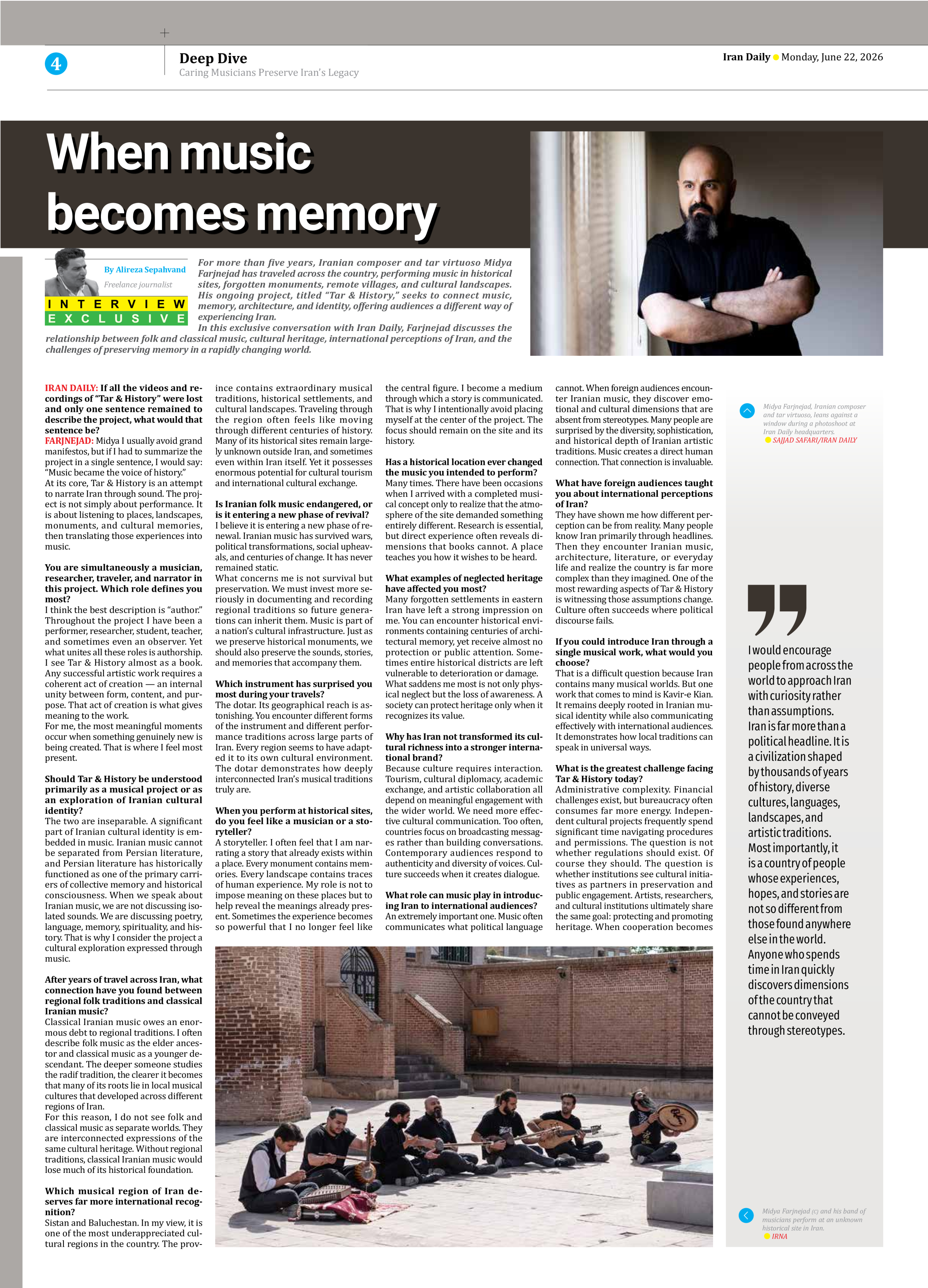


When music becomes memory
For more than five years, Iranian composer and tar virtuoso Midya Farjnejad has traveled across the country, performing music in historical sites, forgotten monuments, remote villages, and cultural landscapes. His ongoing project, titled “Tar & History,” seeks to connect music, memory, architecture, and identity, offering audiences a different way of experiencing Iran. In this exclusive conversation with Iran Daily, Farjnejad discusses the relationship between folk and classical music, cultural heritage, international perceptions of Iran, and the challenges of preserving memory in a rapidly changing world.
Freelance journalist
IRAN DAILY: If all the videos and recordings of “Tar & History” were lost and only one sentence remained to describe the project, what would that sentence be?
FARJNEJAD: Midya I usually avoid grand manifestos, but if I had to summarize the project in a single sentence, I would say: “Music became the voice of history.”
At its core, Tar & History is an attempt to narrate Iran through sound. The project is not simply about performance. It is about listening to places, landscapes, monuments, and cultural memories, then translating those experiences into music.
You are simultaneously a musician, researcher, traveler, and narrator in this project. Which role defines you most?
I think the best description is “author.” Throughout the project I have been a performer, researcher, student, teacher, and sometimes even an observer. Yet what unites all these roles is authorship.
I see Tar & History almost as a book. Any successful artistic work requires a coherent act of creation — an internal unity between form, content, and purpose. That act of creation is what gives meaning to the work.
For me, the most meaningful moments occur when something genuinely new is being created. That is where I feel most present.
Should Tar & History be understood primarily as a musical project or as an exploration of Iranian cultural identity?
The two are inseparable. A significant part of Iranian cultural identity is embedded in music. Iranian music cannot be separated from Persian literature, and Persian literature has historically functioned as one of the primary carriers of collective memory and historical consciousness. When we speak about Iranian music, we are not discussing isolated sounds. We are discussing poetry, language, memory, spirituality, and history. That is why I consider the project a cultural exploration expressed through music.
After years of travel across Iran, what connection have you found between regional folk traditions and classical Iranian music?
Classical Iranian music owes an enormous debt to regional traditions. I often describe folk music as the elder ancestor and classical music as a younger descendant. The deeper someone studies the radif tradition, the clearer it becomes that many of its roots lie in local musical cultures that developed across different regions of Iran.
For this reason, I do not see folk and classical music as separate worlds. They are interconnected expressions of the same cultural heritage. Without regional traditions, classical Iranian music would lose much of its historical foundation.
Which musical region of Iran deserves far more international recognition?
Sistan and Baluchestan. In my view, it is one of the most underappreciated cultural regions in the country. The province contains extraordinary musical traditions, historical settlements, and cultural landscapes. Traveling through the region often feels like moving through different centuries of history. Many of its historical sites remain largely unknown outside Iran, and sometimes even within Iran itself. Yet it possesses enormous potential for cultural tourism and international cultural exchange.
Is Iranian folk music endangered, or is it entering a new phase of revival?
I believe it is entering a new phase of renewal. Iranian music has survived wars, political transformations, social upheavals, and centuries of change. It has never remained static.
What concerns me is not survival but preservation. We must invest more seriously in documenting and recording regional traditions so future generations can inherit them. Music is part of a nation’s cultural infrastructure. Just as we preserve historical monuments, we should also preserve the sounds, stories, and memories that accompany them.
Which instrument has surprised you most during your travels?
The dotar. Its geographical reach is astonishing. You encounter different forms of the instrument and different performance traditions across large parts of Iran. Every region seems to have adapted it to its own cultural environment. The dotar demonstrates how deeply interconnected Iran’s musical traditions truly are.
When you perform at historical sites, do you feel like a musician or a storyteller?
A storyteller. I often feel that I am narrating a story that already exists within a place. Every monument contains memories. Every landscape contains traces of human experience. My role is not to impose meaning on these places but to help reveal the meanings already present. Sometimes the experience becomes so powerful that I no longer feel like the central figure. I become a medium through which a story is communicated. That is why I intentionally avoid placing myself at the center of the project. The focus should remain on the site and its history.
Has a historical location ever changed the music you intended to perform?
Many times. There have been occasions when I arrived with a completed musical concept only to realize that the atmosphere of the site demanded something entirely different. Research is essential, but direct experience often reveals dimensions that books cannot. A place teaches you how it wishes to be heard.
What examples of neglected heritage have affected you most?
Many forgotten settlements in eastern Iran have left a strong impression on me. You can encounter historical environments containing centuries of architectural memory, yet receive almost no protection or public attention. Sometimes entire historical districts are left vulnerable to deterioration or damage.
What saddens me most is not only physical neglect but the loss of awareness. A society can protect heritage only when it recognizes its value.
Why has Iran not transformed its cultural richness into a stronger international brand?
Because culture requires interaction. Tourism, cultural diplomacy, academic exchange, and artistic collaboration all depend on meaningful engagement with the wider world. We need more effective cultural communication. Too often, countries focus on broadcasting messages rather than building conversations. Contemporary audiences respond to authenticity and diversity of voices. Culture succeeds when it creates dialogue.
What role can music play in introducing Iran to international audiences?
An extremely important one. Music often communicates what political language cannot. When foreign audiences encounter Iranian music, they discover emotional and cultural dimensions that are absent from stereotypes. Many people are surprised by the diversity, sophistication, and historical depth of Iranian artistic traditions. Music creates a direct human connection. That connection is invaluable.
What have foreign audiences taught you about international perceptions of Iran?
They have shown me how different perception can be from reality. Many people know Iran primarily through headlines. Then they encounter Iranian music, architecture, literature, or everyday life and realize the country is far more complex than they imagined. One of the most rewarding aspects of Tar & History is witnessing those assumptions change. Culture often succeeds where political discourse fails.
If you could introduce Iran through a single musical work, what would you choose?
That is a difficult question because Iran contains many musical worlds. But one work that comes to mind is Kavir-e Kian. It remains deeply rooted in Iranian musical identity while also communicating effectively with international audiences. It demonstrates how local traditions can speak in universal ways.
What is the greatest challenge facing Tar & History today?
Administrative complexity. Financial challenges exist, but bureaucracy often consumes far more energy. Independent cultural projects frequently spend significant time navigating procedures and permissions. The question is not whether regulations should exist. Of course they should. The question is whether institutions see cultural initiatives as partners in preservation and public engagement. Artists, researchers, and cultural institutions ultimately share the same goal: protecting and promoting heritage. When cooperation becomes easier, everyone benefits.
Do independent cultural projects face greater difficulties than institutional ones?
Generally speaking, yes. Independent projects must create their own infrastructure while simultaneously producing content. That requires persistence. At the same time, independence provides freedom. It allows a project to follow its own creative logic. The ideal situation would be stronger collaboration between institutions and independent cultural initiatives.
Are there still places in Iran where you hope to perform Tar & History?
Historical mosques remain particularly important to me. Iran’s religious architecture forms a significant part of its cultural heritage. These spaces bring together architecture, poetry, calligraphy, spirituality, and history. I believe thoughtful musical presentations can contribute to a deeper appreciation of those environments. Historically, art and spirituality in Iran have often coexisted.
Why is documenting heritage especially important during times of crisis?
Because heritage represents continuity. Historical monuments remind us that previous generations also faced challenges and uncertainties, yet still left meaningful legacies behind. In difficult moments, cultural memory can become a source of resilience. Protecting heritage is therefore not only about preserving the past. It is also about strengthening society’s relationship with its future.
Finally, what message would you like international readers to take away about Iran?
I would encourage people from across the world to approach Iran with curiosity rather than assumptions. Iran is far more than a political headline. It is a civilization shaped by thousands of years of history, diverse cultures, languages, landscapes, and artistic traditions.
Most importantly, it is a country of people whose experiences, hopes, and stories are not so different from those found anywhere else in the world. Anyone who spends time in Iran quickly discovers dimensions of the country that cannot be conveyed through stereotypes.
Tar & History is ultimately an invitation to that discovery. Not through slogans or arguments, but through music because music remains one of the most powerful ways of remembering who we are — and of understanding one another.