







Copy in clipboard...
Vienna initiative recasts Iranian studies through books, new scholarship
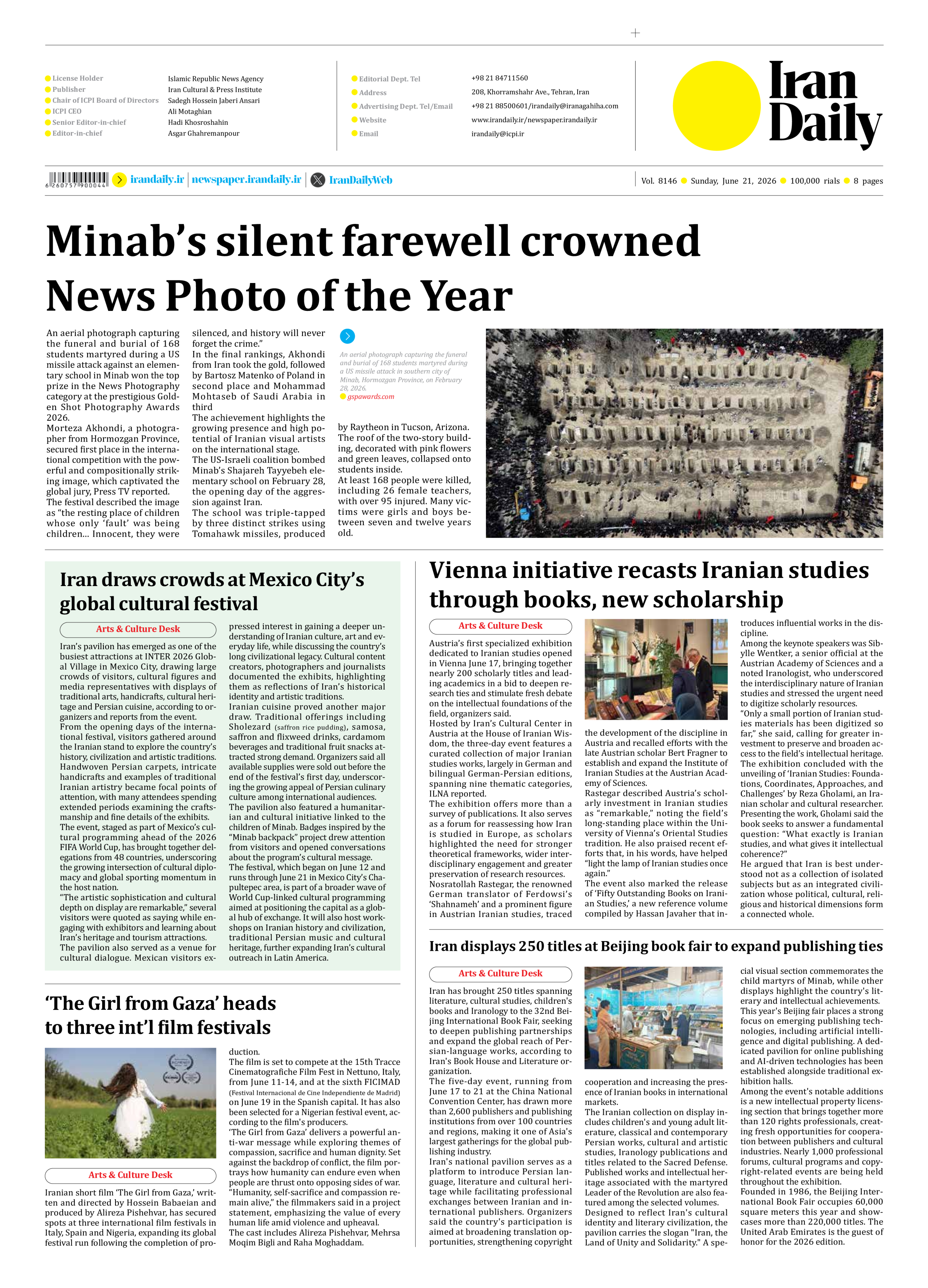
Austria’s first specialized exhibition dedicated to Iranian studies opened in Vienna June 17, bringing together nearly 200 scholarly titles and leading academics in a bid to deepen research ties and stimulate fresh debate on the intellectual foundations of the field, organizers said.
Hosted by Iran’s Cultural Center in Austria at the House of Iranian Wisdom, the three-day event features a curated collection of major Iranian studies works, largely in German and bilingual German-Persian editions, spanning nine thematic categories, ILNA reported.
The exhibition offers more than a survey of publications. It also serves as a forum for reassessing how Iran is studied in Europe, as scholars highlighted the need for stronger theoretical frameworks, wider interdisciplinary engagement and greater preservation of research resources.
Nosratollah Rastegar, the renowned German translator of Ferdowsi’s ‘Shahnameh’ and a prominent figure in Austrian Iranian studies, traced the development of the discipline in Austria and recalled efforts with the late Austrian scholar Bert Fragner to establish and expand the Institute of Iranian Studies at the Austrian Academy of Sciences.
Rastegar described Austria’s scholarly investment in Iranian studies as “remarkable,” noting the field’s long-standing place within the University of Vienna’s Oriental Studies tradition. He also praised recent efforts that, in his words, have helped “light the lamp of Iranian studies once again.”
The event also marked the release of ‘Fifty Outstanding Books on Iranian Studies,’ a new reference volume compiled by Hassan Javaher that introduces influential works in the discipline.
Among the keynote speakers was Sibylle Wentker, a senior official at the Austrian Academy of Sciences and a noted Iranologist, who underscored the interdisciplinary nature of Iranian studies and stressed the urgent need to digitize scholarly resources.
“Only a small portion of Iranian studies materials has been digitized so far,” she said, calling for greater investment to preserve and broaden access to the field’s intellectual heritage.
The exhibition concluded with the unveiling of ‘Iranian Studies: Foundations, Coordinates, Approaches, and Challenges’ by Reza Gholami, an Iranian scholar and cultural researcher. Presenting the work, Gholami said the book seeks to answer a fundamental question: “What exactly is Iranian studies, and what gives it intellectual coherence?”
He argued that Iran is best understood not as a collection of isolated subjects but as an integrated civilization whose political, cultural, religious and historical dimensions form a connected whole.