







Germany’s UNSC setback, limits of selective multilateralism
By Shairee Malhotra
Deputy director of Strategic Studies Programme at ORF
On June 3, 2026, an unprecedented event took place at the United Nations General Assembly (UNGA) in New York. Portugal and Austria defeated Germany by winning the two non-permanent seats on the United Nations Security Council (UNSC) allocated to the Western European and Others Group (WEOG). Besides the UNSC’s P5 members, which have veto power, the UNGA elects 10 non-permanent members from different world regions for staggered two-year terms.
In a secret ballot, Germany received 104 votes, but needed 127 (a two-thirds majority) out of the total 193. Meanwhile, Portugal and Austria received 134 and 131 votes respectively, defeating Germany by a large margin and breaking its winning streak.
For a country that is Europe’s economic powerhouse, has served six previous terms as a non-permanent member on the UNSC, and is amongst the UN’s top financial contributors, the loss was a crushing blow dubbed “the most severe foreign policy defeat yet” for Chancellor Friedrich Merz’s coalition government. The defeat carries implications beyond the actual seat; it signals a fundamental shift in how the world currently perceives Germany.
The long shadow of Berlin’s foreign policy choices
German Foreign Minister Johann Wadephul alluded to Germany’s firm support for Ukraine and its “special historical responsibility” toward Israel as key factors behind the loss. However, analysts have dismissed the Ukraine argument, highlighting Austria and Portugal’s equally strong solidarity with Kyiv. Yet, there is broad agreement that Germany’s posture on the Israel-Palestine issue was a decisive factor.
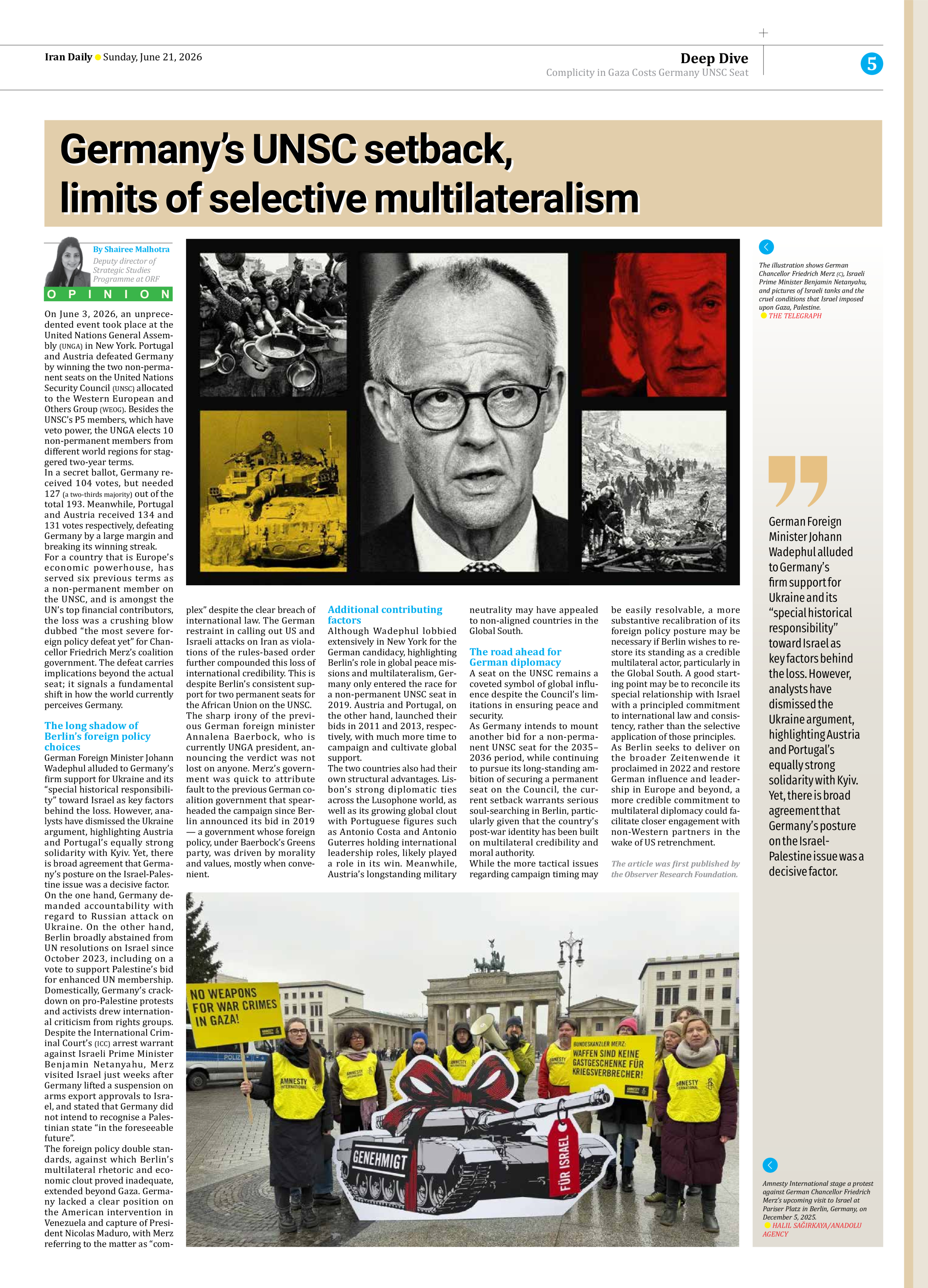
On the one hand, Germany demanded accountability with regard to Russian attack on Ukraine. On the other hand, Berlin broadly abstained from UN resolutions on Israel since October 2023, including on a vote to support Palestine’s bid for enhanced UN membership. Domestically, Germany’s crackdown on pro-Palestine protests and activists drew international criticism from rights groups. Despite the International Criminal Court’s (ICC) arrest warrant against Israeli Prime Minister Benjamin Netanyahu, Merz visited Israel just weeks after Germany lifted a suspension on arms export approvals to Israel, and stated that Germany did not intend to recognise a Palestinian state “in the foreseeable future”.
The foreign policy double standards, against which Berlin’s multilateral rhetoric and economic clout proved inadequate, extended beyond Gaza. Germany lacked a clear position on the American intervention in Venezuela and capture of President Nicolas Maduro, with Merz referring to the matter as “complex” despite the clear breach of international law. The German restraint in calling out US and Israeli attacks on Iran as violations of the rules-based order further compounded this loss of international credibility. This is despite Berlin’s consistent support for two permanent seats for the African Union on the UNSC.
The sharp irony of the previous German foreign minister Annalena Baerbock, who is currently UNGA president, announcing the verdict was not lost on anyone. Merz’s government was quick to attribute fault to the previous German coalition government that spearheaded the campaign since Berlin announced its bid in 2019 — a government whose foreign policy, under Baerbock’s Greens party, was driven by morality and values, mostly when convenient.
Additional contributing factors
Although Wadephul lobbied extensively in New York for the German candidacy, highlighting Berlin’s role in global peace missions and multilateralism, Germany only entered the race for a non-permanent UNSC seat in 2019. Austria and Portugal, on the other hand, launched their bids in 2011 and 2013, respectively, with much more time to campaign and cultivate global support.
The two countries also had their own structural advantages. Lisbon’s strong diplomatic ties across the Lusophone world, as well as its growing global clout with Portuguese figures such as Antonio Costa and Antonio Guterres holding international leadership roles, likely played a role in its win. Meanwhile, Austria’s longstanding military neutrality may have appealed to non-aligned countries in the Global South.
The road ahead for German diplomacy
A seat on the UNSC remains a coveted symbol of global influence despite the Council’s limitations in ensuring peace and security.
As Germany intends to mount another bid for a non-permanent UNSC seat for the 2035–2036 period, while continuing to pursue its long-standing ambition of securing a permanent seat on the Council, the current setback warrants serious soul-searching in Berlin, particularly given that the country’s post-war identity has been built on multilateral credibility and moral authority.
While the more tactical issues regarding campaign timing may be easily resolvable, a more substantive recalibration of its foreign policy posture may be necessary if Berlin wishes to restore its standing as a credible multilateral actor, particularly in the Global South. A good starting point may be to reconcile its special relationship with Israel with a principled commitment to international law and consistency, rather than the selective application of those principles.
As Berlin seeks to deliver on the broader Zeitenwende it proclaimed in 2022 and restore German influence and leadership in Europe and beyond, a more credible commitment to multilateral diplomacy could facilitate closer engagement with non-Western partners in the wake of US retrenchment.
The article was first published by the Observer Research Foundation.