





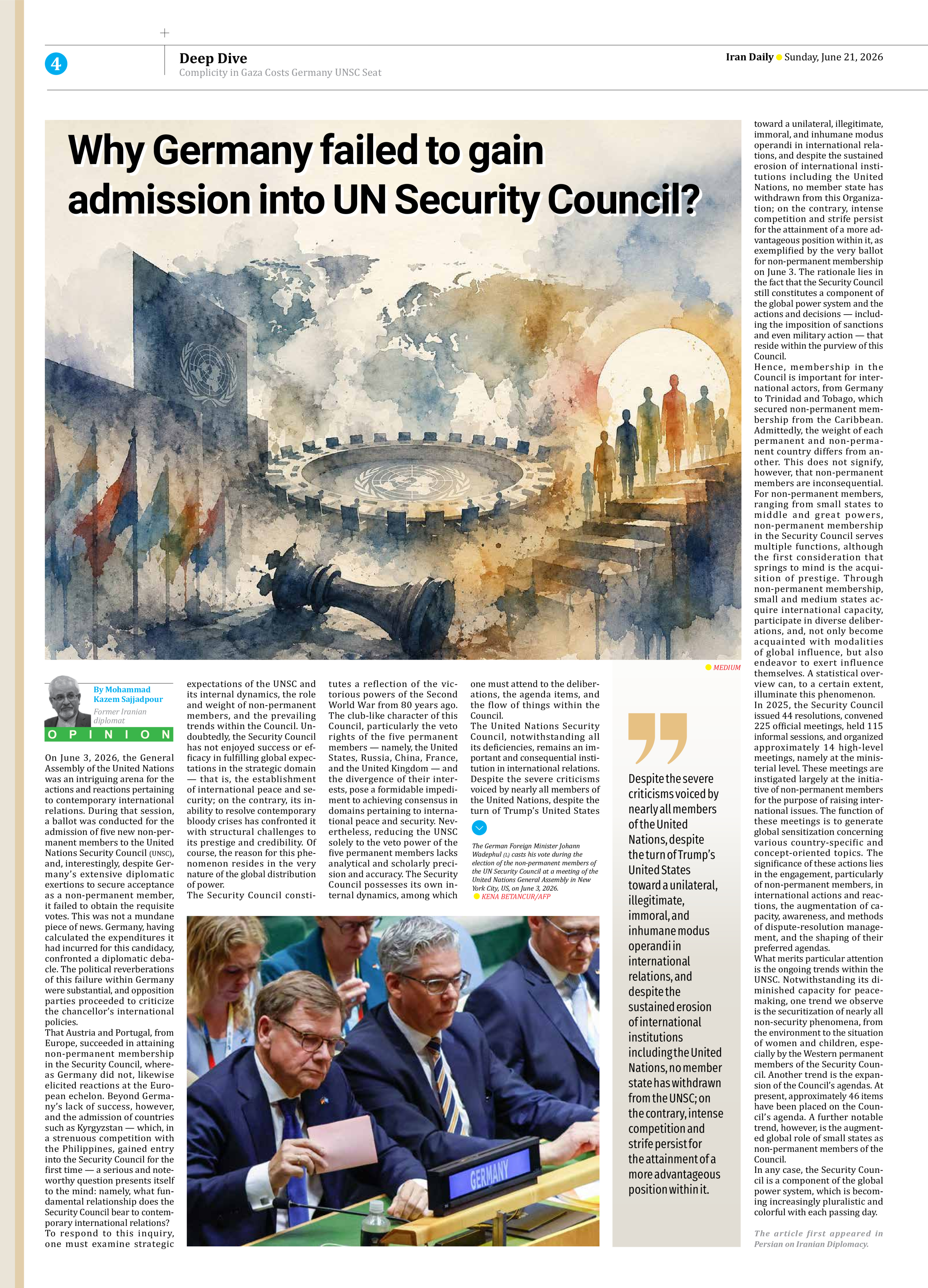


Why Germany failed to gain admission into UN Security Council?
Former Iranian diplomat
On June 3, 2026, the General Assembly of the United Nations was an intriguing arena for the actions and reactions pertaining to contemporary international relations. During that session, a ballot was conducted for the admission of five new non-permanent members to the United Nations Security Council (UNSC), and, interestingly, despite Germany’s extensive diplomatic exertions to secure acceptance as a non-permanent member, it failed to obtain the requisite votes. This was not a mundane piece of news. Germany, having calculated the expenditures it had incurred for this candidacy, confronted a diplomatic debacle. The political reverberations of this failure within Germany were substantial, and opposition parties proceeded to criticize the chancellor’s international policies.
That Austria and Portugal, from Europe, succeeded in attaining non-permanent membership in the Security Council, whereas Germany did not, likewise elicited reactions at the European echelon. Beyond Germany’s lack of success, however, and the admission of countries such as Kyrgyzstan — which, in a strenuous competition with the Philippines, gained entry into the Security Council for the first time — a serious and noteworthy question presents itself to the mind: namely, what fundamental relationship does the Security Council bear to contemporary international relations?
To respond to this inquiry, one must examine strategic expectations of the UNSC and its internal dynamics, the role and weight of non-permanent members, and the prevailing trends within the Council. Undoubtedly, the Security Council has not enjoyed success or efficacy in fulfilling global expectations in the strategic domain — that is, the establishment of international peace and security; on the contrary, its inability to resolve contemporary bloody crises has confronted it with structural challenges to its prestige and credibility. Of course, the reason for this phenomenon resides in the very nature of the global distribution of power.
The Security Council constitutes a reflection of the victorious powers of the Second World War from 80 years ago. The club-like character of this Council, particularly the veto rights of the five permanent members — namely, the United States, Russia, China, France, and the United Kingdom — and the divergence of their interests, pose a formidable impediment to achieving consensus in domains pertaining to international peace and security. Nevertheless, reducing the UNSC solely to the veto power of the five permanent members lacks analytical and scholarly precision and accuracy. The Security Council possesses its own internal dynamics, among which one must attend to the deliberations, the agenda items, and the flow of things within the Council.
The United Nations Security Council, notwithstanding all its deficiencies, remains an important and consequential institution in international relations. Despite the severe criticisms voiced by nearly all members of the United Nations, despite the turn of Trump’s United States toward a unilateral, illegitimate, immoral, and inhumane modus operandi in international relations, and despite the sustained erosion of international institutions including the United Nations, no member state has withdrawn from this Organization; on the contrary, intense competition and strife persist for the attainment of a more advantageous position within it, as exemplified by the very ballot for non-permanent membership on June 3. The rationale lies in the fact that the Security Council still constitutes a component of the global power system and the actions and decisions — including the imposition of sanctions and even military action — that reside within the purview of this Council.
Hence, membership in the Council is important for international actors, from Germany to Trinidad and Tobago, which secured non-permanent membership from the Caribbean. Admittedly, the weight of each permanent and non-permanent country differs from another. This does not signify, however, that non-permanent members are inconsequential. For non-permanent members, ranging from small states to middle and great powers, non-permanent membership in the Security Council serves multiple functions, although the first consideration that springs to mind is the acquisition of prestige. Through non-permanent membership, small and medium states acquire international capacity, participate in diverse deliberations, and, not only become acquainted with modalities of global influence, but also endeavor to exert influence themselves. A statistical overview can, to a certain extent, illuminate this phenomenon.
In 2025, the Security Council issued 44 resolutions, convened 225 official meetings, held 115 informal sessions, and organized approximately 14 high-level meetings, namely at the ministerial level. These meetings are instigated largely at the initiative of non-permanent members for the purpose of raising international issues. The function of these meetings is to generate global sensitization concerning various country-specific and concept-oriented topics. The significance of these actions lies in the engagement, particularly of non-permanent members, in international actions and reactions, the augmentation of capacity, awareness, and methods of dispute-resolution management, and the shaping of their preferred agendas.
What merits particular attention is the ongoing trends within the UNSC. Notwithstanding its diminished capacity for peacemaking, one trend we observe is the securitization of nearly all non-security phenomena, from the environment to the situation of women and children, especially by the Western permanent members of the Security Council. Another trend is the expansion of the Council’s agendas. At present, approximately 46 items have been placed on the Council’s agenda. A further notable trend, however, is the augmented global role of small states as non-permanent members of the Council.
In any case, the Security Council is a component of the global power system, which is becoming increasingly pluralistic and colorful with each passing day.
The article first appeared in
Persian on Iranian Diplomacy.