







Copy in clipboard...
VP announces phased release of $25b frozen assets under US memo
An Iranian vice president said on Saturday that an estimated $25 billion of the country’s frozen assets would gradually be released under a recent memorandum of understanding (MoU) reached between Tehran and Washington.
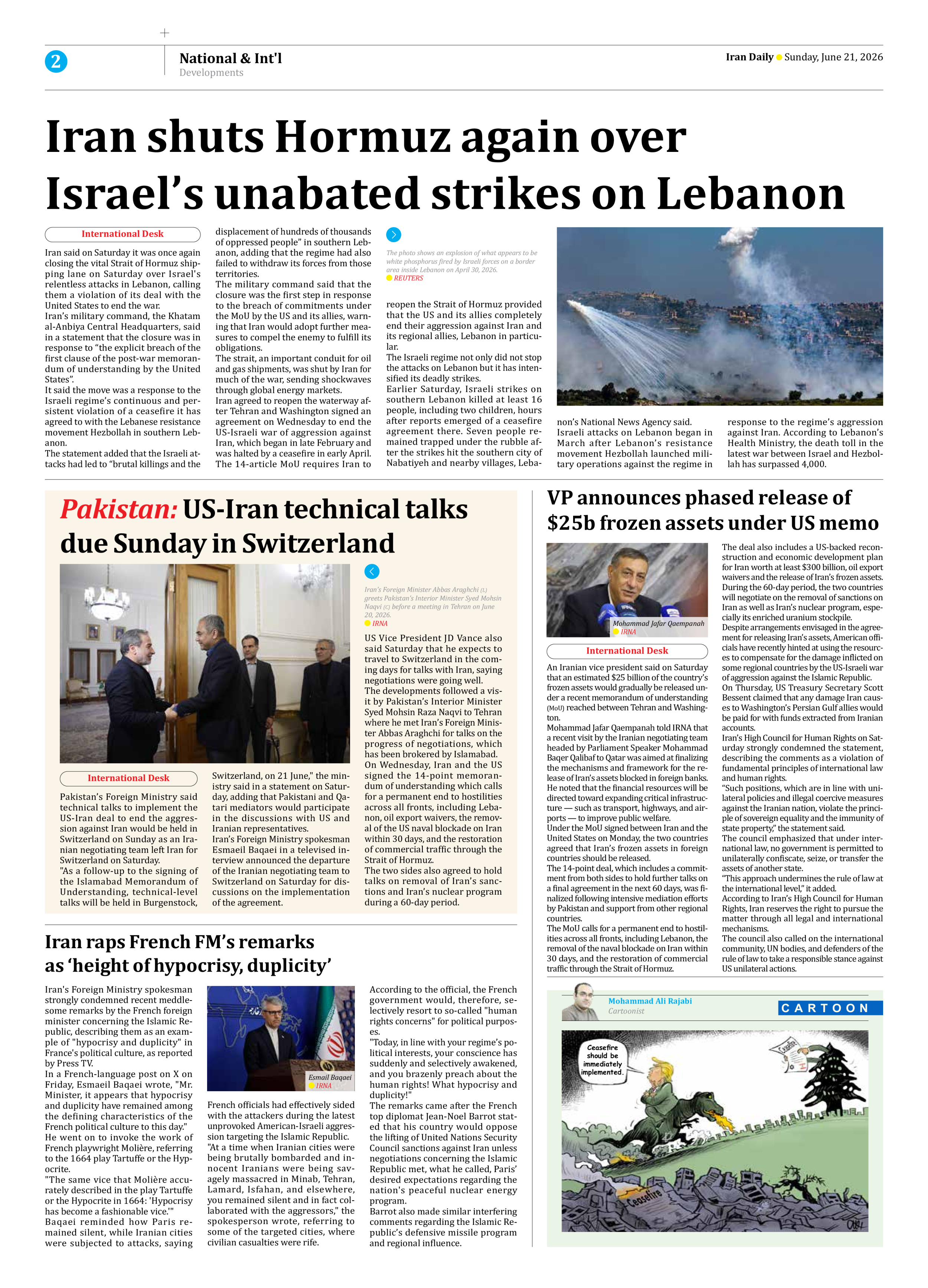
Mohammad Jafar Qaempanah told IRNA that a recent visit by the Iranian negotiating team headed by Parliament Speaker Mohammad Baqer Qalibaf to Qatar was aimed at finalizing the mechanisms and framework for the release of Iran’s assets blocked in foreign banks.
He noted that the financial resources will be directed toward expanding critical infrastructure — such as transport, highways, and airports — to improve public welfare.
Under the MoU signed between Iran and the United States on Monday, the two countries agreed that Iran’s frozen assets in foreign countries should be released.
The 14-point deal, which includes a commitment from both sides to hold further talks on a final agreement in the next 60 days, was finalized following intensive mediation efforts by Pakistan and support from other regional countries.
The MoU calls for a permanent end to hostilities across all fronts, including Lebanon, the removal of the naval blockade on Iran within 30 days, and the restoration of commercial traffic through the Strait of Hormuz.
The deal also includes a US-backed reconstruction and economic development plan for Iran worth at least $300 billion, oil export waivers and the release of Iran’s frozen assets.
During the 60-day period, the two countries will negotiate on the removal of sanctions on Iran as well as Iran’s nuclear program, especially its enriched uranium stockpile.
Despite arrangements envisaged in the agreement for releasing Iran’s assets, American officials have recently hinted at using the resources to compensate for the damage inflicted on some regional countries by the US-Israeli war of aggression against the Islamic Republic.
On Thursday, US Treasury Secretary Scott Bessent claimed that any damage Iran causes to Washington’s Persian Gulf allies would be paid for with funds extracted from Iranian accounts.
Iran’s High Council for Human Rights on Saturday strongly condemned the statement, describing the comments as a violation of fundamental principles of international law and human rights.
“Such positions, which are in line with unilateral policies and illegal coercive measures against the Iranian nation, violate the principle of sovereign equality and the immunity of state property,” the statement said.
The council emphasized that under international law, no government is permitted to unilaterally confiscate, seize, or transfer the assets of another state.
“This approach undermines the rule of law at the international level,” it added.
According to Iran’s High Council for Human Rights, Iran reserves the right to pursue the matter through all legal and international mechanisms.
The council also called on the international community, UN bodies, and defenders of the rule of law to take a responsible stance against US unilateral actions.