







EU’s challenge in advancing unified policy toward China
By Morteza Makki
Expert on European affairs
If, during previous decades, European leaders regarded the expansion of trade with China as an emblem of the success of globalization and economic interdependence, that very interdependence has now turned into a source of economic, industrial, and even security-related apprehensions. In fact, Europe is transitioning past a historical epoch; an epoch in which it was presumed that China’s integration into the global economy would engender greater political and economic convergence, yet many European policymakers have now concluded that this assumption has not merely failed to materialize, but has, in certain domains, produced antithetical outcomes.
An analysis of economic trajectories demonstrates that Brussels’s concerns do not emanate solely from the enlargement of the trade deficit with China, but are rooted in more profound transformations within the structure of the global economy. Throughout the past two decades, China succeeded in ascending from the status of the “world’s factory” to the position of an advanced industrial and technological power. Initially, this transformation was regarded as a substantial opportunity for Europe because European corporations benefited from China’s vast market, and European consumers likewise obtained access to inexpensive goods. Yet the very factors that were once perceived as advantages have now evolved into strategic concerns.
Today, numerous proprietors of European industries contend that competition with Chinese firms, in fields ranging from the steel industry to electric vehicles, solar panels, batteries, and even advanced technologies — which benefit from extensive support from the central governments — inexpensive access to capital, subsidized energy, and long-term industrial policies, has become progressively more difficult.
Studies published by think tanks such as Bruegel, European Policy Centre, European Union Institute for Security Studies, and Council on Foreign Relations indicate that Europe’s principal concern is no longer merely trade, but rather the issue of “economic security,” a concept that, following the COVID-19 pandemic, supply-chain disruptions, and the war in Ukraine, has become one of the principal watchwords of policymaking in Europe. European leaders, particularly after experiencing extensive dependence upon Russian gas, recognized that excessive reliance upon a single external power can, under crisis conditions, transform into a geopolitical vulnerability. The same concern is now being raised regarding China. Europe’s dependence upon imports of rare mineral elements, critical raw materials, batteries, semiconductors, and numerous technologies required for the green transition has impelled Brussels to reassess its economic relations with Beijing.
This alteration in outlook has coincided with mounting concerns regarding China’s excess production capacity. Numerous European economists maintain that China’s slowing economic growth and structural economic issues have rendered Beijing more dependent upon exports than before. Consequently, an immense volume of Chinese goods enters global markets at highly competitive prices. From the European perspective, this trend has not only intensified the European Union’s trade deficit, but has also weakened the competitive capabilities of many domestic industries. For this reason, Brussels has, in recent years, deployed an array of trade-defense instruments, ranging from the imposition of tariffs upon Chinese electric vehicles to intensified scrutiny of foreign investments, examinations of Chinese state subsidies, and the formulation of new regulations designed to support Europe’s strategic industries.
Nevertheless, Europe’s principal challenge is that it cannot pursue the same trajectory adopted by the United States. Unlike Washington, Europe’s economy possesses considerably deeper ties with China. China is among the European Union’s largest trading partners, and thousands of European companies derive a substantial portion of their revenues from the Chinese market. The German economy, in particular, which is regarded as Europe’s industrial engine, remains dependent upon the Chinese market across numerous sectors. Major German automobile manufacturers benefited for years from the growth of the Chinese market and continue to conduct a significant share of their global sales within that country.
This dependence has resulted in the absence of complete consensus within the European Union regarding the appropriate manner of confronting China. France, Lithuania, and several other states advocate a more stringent approach and maintain that Europe must safeguard its strategic industries against unfair competition. Conversely, Germany and several Southern European countries are concerned that escalating tensions may provoke retaliatory measures from China and extinguish existing economic opportunities.
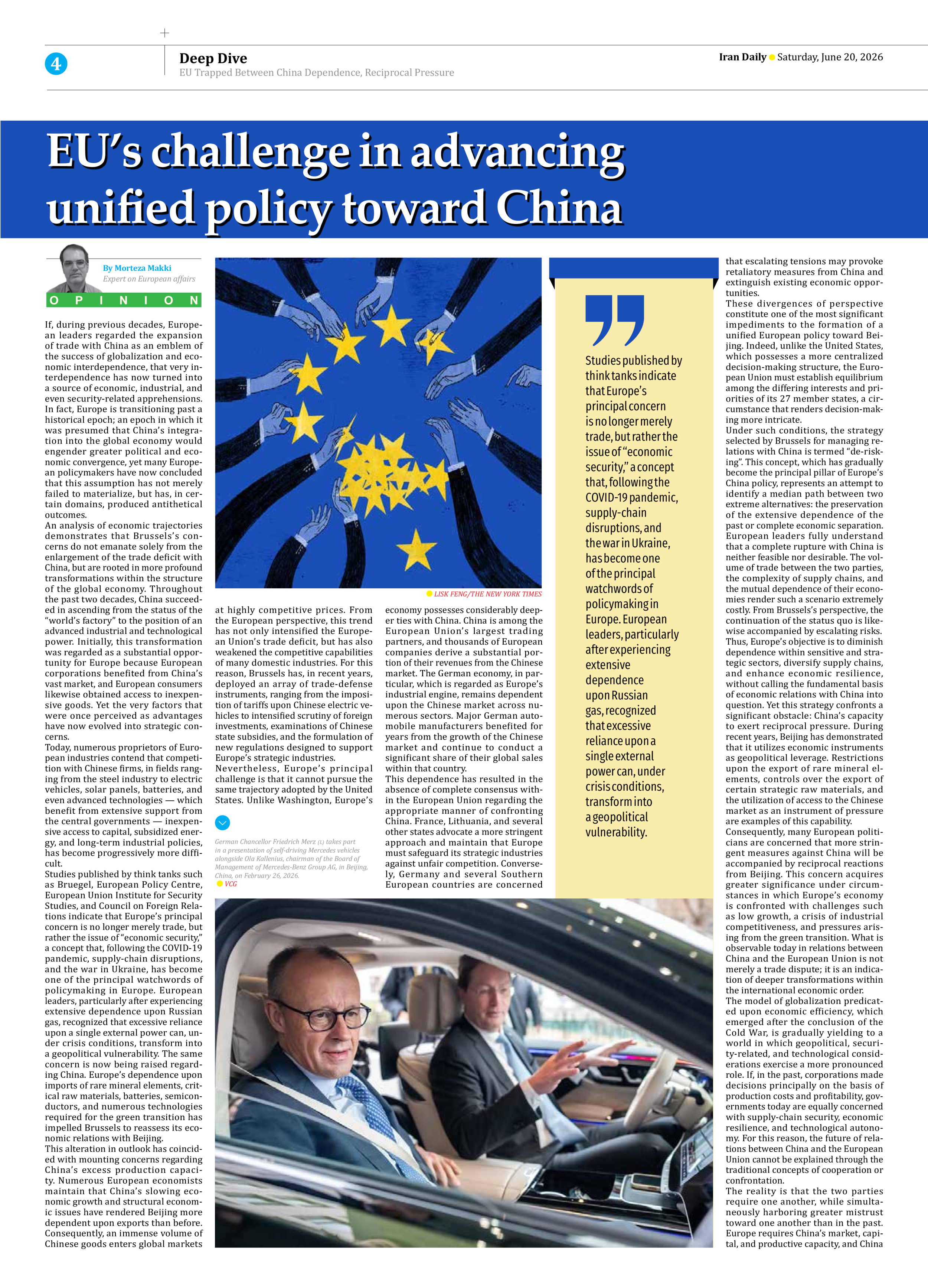
These divergences of perspective constitute one of the most significant impediments to the formation of a unified European policy toward Beijing. Indeed, unlike the United States, which possesses a more centralized decision-making structure, the European Union must establish equilibrium among the differing interests and priorities of its 27 member states, a circumstance that renders decision-making more intricate.
Under such conditions, the strategy selected by Brussels for managing relations with China is termed “de-risking”. This concept, which has gradually become the principal pillar of Europe’s China policy, represents an attempt to identify a median path between two extreme alternatives: the preservation of the extensive dependence of the past or complete economic separation. European leaders fully understand that a complete rupture with China is neither feasible nor desirable. The volume of trade between the two parties, the complexity of supply chains, and the mutual dependence of their economies render such a scenario extremely costly. From Brussels’s perspective, the continuation of the status quo is likewise accompanied by escalating risks.
Thus, Europe’s objective is to diminish dependence within sensitive and strategic sectors, diversify supply chains, and enhance economic resilience, without calling the fundamental basis of economic relations with China into question. Yet this strategy confronts a significant obstacle: China’s capacity to exert reciprocal pressure. During recent years, Beijing has demonstrated that it utilizes economic instruments as geopolitical leverage. Restrictions upon the export of rare mineral elements, controls over the export of certain strategic raw materials, and the utilization of access to the Chinese market as an instrument of pressure are examples of this capability.
Consequently, many European politicians are concerned that more stringent measures against China will be accompanied by reciprocal reactions from Beijing. This concern acquires greater significance under circumstances in which Europe’s economy is confronted with challenges such as low growth, a crisis of industrial competitiveness, and pressures arising from the green transition. What is observable today in relations between China and the European Union is not merely a trade dispute; it is an indication of deeper transformations within the international economic order.
The model of globalization predicated upon economic efficiency, which emerged after the conclusion of the Cold War, is gradually yielding to a world in which geopolitical, security-related, and technological considerations exercise a more pronounced role. If, in the past, corporations made decisions principally on the basis of production costs and profitability, governments today are equally concerned with supply-chain security, economic resilience, and technological autonomy. For this reason, the future of relations between China and the European Union cannot be explained through the traditional concepts of cooperation or confrontation.
The reality is that the two parties require one another, while simultaneously harboring greater mistrust toward one another than in the past. Europe requires China’s market, capital, and productive capacity, and China
likewise depends upon Europe’s technology, investment, and consumer market. Yet alongside this interdependence, competition over advanced technologies, future industries, supply chains, and geopolitical influence is intensifying.
From this perspective, relations between Brussels and Beijing have entered a phase of “managed competition”; a phase in which neither a return to the economic optimism of previous decades appears probable nor the emergence of a full-scale economic Cold War. What appears more probable is the formation of a new order governing relations between the two parties. An order in which trade and investment will continue, yet will be influenced, more than ever before, by security-related, industrial, and strategic considerations.
In essence, Europe has now concluded that the China question is no longer merely an economic issue, but has become one of the European Union’s most consequential strategic tests in the 21st century; a test whose outcome will determine not only the future of Europe–China relations, but also a portion of the future of the global economic order itself.
The article was first published in Persian by the Strategic Council for Foreign Relations.