







Copy in clipboard...
Pezeshkian, Trump ink MoU to end war, reopen Hormuz
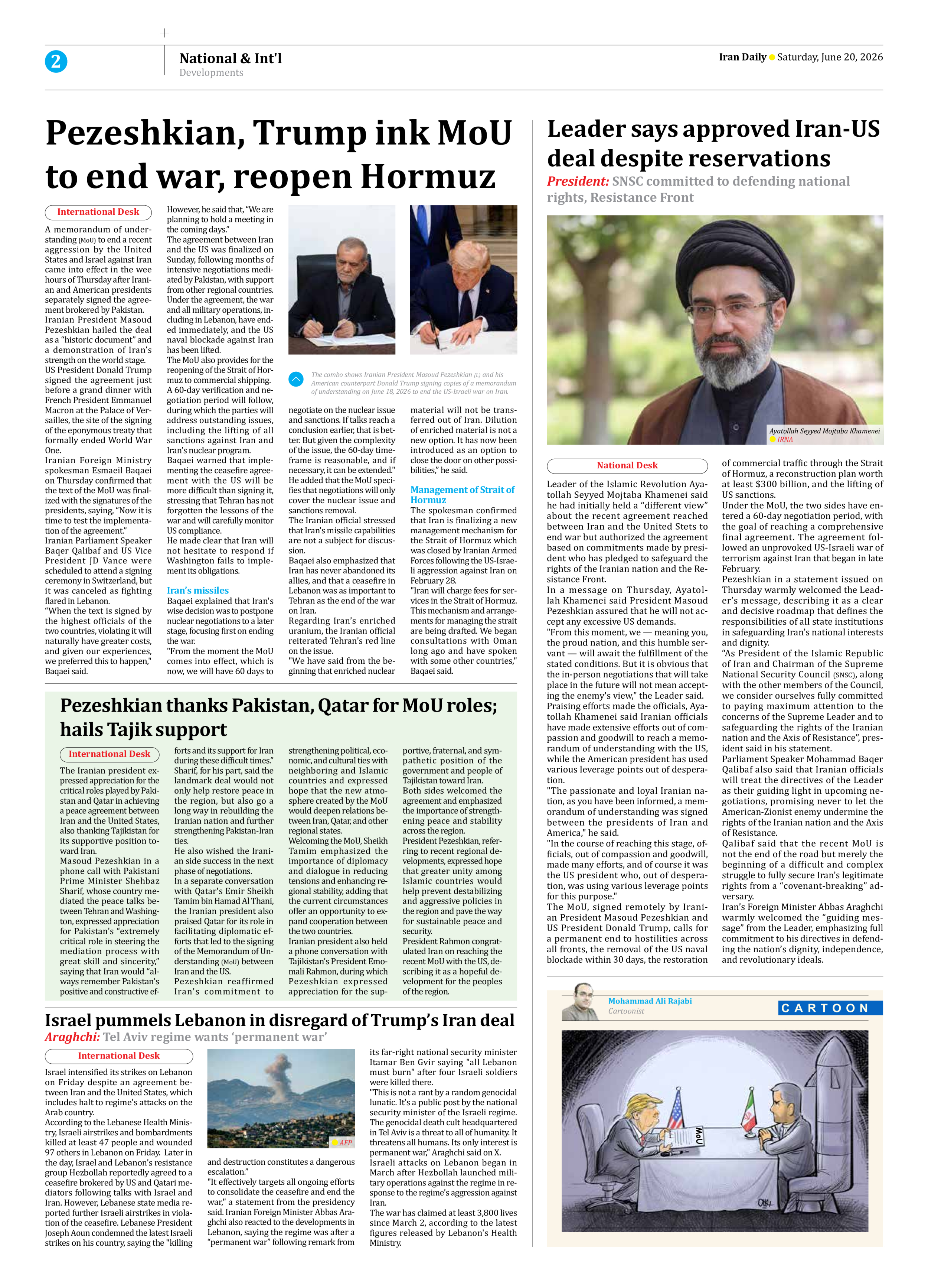
A memorandum of understanding (MoU) to end a recent aggression by the United States and Israel against Iran came into effect in the wee hours of Thursday after Iranian and American presidents separately signed the agreement brokered by Pakistan.
Iranian President Masoud Pezeshkian hailed the deal as a “historic document” and a demonstration of Iran’s strength on the world stage.
US President Donald Trump signed the agreement just before a grand dinner with French President Emmanuel Macron at the Palace of Versailles, the site of the signing of the eponymous treaty that formally ended World War One.
Iranian Foreign Ministry spokesman Esmaeil Baqaei on Thursday confirmed that the text of the MoU was finalized with the signatures of the presidents, saying, “Now it is time to test the implementation of the agreement.”
Iranian Parliament Speaker Baqer Qalibaf and US Vice President JD Vance were scheduled to attend a signing ceremony in Switzerland, but it was canceled as fighting flared in Lebanon.
“When the text is signed by the highest officials of the two countries, violating it will naturally have greater costs, and given our experiences, we preferred this to happen," Baqaei said.
However, he said that, “We are planning to hold a meeting in the coming days.”
The agreement between Iran and the US was finalized on Sunday, following months of intensive negotiations mediated by Pakistan, with support from other regional countries.
Under the agreement, the war and all military operations, including in Lebanon, have ended immediately, and the US naval blockade against Iran has been lifted.
The MoU also provides for the reopening of the Strait of Hormuz to commercial shipping.
A 60‑day verification and negotiation period will follow, during which the parties will address outstanding issues, including the lifting of all sanctions against Iran and Iran’s nuclear program.
Baqaei warned that implementing the ceasefire agreement with the US will be more difficult than signing it, stressing that Tehran has not forgotten the lessons of the war and will carefully monitor US compliance.
He made clear that Iran will not hesitate to respond if Washington fails to implement its obligations.
Iran’s missiles
Baqaei explained that Iran's wise decision was to postpone nuclear negotiations to a later stage, focusing first on ending the war.
"From the moment the MoU comes into effect, which is now, we will have 60 days to negotiate on the nuclear issue and sanctions. If talks reach a conclusion earlier, that is better. But given the complexity of the issue, the 60-day timeframe is reasonable, and if necessary, it can be extended."
He added that the MoU specifies that negotiations will only cover the nuclear issue and sanctions removal.
The Iranian official stressed that Iran's missile capabilities are not a subject for discussion.
Baqaei also emphasized that Iran has never abandoned its allies, and that a ceasefire in Lebanon was as important to Tehran as the end of the war on Iran.
Regarding Iran’s enriched uranium, the Iranian official reiterated Tehran’s red line on the issue.
"We have said from the beginning that enriched nuclear material will not be transferred out of Iran. Dilution of enriched material is not a new option. It has now been introduced as an option to close the door on other possibilities,” he said.
Management of Strait of Hormuz
The spokesman confirmed that Iran is finalizing a new management mechanism for the Strait of Hormuz which was closed by Iranian Armed Forces following the US-Israeli aggression against Iran on February 28.
"Iran will charge fees for services in the Strait of Hormuz. This mechanism and arrangements for managing the strait are being drafted. We began consultations with Oman long ago and have spoken with some other countries," Baqaei said.