







Iran missed ‘golden opportunity’ against New Zealand, Jalali says
By Sadeq Dehqan
Staff writer
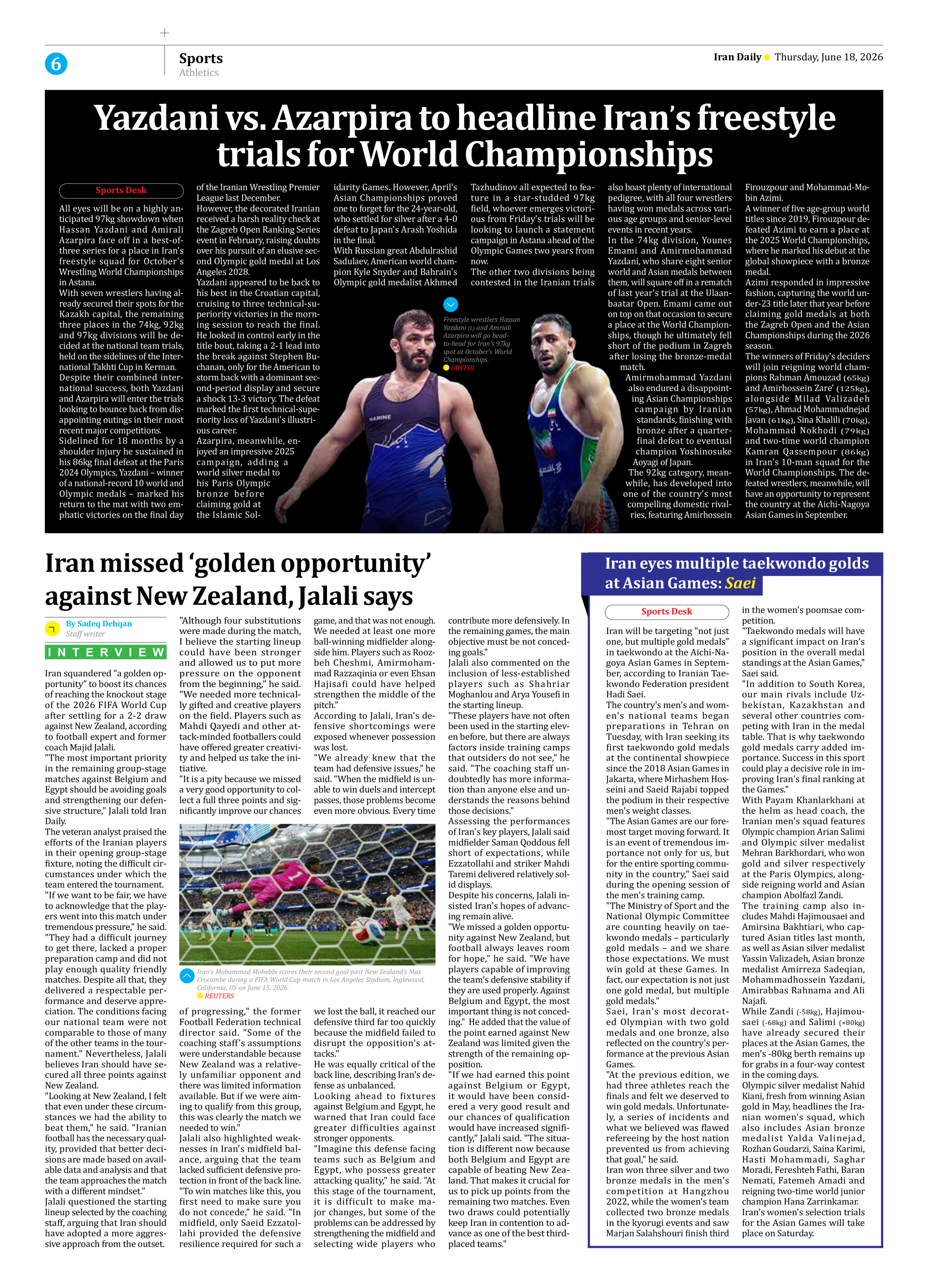
Iran squandered “a golden opportunity” to boost its chances of reaching the knockout stage of the 2026 FIFA World Cup after settling for a 2-2 draw against New Zealand, according to football expert and former coach Majid Jalali.
"The most important priority in the remaining group-stage matches against Belgium and Egypt should be avoiding goals and strengthening our defensive structure," Jalali told Iran Daily.
The veteran analyst praised the efforts of the Iranian players in their opening group-stage fixture, noting the difficult circumstances under which the team entered the tournament.
"If we want to be fair, we have to acknowledge that the players went into this match under tremendous pressure," he said. "They had a difficult journey to get there, lacked a proper preparation camp and did not play enough quality friendly matches. Despite all that, they delivered a respectable performance and deserve appreciation. The conditions facing our national team were not comparable to those of many of the other teams in the tournament." Nevertheless, Jalali believes Iran should have secured all three points against New Zealand.
"Looking at New Zealand, I felt that even under these circumstances we had the ability to beat them," he said. "Iranian football has the necessary quality, provided that better decisions are made based on available data and analysis and that the team approaches the match with a different mindset."
Jalali questioned the starting lineup selected by the coaching staff, arguing that Iran should have adopted a more aggressive approach from the outset.
"Although four substitutions were made during the match, I believe the starting lineup could have been stronger and allowed us to put more pressure on the opponent from the beginning," he said. "We needed more technically gifted and creative players on the field. Players such as Mahdi Qayedi and other attack-minded footballers could have offered greater creativity and helped us take the initiative.
"It is a pity because we missed a very good opportunity to collect a full three points and significantly improve our chances of progressing," the former Football Federation technical director said. "Some of the coaching staff's assumptions were understandable because New Zealand was a relatively unfamiliar opponent and there was limited information available. But if we were aiming to qualify from this group, this was clearly the match we needed to win."
Jalali also highlighted weaknesses in Iran's midfield balance, arguing that the team lacked sufficient defensive protection in front of the back line.
"To win matches like this, you first need to make sure you do not concede," he said. "In midfield, only Saeid Ezzatollahi provided the defensive resilience required for such a game, and that was not enough. We needed at least one more ball-winning midfielder alongside him. Players such as Roozbeh Cheshmi, Amirmohammad Razzaqinia or even Ehsan Hajisafi could have helped strengthen the middle of the pitch."
According to Jalali, Iran's defensive shortcomings were exposed whenever possession was lost.
"We already knew that the team had defensive issues," he said. "When the midfield is unable to win duels and intercept passes, those problems become even more obvious. Every time we lost the ball, it reached our defensive third far too quickly because the midfield failed to disrupt the opposition's attacks."
He was equally critical of the back line, describing Iran's defense as unbalanced.
Looking ahead to fixtures against Belgium and Egypt, he warned that Iran could face greater difficulties against stronger opponents.
"Imagine this defense facing teams such as Belgium and Egypt, who possess greater attacking quality," he said. "At this stage of the tournament, it is difficult to make major changes, but some of the problems can be addressed by strengthening the midfield and selecting wide players who contribute more defensively. In the remaining games, the main objective must be not conceding goals."
Jalali also commented on the inclusion of less-established players such as Shahriar Moghanlou and Arya Yousefi in the starting lineup.
"These players have not often been used in the starting eleven before, but there are always factors inside training camps that outsiders do not see," he said. "The coaching staff undoubtedly has more information than anyone else and understands the reasons behind those decisions."
Assessing the performances of Iran's key players, Jalali said midfielder Saman Qoddous fell short of expectations, while Ezzatollahi and striker Mahdi Taremi delivered relatively solid displays.
Despite his concerns, Jalali insisted Iran's hopes of advancing remain alive.
"We missed a golden opportunity against New Zealand, but football always leaves room for hope," he said. "We have players capable of improving the team's defensive stability if they are used properly. Against Belgium and Egypt, the most important thing is not conceding." He added that the value of the point earned against New Zealand was limited given the strength of the remaining opposition.
"If we had earned this point against Belgium or Egypt, it would have been considered a very good result and our chances of qualification would have increased significantly," Jalali said. "The situation is different now because both Belgium and Egypt are capable of beating New Zealand. That makes it crucial for us to pick up points from the remaining two matches. Even two draws could potentially keep Iran in contention to advance as one of the best third-placed teams."