







Consequences of recent election in Armenia
By Motahare Heydari
Expert on Caucasus affairs
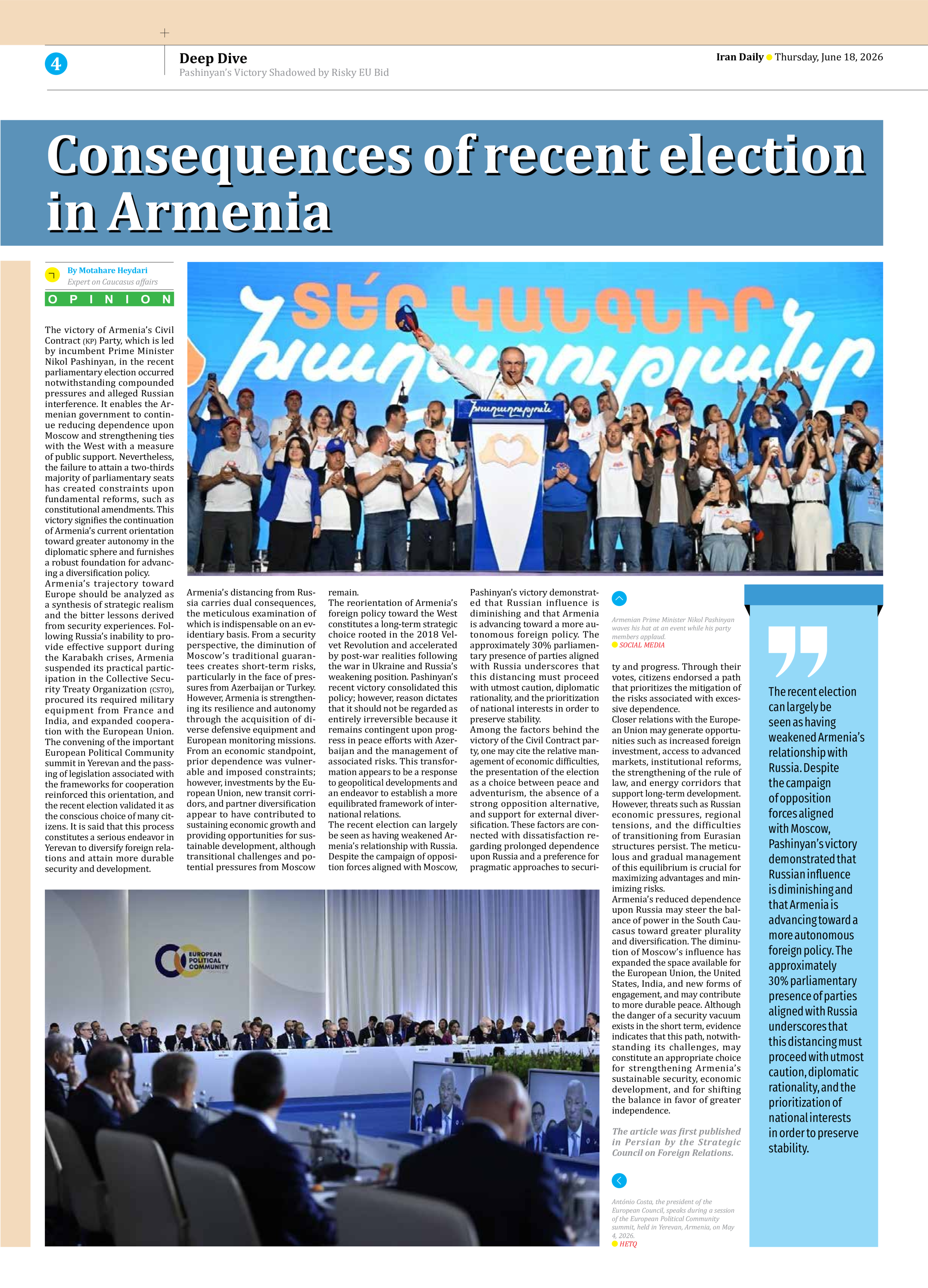
The victory of Armenia’s Civil Contract (KP) Party, which is led by incumbent Prime Minister Nikol Pashinyan, in the recent parliamentary election occurred notwithstanding compounded pressures and alleged Russian interference. It enables the Armenian government to continue reducing dependence upon Moscow and strengthening ties with the West with a measure of public support. Nevertheless, the failure to attain a two-thirds majority of parliamentary seats has created constraints upon fundamental reforms, such as constitutional amendments. This victory signifies the continuation of Armenia’s current orientation toward greater autonomy in the diplomatic sphere and furnishes a robust foundation for advancing a diversification policy.
Armenia’s trajectory toward Europe should be analyzed as a synthesis of strategic realism and the bitter lessons derived from security experiences. Following Russia’s inability to provide effective support during the Karabakh crises, Armenia suspended its practical participation in the Collective Security Treaty Organization (CSTO), procured its required military equipment from France and India, and expanded cooperation with the European Union. The convening of the important European Political Community summit in Yerevan and the passing of legislation associated with the frameworks for cooperation reinforced this orientation, and the recent election validated it as the conscious choice of many citizens. It is said that this process constitutes a serious endeavor in Yerevan to diversify foreign relations and attain more durable security and development.
Armenia’s distancing from Russia carries dual consequences, the meticulous examination of which is indispensable on an evidentiary basis. From a security perspective, the diminution of Moscow’s traditional guarantees creates short-term risks, particularly in the face of pressures from Azerbaijan or Turkey. However, Armenia is strengthening its resilience and autonomy through the acquisition of diverse defensive equipment and European monitoring missions. From an economic standpoint, prior dependence was vulnerable and imposed constraints; however, investments by the European Union, new transit corridors, and partner diversification appear to have contributed to sustaining economic growth and providing opportunities for sustainable development, although transitional challenges and potential pressures from Moscow remain.
The reorientation of Armenia’s foreign policy toward the West constitutes a long-term strategic choice rooted in the 2018 Velvet Revolution and accelerated by post-war realities following the war in Ukraine and Russia’s weakening position. Pashinyan’s recent victory consolidated this policy; however, reason dictates that it should not be regarded as entirely irreversible because it remains contingent upon progress in peace efforts with Azerbaijan and the management of associated risks. This transformation appears to be a response to geopolitical developments and an endeavor to establish a more equilibrated framework of international relations.
The recent election can largely be seen as having weakened Armenia’s relationship with Russia. Despite the campaign of opposition forces aligned with Moscow, Pashinyan’s victory demonstrated that Russian influence is diminishing and that Armenia is advancing toward a more autonomous foreign policy. The approximately 30% parliamentary presence of parties aligned with Russia underscores that this distancing must proceed with utmost caution, diplomatic rationality, and the prioritization of national interests in order to preserve stability.
Among the factors behind the victory of the Civil Contract party, one may cite the relative management of economic difficulties, the presentation of the election as a choice between peace and adventurism, the absence of a strong opposition alternative, and support for external diversification. These factors are connected with dissatisfaction regarding prolonged dependence upon Russia and a preference for pragmatic approaches to security and progress. Through their votes, citizens endorsed a path that prioritizes the mitigation of the risks associated with excessive dependence.
Closer relations with the European Union may generate opportunities such as increased foreign investment, access to advanced markets, institutional reforms, the strengthening of the rule of law, and energy corridors that support long-term development. However, threats such as Russian economic pressures, regional tensions, and the difficulties of transitioning from Eurasian structures persist. The meticulous and gradual management of this equilibrium is crucial for maximizing advantages and minimizing risks.
Armenia’s reduced dependence upon Russia may steer the balance of power in the South Caucasus toward greater plurality and diversification. The diminution of Moscow’s influence has expanded the space available for the European Union, the United States, India, and new forms of engagement, and may contribute to more durable peace. Although the danger of a security vacuum exists in the short term, evidence indicates that this path, notwithstanding its challenges, may constitute an appropriate choice for strengthening Armenia’s sustainable security, economic development, and for shifting the balance in favor of greater independence.
The article was first published in Persian by the Strategic Council on Foreign Relations.