







Russia, China back US-Iran peace memorandum
US bound to ensure proper implementation of MoU: Araghchi
Russian and Chinese foreign ministers said on Wednesday that their countries fully support a memorandum of understanding (MoU) recently reached between Iran and the United States to end the aggression against Iran.
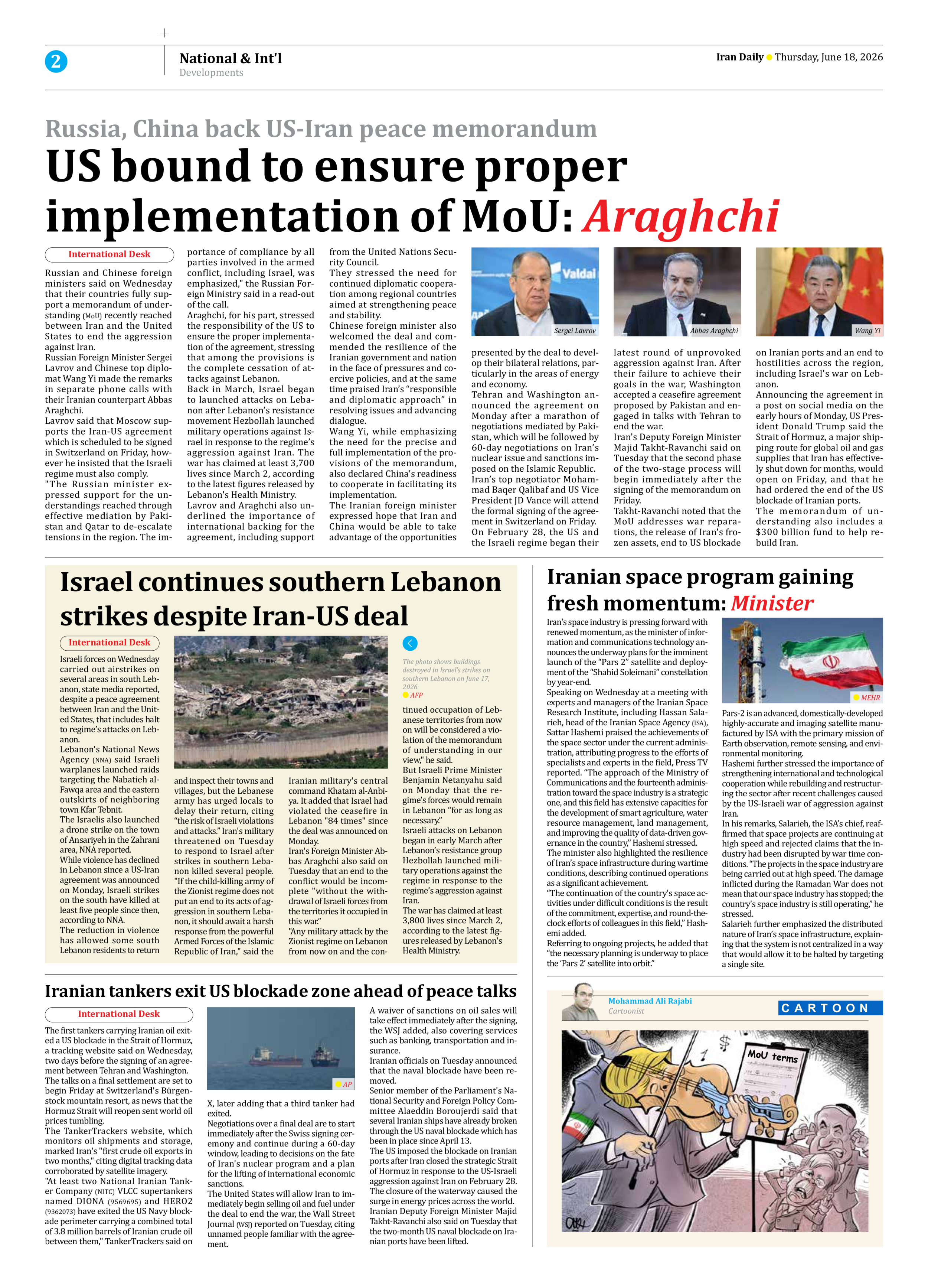
Russian Foreign Minister Sergei Lavrov and Chinese top diplomat Wang Yi made the remarks in separate phone calls with their Iranian counterpart Abbas Araghchi.
Lavrov said that Moscow supports the Iran-US agreement which is scheduled to be signed in Switzerland on Friday, however he insisted that the Israeli regime must also comply.
"The Russian minister expressed support for the understandings reached through effective mediation by Pakistan and Qatar to de-escalate tensions in the region. The importance of compliance by all parties involved in the armed conflict, including Israel, was emphasized," the Russian Foreign Ministry said in a read-out of the call.
Araghchi, for his part, stressed the responsibility of the US to ensure the proper implementation of the agreement, stressing that among the provisions is the complete cessation of attacks against Lebanon.
Back in March, Israel began to launched attacks on Lebanon after Lebanon’s resistance movement Hezbollah launched military operations against Israel in response to the regime’s aggression against Iran. The war has claimed at least 3,700 lives since March 2, according to the latest figures released by Lebanon's Health Ministry.
Lavrov and Araghchi also underlined the importance of international backing for the agreement, including support from the United Nations Security Council.
They stressed the need for continued diplomatic cooperation among regional countries aimed at strengthening peace and stability.
Chinese foreign minister also welcomed the deal and commended the resilience of the Iranian government and nation in the face of pressures and coercive policies, and at the same time praised Iran’s “responsible and diplomatic approach” in resolving issues and advancing dialogue.
Wang Yi, while emphasizing the need for the precise and full implementation of the provisions of the memorandum, also declared China's readiness to cooperate in facilitating its implementation.
The Iranian foreign minister expressed hope that Iran and China would be able to take advantage of the opportunities presented by the deal to develop their bilateral relations, particularly in the areas of energy and economy.
Tehran and Washington announced the agreement on Monday after a marathon of negotiations mediated by Pakistan, which will be followed by 60-day negotiations on Iran’s nuclear issue and sanctions imposed on the Islamic Republic.
Iran’s top negotiator Mohammad Baqer Qalibaf and US Vice President JD Vance will attend the formal signing of the agreement in Switzerland on Friday.
On February 28, the US and the Israeli regime began their latest round of unprovoked aggression against Iran. After their failure to achieve their goals in the war, Washington accepted a ceasefire agreement proposed by Pakistan and engaged in talks with Tehran to end the war.
Iran’s Deputy Foreign Minister Majid Takht-Ravanchi said on Tuesday that the second phase of the two-stage process will begin immediately after the signing of the memorandum on Friday.
Takht-Ravanchi noted that the MoU addresses war reparations, the release of Iran's frozen assets, end to US blockade on Iranian ports and an end to hostilities across the region, including Israel’s war on Lebanon.
Announcing the agreement in a post on social media on the early hours of Monday, US President Donald Trump said the Strait of Hormuz, a major shipping route for global oil and gas supplies that Iran has effectively shut down for months, would open on Friday, and that he had ordered the end of the US blockade of Iranian ports.
The memorandum of understanding also includes a
$300 billion fund to help rebuild Iran.