





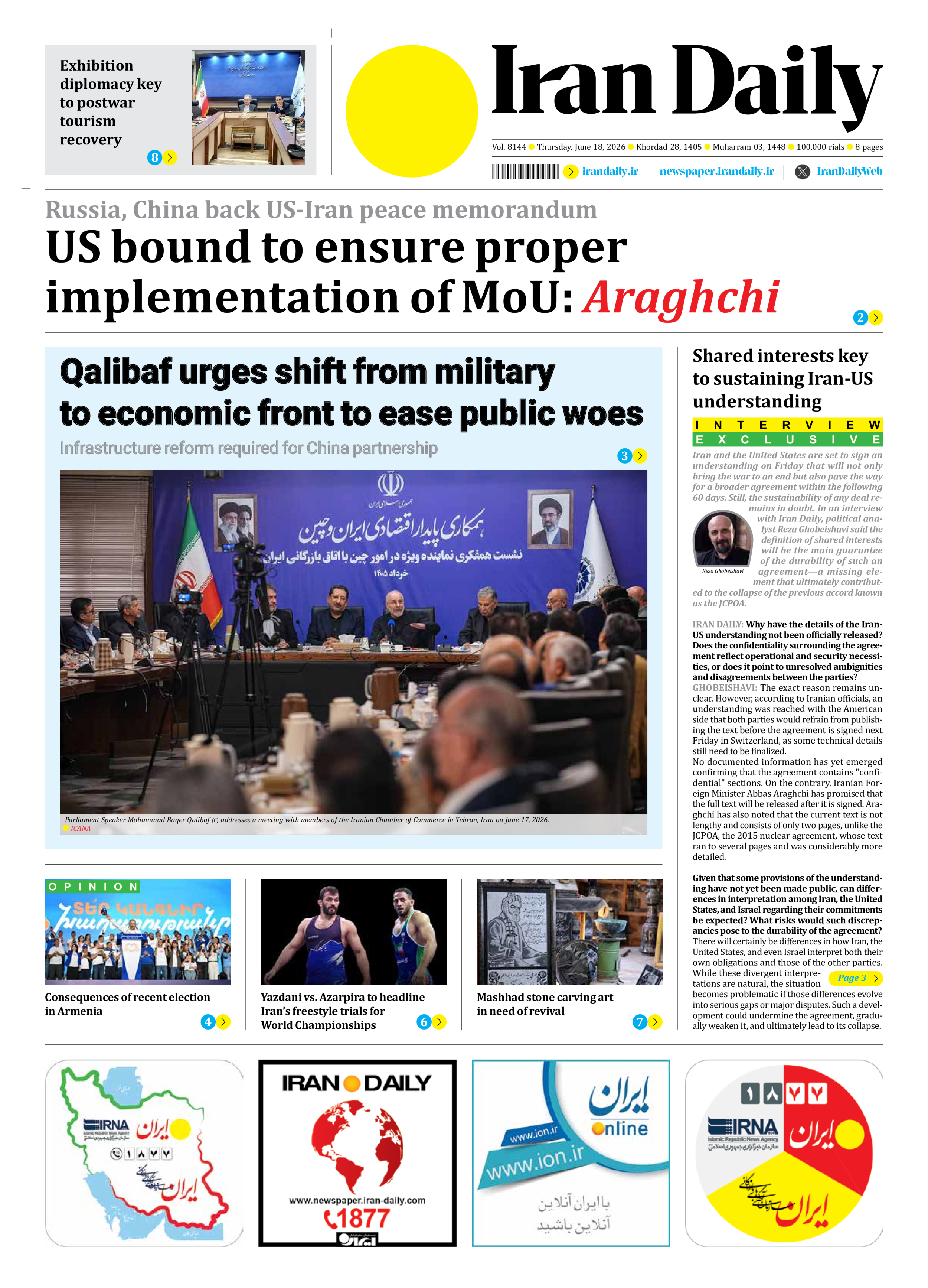


Shared interests key to sustaining Iran-US understanding
Iran and the United States are set to sign an understanding on Friday that will not only bring the war to an end but also pave the way for a broader agreement within the following 60 days. Still, the sustainability of any deal remains in doubt. In an interview with Iran Daily, political analyst Reza Ghobeishavi said the definition of shared interests will be the main guarantee of the durability of such an agreement—a missing element that ultimately contributed to the collapse of the previous accord known as the JCPOA.
IRAN DAILY: Why have the details of the Iran-US understanding not been officially released? Does the confidentiality surrounding the agreement reflect operational and security necessities, or does it point to unresolved ambiguities and disagreements between the parties?
GHOBEISHAVI: The exact reason remains unclear. However, according to Iranian officials, an understanding was reached with the American side that both parties would refrain from publishing the text before the agreement is signed next Friday in Switzerland, as some technical details still need to be finalized.
No documented information has yet emerged confirming that the agreement contains "confidential" sections. On the contrary, Iranian Foreign Minister Abbas Araghchi has promised that the full text will be released after it is signed. Araghchi has also noted that the current text is not lengthy and consists of only two pages, unlike the JCPOA, the 2015 nuclear agreement, whose text ran to several pages and was considerably more detailed.
Given that some provisions of the understanding have not yet been made public, can differences in interpretation among Iran, the United States, and Israel regarding their commitments be expected? What risks would such discrepancies pose to the durability of the agreement?
There will certainly be differences in how Iran, the United States, and even Israel interpret both their own obligations and those of the other parties. While these divergent interpretations are natural, the situation becomes problematic if those differences evolve into serious gaps or major disputes. Such a development could undermine the agreement, gradually weaken it, and ultimately lead to its collapse.
Page 3