







FIFA World Cup:
‘Like a disaster’: Qalenoei, Taremi decry Iran’s mistreatment after New Zealand draw
Iran head coach Amir Qalenoei and skipper Mahdi Taremi expressed frustration over the co-host's treatment of their team after opening their World Cup campaign with a 2-2 draw against New Zealand in Group G in Los Angeles, California, on Monday.
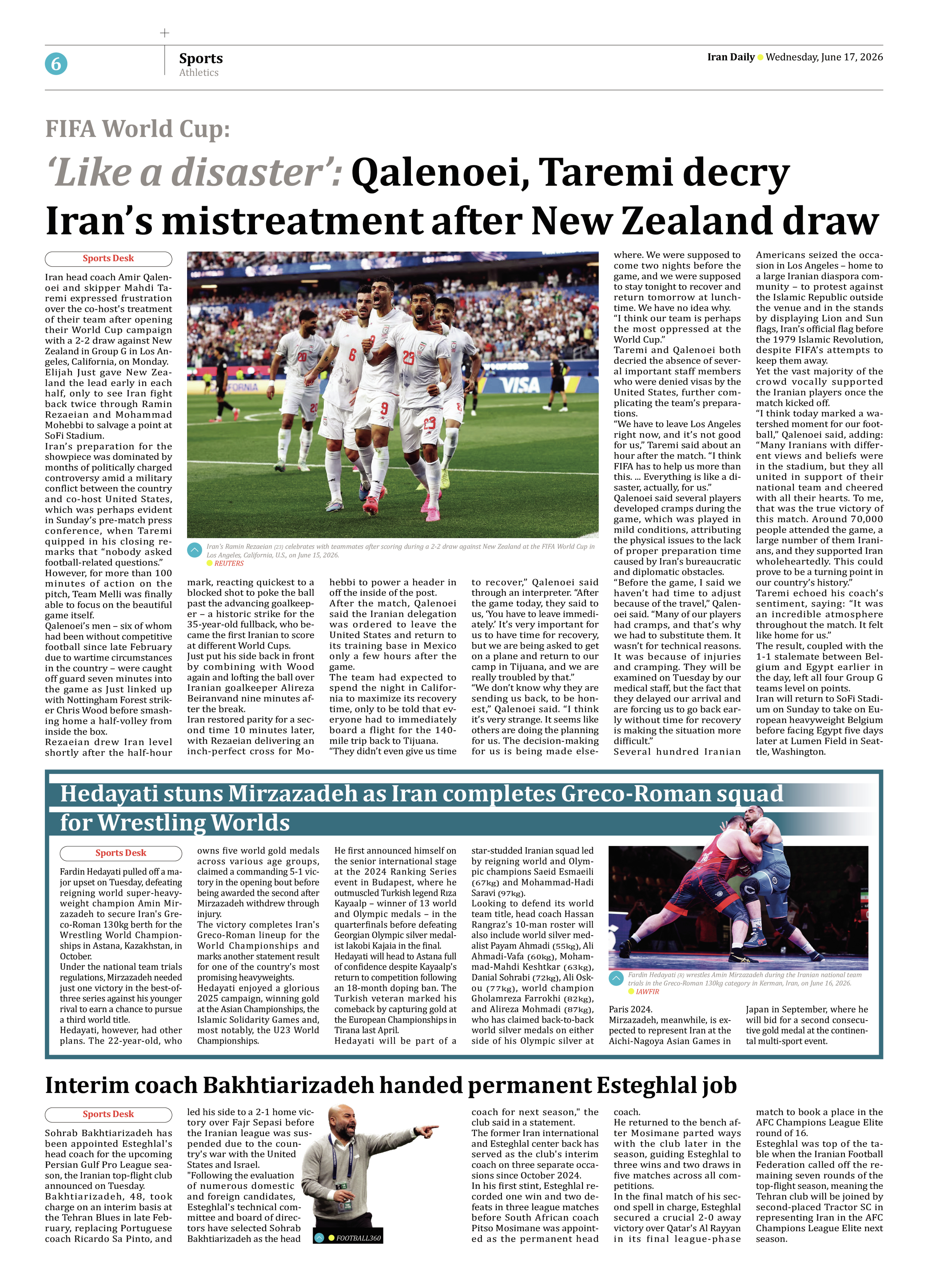
Elijah Just gave New Zealand the lead early in each half, only to see Iran fight back twice through Ramin Rezaeian and Mohammad Mohebbi to salvage a point at SoFi Stadium.
Iran’s preparation for the showpiece was dominated by months of politically charged controversy amid a military conflict between the country and co-host United States, which was perhaps evident in Sunday’s pre-match press conference, when Taremi quipped in his closing remarks that “nobody asked football-related questions.”
However, for more than 100 minutes of action on the pitch, Team Melli was finally able to focus on the beautiful game itself.
Qalenoei’s men – six of whom had been without competitive football since late February due to wartime circumstances in the country – were caught off guard seven minutes into the game as Just linked up with Nottingham Forest striker Chris Wood before smashing home a half-volley from inside the box.
Rezaeian drew Iran level shortly after the half-hour mark, reacting quickest to a blocked shot to poke the ball past the advancing goalkeeper – a historic strike for the 35-year-old fullback, who became the first Iranian to score at different World Cups.
Just put his side back in front by combining with Wood again and lofting the ball over Iranian goalkeeper Alireza Beiranvand nine minutes after the break.
Iran restored parity for a second time 10 minutes later, with Rezaeian delivering an inch-perfect cross for Mohebbi to power a header in off the inside of the post.
After the match, Qalenoei said the Iranian delegation was ordered to leave the United States and return to its training base in Mexico only a few hours after the game.
The team had expected to spend the night in California to maximize its recovery time, only to be told that everyone had to immediately board a flight for the 140-mile trip back to Tijuana.
“They didn’t even give us time to recover,” Qalenoei said through an interpreter. “After the game today, they said to us, ‘You have to leave immediately.’ It’s very important for us to have time for recovery, but we are being asked to get on a plane and return to our camp in Tijuana, and we are really troubled by that.”
“We don’t know why they are sending us back, to be honest,” Qalenoei said. “I think it’s very strange. It seems like others are doing the planning for us. The decision-making for us is being made elsewhere. We were supposed to come two nights before the game, and we were supposed to stay tonight to recover and return tomorrow at lunchtime. We have no idea why.
“I think our team is perhaps the most oppressed at the World Cup.”
Taremi and Qalenoei both decried the absence of several important staff members who were denied visas by the United States, further complicating the team’s preparations.
“We have to leave Los Angeles right now, and it’s not good for us,” Taremi said about an hour after the match. “I think FIFA has to help us more than this. ... Everything is like a disaster, actually, for us.”
Qalenoei said several players developed cramps during the game, which was played in mild conditions, attributing the physical issues to the lack of proper preparation time caused by Iran’s bureaucratic and diplomatic obstacles.
“Before the game, I said we haven’t had time to adjust because of the travel,” Qalenoei said. “Many of our players had cramps, and that’s why we had to substitute them. It wasn’t for technical reasons. It was because of injuries and cramping. They will be examined on Tuesday by our medical staff, but the fact that they delayed our arrival and are forcing us to go back early without time for recovery is making the situation more difficult.”
Several hundred Iranian Americans seized the occasion in Los Angeles – home to a large Iranian diaspora community – to protest against the Islamic Republic outside the venue and in the stands by displaying Lion and Sun flags, Iran’s official flag before the 1979 Islamic Revolution, despite FIFA’s attempts to keep them away.
Yet the vast majority of the crowd vocally supported the Iranian players once the match kicked off.
“I think today marked a watershed moment for our football,” Qalenoei said, adding: “Many Iranians with different views and beliefs were in the stadium, but they all united in support of their national team and cheered with all their hearts. To me, that was the true victory of this match. Around 70,000 people attended the game, a large number of them Iranians, and they supported Iran wholeheartedly. This could prove to be a turning point in our country’s history.”
Taremi echoed his coach’s sentiment, saying: “It was an incredible atmosphere throughout the match. It felt like home for us.”
The result, coupled with the 1-1 stalemate between Belgium and Egypt earlier in the day, left all four Group G teams level on points.
Iran will return to SoFi Stadium on Sunday to take on European heavyweight Belgium before facing Egypt five days later at Lumen Field in Seattle, Washington.