







Rudshur Power Plant starts up largest high-efficiency steam unit
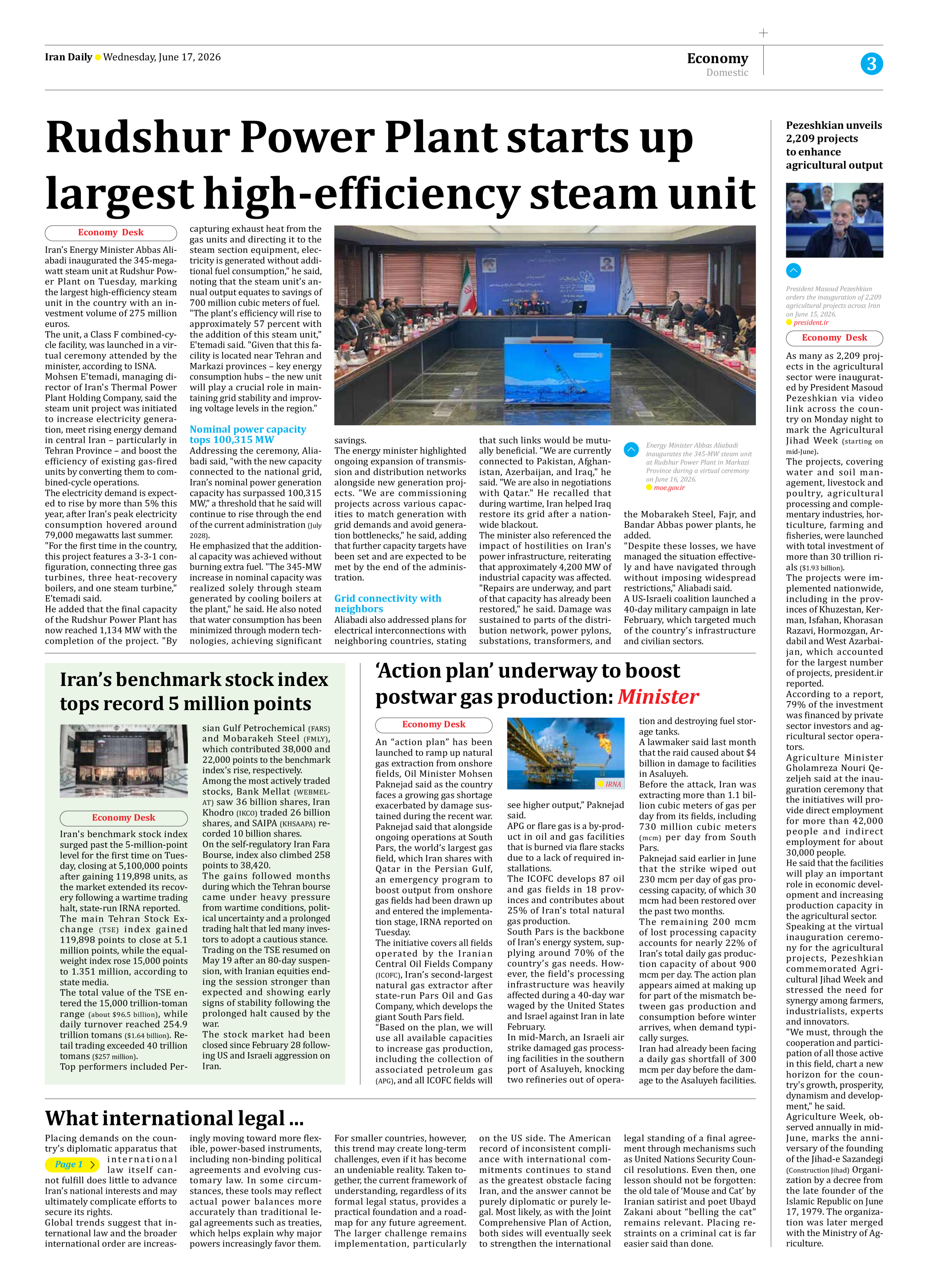
Iran’s Energy Minister Abbas Aliabadi inaugurated the 345-megawatt steam unit at Rudshur Power Plant on Tuesday, marking the largest high-efficiency steam unit in the country with an investment volume of 275 million euros.
The unit, a Class F combined-cycle facility, was launched in a virtual ceremony attended by the minister, according to ISNA.
Mohsen E'temadi, managing director of Iran's Thermal Power Plant Holding Company, said the steam unit project was initiated to increase electricity generation, meet rising energy demand in central Iran – particularly in Tehran Province – and boost the efficiency of existing gas-fired units by converting them to combined-cycle operations.
The electricity demand is expected to rise by more than 5% this year, after Iran's peak electricity consumption hovered around 79,000 megawatts last summer.
"For the first time in the country, this project features a 3-3-1 configuration, connecting three gas turbines, three heat-recovery boilers, and one steam turbine," E'temadi said.
He added that the final capacity of the Rudshur Power Plant has now reached 1,134 MW with the completion of the project. "By capturing exhaust heat from the gas units and directing it to the steam section equipment, electricity is generated without additional fuel consumption," he said, noting that the steam unit’s annual output equates to savings of 700 million cubic meters of fuel.
"The plant's efficiency will rise to approximately 57 percent with the addition of this steam unit," E'temadi said. "Given that this facility is located near Tehran and Markazi provinces – key energy consumption hubs – the new unit will play a crucial role in maintaining grid stability and improving voltage levels in the region."
Nominal power capacity tops 100,315 MW
Addressing the ceremony, Aliabadi said, “with the new capacity connected to the national grid, Iran’s nominal power generation capacity has surpassed 100,315 MW,” a threshold that he said will continue to rise through the end of the current administration (July 2028).
He emphasized that the additional capacity was achieved without burning extra fuel. "The 345-MW increase in nominal capacity was realized solely through steam generated by cooling boilers at the plant," he said. He also noted that water consumption has been minimized through modern technologies, achieving significant savings.
The energy minister highlighted ongoing expansion of transmission and distribution networks alongside new generation projects. "We are commissioning projects across various capacities to match generation with grid demands and avoid generation bottlenecks," he said, adding that further capacity targets have been set and are expected to be met by the end of the administration.
Grid connectivity with neighbors
Aliabadi also addressed plans for electrical interconnections with neighboring countries, stating that such links would be mutually beneficial. "We are currently connected to Pakistan, Afghanistan, Azerbaijan, and Iraq," he said. "We are also in negotiations with Qatar." He recalled that during wartime, Iran helped Iraq restore its grid after a nationwide blackout.
The minister also referenced the impact of hostilities on Iran's power infrastructure, reiterating that approximately 4,200 MW of industrial capacity was affected. "Repairs are underway, and part of that capacity has already been restored," he said. Damage was sustained to parts of the distribution network, power pylons, substations, transformers, and the Mobarakeh Steel, Fajr, and Bandar Abbas power plants, he added.
"Despite these losses, we have managed the situation effectively and have navigated through without imposing widespread restrictions," Aliabadi said.
A US-Israeli coalition launched a 40-day military campaign in late February, which targeted much of the country’s infrastructure and civilian sectors.