







Train passes through history in Savadkuh
Savadkuh is a museum — a museum without walls, where the sky serves as its roof and its treasures include historic bridges and trees that are millions of years old. It is a museum that moves slowly, allowing visitors to observe every detail through a train window and offering a perspective unlike anything seen in photographs.
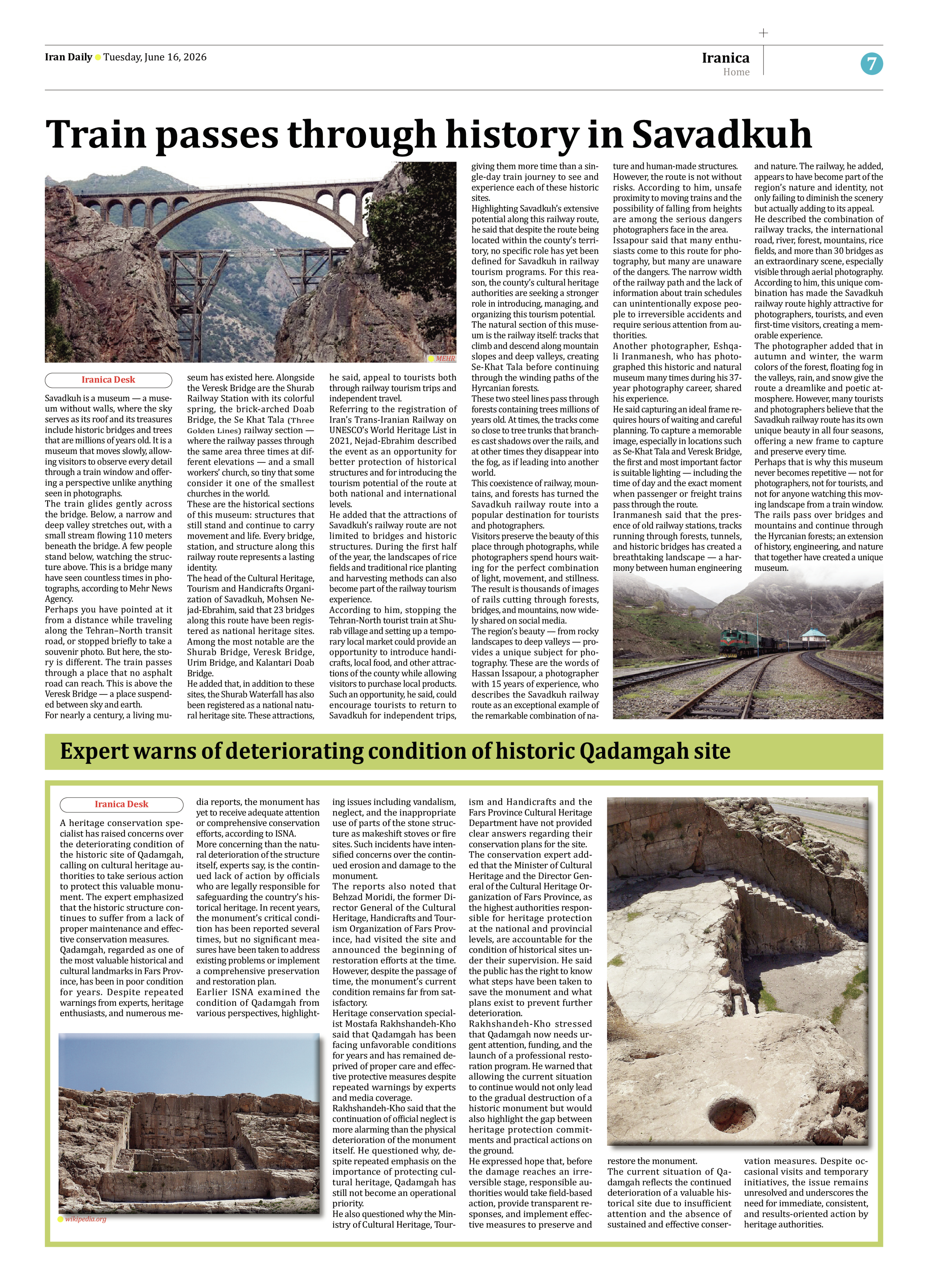
The train glides gently across the bridge. Below, a narrow and deep valley stretches out, with a small stream flowing 110 meters beneath the bridge. A few people stand below, watching the structure above. This is a bridge many have seen countless times in photographs, according to Mehr News Agency.
Perhaps you have pointed at it from a distance while traveling along the Tehran–North transit road, or stopped briefly to take a souvenir photo. But here, the story is different. The train passes through a place that no asphalt road can reach. This is above the Veresk Bridge — a place suspended between sky and earth.
For nearly a century, a living museum has existed here. Alongside the Veresk Bridge are the Shurab Railway Station with its colorful spring, the brick-arched Doab Bridge, the Se Khat Tala (Three Golden Lines) railway section — where the railway passes through the same area three times at different elevations — and a small workers’ church, so tiny that some consider it one of the smallest churches in the world.
These are the historical sections of this museum: structures that still stand and continue to carry movement and life. Every bridge, station, and structure along this railway route represents a lasting identity.
The head of the Cultural Heritage, Tourism and Handicrafts Organization of Savadkuh, Mohsen Nejad-Ebrahim, said that 23 bridges along this route have been registered as national heritage sites. Among the most notable are the Shurab Bridge, Veresk Bridge, Urim Bridge, and Kalantari Doab Bridge.
He added that, in addition to these sites, the Shurab Waterfall has also been registered as a national natural heritage site. These attractions, he said, appeal to tourists both through railway tourism trips and independent travel.
Referring to the registration of Iran’s Trans-Iranian Railway on UNESCO’s World Heritage List in 2021, Nejad-Ebrahim described the event as an opportunity for better protection of historical structures and for introducing the tourism potential of the route at both national and international levels.
He added that the attractions of Savadkuh’s railway route are not limited to bridges and historic structures. During the first half of the year, the landscapes of rice fields and traditional rice planting and harvesting methods can also become part of the railway tourism experience.
According to him, stopping the Tehran-North tourist train at Shurab village and setting up a temporary local market could provide an opportunity to introduce handicrafts, local food, and other attractions of the county while allowing visitors to purchase local products.
Such an opportunity, he said, could encourage tourists to return to Savadkuh for independent trips, giving them more time than a single-day train journey to see and experience each of these historic sites.
Highlighting Savadkuh’s extensive potential along this railway route, he said that despite the route being located within the county’s territory, no specific role has yet been defined for Savadkuh in railway tourism programs. For this reason, the county’s cultural heritage authorities are seeking a stronger role in introducing, managing, and organizing this tourism potential.
The natural section of this museum is the railway itself: tracks that climb and descend along mountain slopes and deep valleys, creating Se-Khat Tala before continuing through the winding paths of the Hyrcanian forests.
These two steel lines pass through forests containing trees millions of years old. At times, the tracks come so close to tree trunks that branches cast shadows over the rails, and at other times they disappear into the fog, as if leading into another world.
This coexistence of railway, mountains, and forests has turned the Savadkuh railway route into a popular destination for tourists and photographers.
Visitors preserve the beauty of this place through photographs, while photographers spend hours waiting for the perfect combination of light, movement, and stillness. The result is thousands of images of rails cutting through forests, bridges, and mountains, now widely shared on social media.
The region’s beauty — from rocky landscapes to deep valleys — provides a unique subject for photography. These are the words of Hassan Issapour, a photographer with 15 years of experience, who describes the Savadkuh railway route as an exceptional example of the remarkable combination of nature and human-made structures.
However, the route is not without risks. According to him, unsafe proximity to moving trains and the possibility of falling from heights are among the serious dangers photographers face in the area.
Issapour said that many enthusiasts come to this route for photography, but many are unaware of the dangers. The narrow width of the railway path and the lack of information about train schedules can unintentionally expose people to irreversible accidents and require serious attention from authorities.
Another photographer, Eshqali Iranmanesh, who has photographed this historic and natural museum many times during his 37-year photography career, shared his experience.
He said capturing an ideal frame requires hours of waiting and careful planning. To capture a memorable image, especially in locations such as Se-Khat Tala and Veresk Bridge, the first and most important factor is suitable lighting — including the time of day and the exact moment when passenger or freight trains pass through the route.
Iranmanesh said that the presence of old railway stations, tracks running through forests, tunnels, and historic bridges has created a breathtaking landscape — a harmony between human engineering and nature. The railway, he added, appears to have become part of the region’s nature and identity, not only failing to diminish the scenery but actually adding to its appeal.
He described the combination of railway tracks, the international road, river, forest, mountains, rice fields, and more than 30 bridges as an extraordinary scene, especially visible through aerial photography.
According to him, this unique combination has made the Savadkuh railway route highly attractive for photographers, tourists, and even first-time visitors, creating a memorable experience.
The photographer added that in autumn and winter, the warm colors of the forest, floating fog in the valleys, rain, and snow give the route a dreamlike and poetic atmosphere. However, many tourists and photographers believe that the Savadkuh railway route has its own unique beauty in all four seasons, offering a new frame to capture and preserve every time.
Perhaps that is why this museum never becomes repetitive — not for photographers, not for tourists, and not for anyone watching this moving landscape from a train window. The rails pass over bridges and mountains and continue through the Hyrcanian forests; an extension of history, engineering, and nature that together have created a unique museum.