





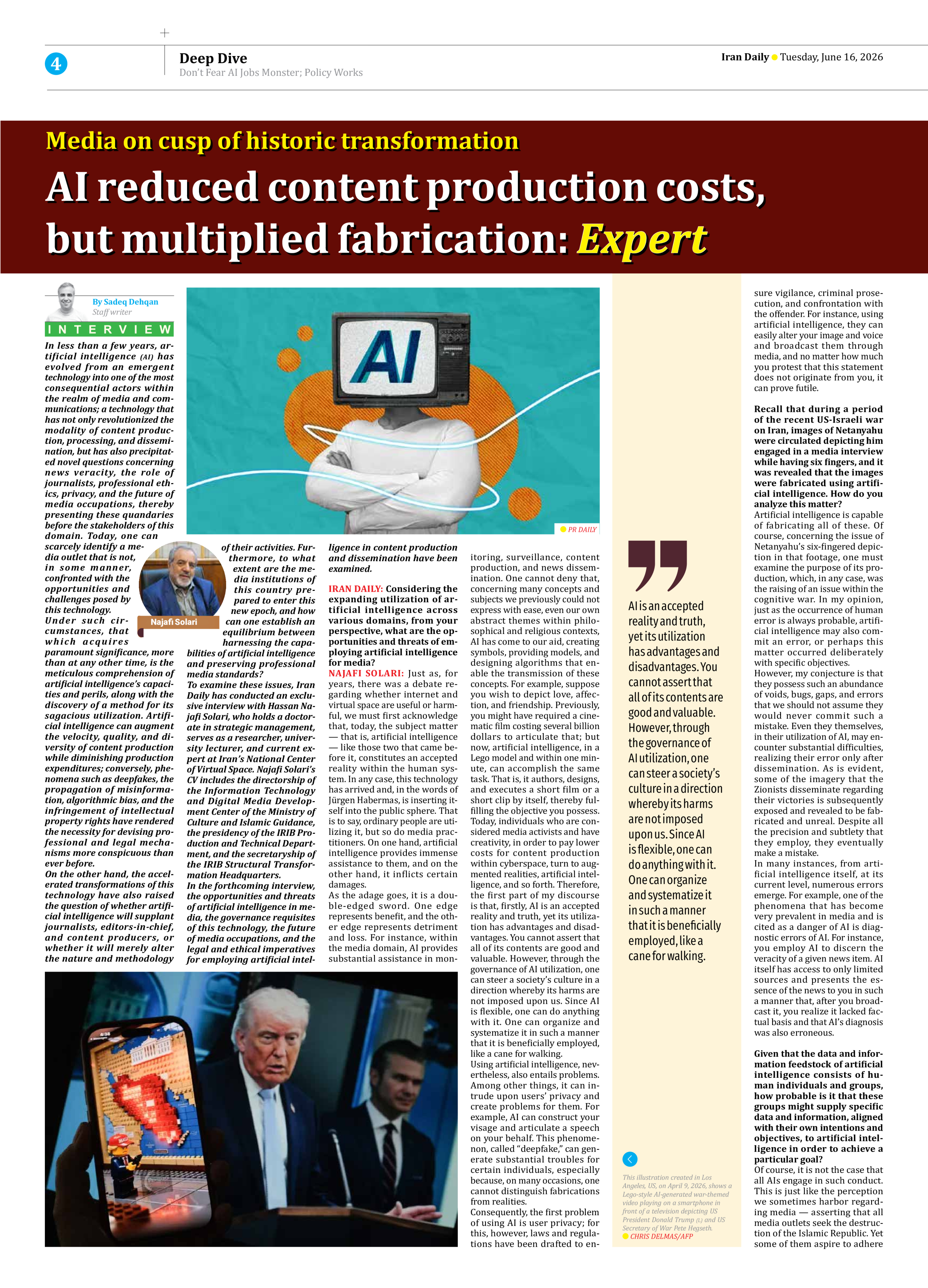


Media on cusp of historic transformation
AI reduced content production costs, but multiplied fabrication: Expert
By Sadeq Dehqan
Staff writer
In less than a few years, artificial intelligence (AI) has evolved from an emergent technology into one of the most consequential actors within the realm of media and communications; a technology that has not only revolutionized the modality of content production, processing, and dissemination, but has also precipitated novel questions concerning news veracity, the role of journalists, professional ethics, privacy, and the future of media occupations, thereby presenting these quandaries before the stakeholders of this domain. Today, one can scarcely identify a media outlet that is not, in some manner, confronted with the opportunities and challenges posed by this technology.
Under such circumstances, that which acquires paramount significance, more than at any other time, is the meticulous comprehension of artificial intelligence’s capacities and perils, along with the discovery of a method for its sagacious utilization. Artificial intelligence can augment the velocity, quality, and diversity of content production while diminishing production expenditures; conversely, phenomena such as deepfakes, the propagation of misinformation, algorithmic bias, and the infringement of intellectual property rights have rendered the necessity for devising professional and legal mechanisms more conspicuous than ever before.
On the other hand, the accelerated transformations of this technology have also raised the question of whether artificial intelligence will supplant journalists, editors-in-chief, and content producers, or whether it will merely alter the nature and methodology of their activities. Furthermore, to what extent are the media institutions of this country prepared to enter this new epoch, and how can one establish an equilibrium between harnessing the capabilities of artificial intelligence and preserving professional media standards?
To examine these issues, Iran Daily has conducted an exclusive interview with Hassan Najafi Solari, who holds a doctorate in strategic management, serves as a researcher, university lecturer, and current expert at Iran’s National Center of Virtual Space. Najafi Solari’s CV includes the directorship of the Information Technology and Digital Media Development Center of the Ministry of Culture and Islamic Guidance, the presidency of the IRIB Production and Technical Department, and the secretaryship of the IRIB Structural Transformation Headquarters.
In the forthcoming interview, the opportunities and threats of artificial intelligence in media, the governance requisites of this technology, the future of media occupations, and the legal and ethical imperatives for employing artificial intelligence in content production and dissemination have been examined.
IRAN DAILY: Considering the expanding utilization of artificial intelligence across various domains, from your perspective, what are the opportunities and threats of employing artificial intelligence for media?
NAJAFI SOLARI: Just as, for years, there was a debate regarding whether internet and virtual space are useful or harmful, we must first acknowledge that, today, the subject matter — that is, artificial intelligence — like those two that came before it, constitutes an accepted reality within the human system. In any case, this technology has arrived and, in the words of Jürgen Habermas, is inserting itself into the public sphere. That is to say, ordinary people are utilizing it, but so do media practitioners. On one hand, artificial intelligence provides immense assistance to them, and on the other hand, it inflicts certain damages.
As the adage goes, it is a double-edged sword. One edge represents benefit, and the other edge represents detriment and loss. For instance, within the media domain, AI provides substantial assistance in monitoring, surveillance, content production, and news dissemination. One cannot deny that, concerning many concepts and subjects we previously could not express with ease, even our own abstract themes within philosophical and religious contexts, AI has come to our aid, creating symbols, providing models, and designing algorithms that enable the transmission of these concepts. For example, suppose you wish to depict love, affection, and friendship. Previously, you might have required a cinematic film costing several billion dollars to articulate that; but now, artificial intelligence, in a Lego model and within one minute, can accomplish the same task. That is, it authors, designs, and executes a short film or a short clip by itself, thereby fulfilling the objective you possess.
Today, individuals who are considered media activists and have creativity, in order to pay lower costs for content production within cyberspace, turn to augmented realities, artificial intelligence, and so forth. Therefore, the first part of my discourse is that, firstly, AI is an accepted reality and truth, yet its utilization has advantages and disadvantages. You cannot assert that all of its contents are good and valuable. However, through the governance of AI utilization, one can steer a society’s culture in a direction whereby its harms are not imposed upon us. Since AI is flexible, one can do anything with it. One can organize and systematize it in such a manner that it is beneficially employed, like a cane for walking.
Using artificial intelligence, nevertheless, also entails problems. Among other things, it can intrude upon users’ privacy and create problems for them. For example, AI can construct your visage and articulate a speech on your behalf. This phenomenon, called “deepfake,” can generate substantial troubles for certain individuals, especially because, on many occasions, one cannot distinguish fabrications from realities.
Consequently, the first problem of using AI is user privacy; for this, however, laws and regulations have been drafted to ensure vigilance, criminal prosecution, and confrontation with the offender. For instance, using artificial intelligence, they can easily alter your image and voice and broadcast them through media, and no matter how much you protest that this statement does not originate from you, it can prove futile.
Recall that during a period of the recent US-Israeli war on Iran, images of Netanyahu were circulated depicting him engaged in a media interview while having six fingers, and it was revealed that the images were fabricated using artificial intelligence. How do you analyze this matter?
Artificial intelligence is capable of fabricating all of these. Of course, concerning the issue of Netanyahu’s six-fingered depiction in that footage, one must examine the purpose of its production, which, in any case, was the raising of an issue within the cognitive war. In my opinion, just as the occurrence of human error is always probable, artificial intelligence may also commit an error, or perhaps this matter occurred deliberately with specific objectives.
However, my conjecture is that they possess such an abundance of voids, bugs, gaps, and errors that we should not assume they would never commit such a mistake. Even they themselves, in their utilization of AI, may encounter substantial difficulties, realizing their error only after dissemination. As is evident, some of the imagery that the Zionists disseminate regarding their victories is subsequently exposed and revealed to be fabricated and unreal. Despite all the precision and subtlety that they employ, they eventually make a mistake.
In many instances, from artificial intelligence itself, at its current level, numerous errors emerge. For example, one of the phenomena that has become very prevalent in media and is cited as a danger of AI is diagnostic errors of AI. For instance, you employ AI to discern the veracity of a given news item. AI itself has access to only limited sources and presents the essence of the news to you in such a manner that, after you broadcast it, you realize it lacked factual basis and that AI’s diagnosis was also erroneous.
Given that the data and information feedstock of artificial intelligence consists of human individuals and groups, how probable is it that these groups might supply specific data and information, aligned with their own intentions and objectives, to artificial intelligence in order to achieve a particular goal?
Of course, it is not the case that all AIs engage in such conduct. This is just like the perception we sometimes harbor regarding media — asserting that all media outlets seek the destruction of the Islamic Republic. Yet some of them aspire to adhere to journalistic standards, and their objective is not to harm. They may commit an error, fall into misunderstanding, and become ensnared by the Zionists or America’s cognitive warfare, but their primary intention is not that. That is, they wish to exercise due diligence to comply with their media standards, yet they may eventually err.
The exact same circumstance applies to artificial intelligence. We cannot assert that behind all AIs created by humans, there exists a harmful purpose, such as the realization of a political party’s ultimate aim or the desires of an individual. It may not be so. Some professional media outlets do not sacrifice their credibility for such matters. In the technology domain, for example, Microsoft, after realizing that Israel was utilizing its suite of capabilities to commit violence and massacre Palestinians, imposed restrictions upon Israel. Whereas our subjective impression of this company is that it is entirely Zionist and under their control, yet we observe that this is not the case and that, in certain instances, it has disapproved of the massacres and the hostile, anti-human policies of the Zionists because it does not wish its credibility to be impugned. Therefore, to preserve its social capital and brand, it may not consent to the utilization of artificial intelligence for the attainment of improper and publicly undesirable objectives.
How prepared are Iran’s national media and other media institutions for producing content predicated upon artificial intelligence? To what extent is this infrastructure and platform available for our media institutions?
In this regard, they face no limitations. The matter is that, in my view, artificial intelligence is a facilitator. Contrary to the opinion of many who assert that its utilization in media and other sectors necessitates special structures and exorbitant costs, I believe that is absolutely not the case. Artificial intelligence has arrived to eliminate those complex structures, and this system is, in practice, a facilitator. Therefore, no problem exists in this domain. So much so that, currently, our national media, other media outlets, dissemination and production platforms, and home cinema face no limitations in this regard. AI has already come to our aid in certain fundamental science domains, such as botany, medicine, mathematics, and so forth, and numerous uses are being made of it. There even exists Iranian AI, which can assist us in specific situations when international internet access is unavailable.
In your opinion, does the utilization of artificial intelligence call into question the professional work of a media outlet and render it less valuable?
In truth, two perspectives exist among professors, thinkers, and experts working closely with highly reputable media and artificial intelligence.
One perspective insists that editors-in-chief and journalists should rigorously abstain and not become addicted to artificial intelligence. This group believes that which imparts luster, beauty, and appeal to media is that the production be human-made and that the human beings themselves have created it. In the domains of translation, transcription, and copyediting, they permit machine assistance, but they assert that you should accept that the error rate of artificial intelligence exceeds that of human beings, and that AI has not yet reached the stage where it is error-free. Their opinion is that you should exercise a modicum of patience, and that your own work is superior to the machine’s work.
The second group, the absolute opposite of the first group, asserts that the first group is entirely wasting its time: the world is moving toward a state where we will no longer require journalists, editors, or editors-in-chief. Artificial intelligence will produce everything for us. Why waste time? AI itself monitors, identifies the best news, then tweets it, edits it if necessary, analyzes it if necessary, and if a film or photograph is to be appended, it produces and uploads it by itself, and it also locates its own target audience.
I believe that professional media practitioners must consider both facets. That is, you should employ artificial intelligence, but simultaneously combine it with human supervision. Also, we should continuously update our artificial intelligence’s learning models. For example, do not become so engrossed in ChatGPT that you believe it suffices. Furthermore, professionals should employ multiple layers for artificial intelligence. Meaning, if you have used ChatGPT and it has produced a content for you, verify and check it with another artificial intelligence. Most importantly, in the domains of professional AI utilization, adherence to international legal frameworks is obligatory. Has the AI complied with international law? Has it respected copyright? Has it considered authorial rights? Has it cited the source, or has it plagiarized?
Does Iran require specific regulations for the proper method of artificial intelligence utilization, red lines for the employment of this technology, and penalties for its improper use?
Fortunately, concerning crime and criminalization within the cyberspace and media domain, we possess extensive legislation. Press laws have existed since the Qajar era and have been continuously updated. During the Pahlavi period, we again enacted laws, and after the Islamic Revolution, we have updated these laws.
A substantial portion of those same press laws can be applied within cyberspace and to artificial intelligence. Our predicament is that we imagine that, because artificial intelligence has arrived, we must enact new legislation pertaining to it, and, for example, suppose that when a person’s reputation and dignity are compromised by artificial intelligence, we require a new law to address it. Whereas, for instance, in the press law of the year 1968 (1347 Hijri), it is stipulated that if anyone produces and disseminates material that impugns the credibility and dignity of a person, this constitutes a criminal offense and carries, for example, a sentence of three months to one year of imprisonment. Now, if someone performs this action using AI and impugns a person’s dignity, what difference does it make? Then, it was a publication or magazine; now, it is AI.
I believe we already possess the necessary regulations for this domain. We simply do not know how to enforce them, or we do not do so effectively. Or, if we attempt to enforce them, an uproar and a bizarre commotion will be instigated against us in cyberspace and the international arena, and we fear enforcing them. For example, the Mossad, utilizing media and psychological warfare, engages in the character assassination of high-level figures of Iran and attempts to damage their dignity and credibility, and certain individuals within the country have unwittingly become agents of the Mossad and have perpetrated this act. Numerous instances exist where the Mossad initiated the action, but domestic agents carried it through, destroying the dignity and credibility of a figure. Subsequently, it has been discovered that this was the Mossad’s doing, yet the domestic agents continued. Now, if we seek to prosecute those domestic agents, an uproar ensues. Everyone rises against us, claiming you do not grant freedom, or you fear artificial intelligence, or you have shackled the nation, and similar statements.
Whereas the tangible reality is that if a crime or error of artificial intelligence has been criminalized in Europe and legislation has been enacted for it, precisely the same can be considered a crime in Iran. Why do we harbor worry and fear? On the contrary, we should learn from them. Currently, in the domain of cyberspace and artificial intelligence, the pioneering countries in legislation and the protection of users’ rights are the advanced nations. For example, if, in a kindergarten, educators discover that a child has accessed their father’s or mother’s mobile phone and utilized AI in a manner that is harmful to them and causes them distress, European Union laws stipulate that this child must be removed from the custody of that father and mother because they lack the competence and qualification to raise this child. But, if in our country, you tell someone, “Sir, you have not observed children’s rights and have permitted them access to anything,” they respond, “You have abolished civil liberty.”
Adherence to international legal frameworks, in my opinion, is a significant issue and a current vulnerability in Iran and the world. Fortunately, in Iran, numerous laws exist in this domain that merely require enforcement. Internationally, they have commenced very vigilantly, expressing their familial, governmental, administrative, and organizational concerns, enacting legislation for them, and exercising vigilance. We, too, can avail ourselves of these laws.
Regarding the future of occupations related to AI, for example, media-related tasks such as editing, content production, and so forth, to what extent might these occupations be damaged or eliminated?
Yes, it is asserted that certain occupations will be eliminated or rendered less effective. But my answer is negative. I contend that the nature of occupations will change; the identity of occupations will change.
I shall provide an example: Once upon a time, banking and banking affairs were entirely manual. You would go to the bank, they would open a paper card for you and write your account number upon it. Whenever you went to deposit money, they would record it on that card as well as in the booklet that you had; that is, two papers existed in parallel. But now, those banking occupations that essentially involved writing on papers and organizing documents no longer exist externally. In their place, operators sit who work behind computer systems. Yet, not only has the number of bank employees not diminished, but additional occupations have been created, and the number of banks and related occupations has increased compared to before. That is, electronic banking has only altered the nature of occupations, and not only have occupations not disappeared, but they have also multiplied.
The same applies to media. It is true that you no longer have, for example, a program reviewer, a supervisor, or a text editor, and AI can perform these tasks for you, but because AI has not achieved perfection and the probability of error or mistake on its part exists, the need for a specialist in that domain persists to supervise AI’s work and output. Nonetheless, if you go looking for the sentiment embedded in a poem or text, productions derived from AI cannot compare to those produced by humans, and AI’s productions are typically devoid of that delicacy and authenticity present in human productions.
Therefore, it is natural that numerous and diverse occupations will be added within media for the utilization of artificial intelligence and for media development. Once upon a time, there were 30 occupations in television; now, there are 100 different occupations, but the nature of occupations has transformed. For example, in animation production, once upon a time, drawing was done on celluloid, and one person would draw a single frame. But now, a multi-person team performs a portion of the work, with the difference that the quality of animations has become vastly superior and more natural compared to before.