





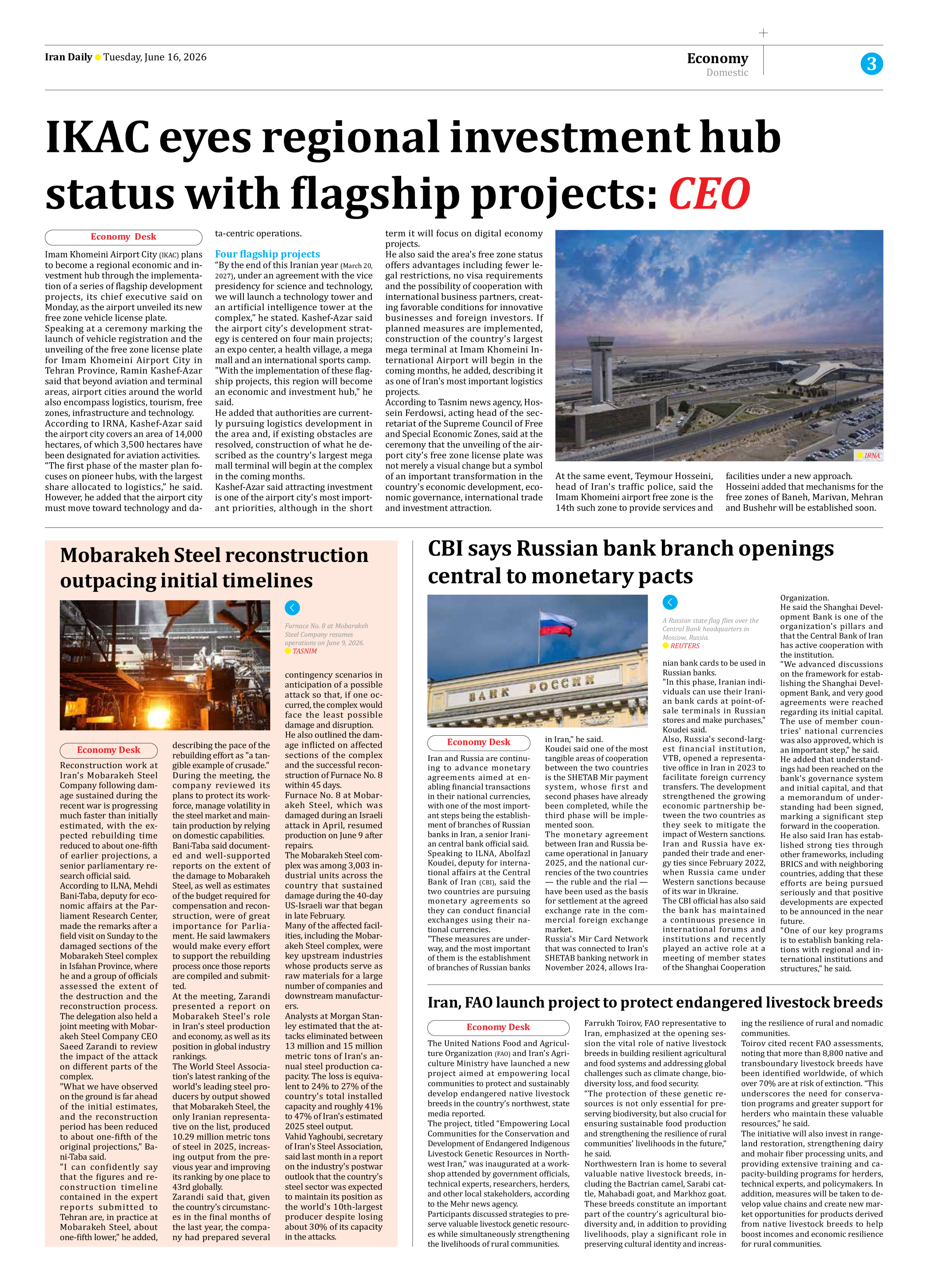


Mobarakeh Steel reconstruction outpacing initial timelines
Reconstruction work at Iran's Mobarakeh Steel Company following damage sustained during the recent war is progressing much faster than initially estimated, with the expected rebuilding time reduced to about one-fifth of earlier projections, a senior parliamentary research official said.
According to ILNA, Mehdi Bani-Taba, deputy for economic affairs at the Parliament Research Center, made the remarks after a field visit on Sunday to the damaged sections of the Mobarakeh Steel complex in Isfahan Province, where he and a group of officials assessed the extent of the destruction and the reconstruction process. The delegation also held a joint meeting with Mobarakeh Steel Company CEO Saeed Zarandi to review the impact of the attack on different parts of the complex.
"What we have observed on the ground is far ahead of the initial estimates, and the reconstruction period has been reduced to about one-fifth of the original projections," Bani-Taba said.
"I can confidently say that the figures and reconstruction timeline contained in the expert reports submitted to Tehran are, in practice at Mobarakeh Steel, about one-fifth lower," he added, describing the pace of the rebuilding effort as "a tangible example of crusade."
During the meeting, the company reviewed its plans to protect its workforce, manage volatility in the steel market and maintain production by relying on domestic capabilities.
Bani-Taba said documented and well-supported reports on the extent of the damage to Mobarakeh Steel, as well as estimates of the budget required for compensation and reconstruction, were of great importance for Parliament. He said lawmakers would make every effort to support the rebuilding process once those reports are compiled and submitted.
At the meeting, Zarandi presented a report on Mobarakeh Steel's role in Iran's steel production and economy, as well as its position in global industry rankings.
The World Steel Association's latest ranking of the world's leading steel producers by output showed that Mobarakeh Steel, the only Iranian representative on the list, produced 10.29 million metric tons of steel in 2025, increasing output from the previous year and improving its ranking by one place to 43rd globally.
Zarandi said that, given the country's circumstances in the final months of the last year, the company had prepared several contingency scenarios in anticipation of a possible attack so that, if one occurred, the complex would face the least possible damage and disruption.
He also outlined the damage inflicted on affected sections of the complex and the successful reconstruction of Furnace No. 8 within 45 days.
Furnace No. 8 at Mobarakeh Steel, which was damaged during an Israeli attack in April, resumed production on June 9 after repairs.
The Mobarakeh Steel complex was among 3,003 industrial units across the country that sustained damage during the 40-day US-Israeli war that began in late February.
Many of the affected facilities, including the Mobarakeh Steel complex, were key upstream industries whose products serve as raw materials for a large number of companies and downstream manufacturers.
Analysts at Morgan Stanley estimated that the attacks eliminated between 13 million and 15 million metric tons of Iran's annual steel production capacity. The loss is equivalent to 24% to 27% of the country's total installed capacity and roughly 41% to 47% of Iran's estimated 2025 steel output.
Vahid Yaghoubi, secretary of Iran's Steel Association, said last month in a report on the industry's postwar outlook that the country's steel sector was expected to maintain its position as the world's 10th-largest producer despite losing about 30% of its capacity in the attacks.