







Kamar Zarrin where Isfahan’s development met its history
In historic cities, whenever an excavator begins work on an urban development project, it encounters more than soil and stone — it confronts the identity and history of the city itself. The Kamar Zarrin passage rehabilitation project in Isfahan became a clear example of navigating the delicate boundary between urban development and cultural heritage preservation. What began as an implementation challenge and an institutional dispute eventually turned into a bittersweet experience that could reshape the approach to urban management in Iran’s historic cities.
The recent opening of the Kamar Zarrin Site Museum marked the completion of one of Isfahan’s most challenging and controversial urban and heritage projects in recent years. From its earliest stages, the project was caught between the municipality’s development priorities and archaeologists’ preservation concerns, according to IRNA.
After more than two years of controversy surrounding the historic passage, the first phase — including the passage and the site museum — has become operational. The second phase, involving the construction of a protective roof, has prepared the site for future scientific excavations, provided that the required funding is secured.
The story of Kamar Zarrin reflects the complexity of development in historic urban areas. The initial goal was simply to improve a passageway and implement an infrastructure project to facilitate movement. However, what lay beneath the surface revealed a different reality. During rehabilitation works, the discovery of archaeological evidence and historical layers halted excavation activities and transformed the project into something far beyond a conventional construction plan.
The sudden discovery of ancient layers changed the nature of the project and led to the creation of Isfahan’s first urban archaeology model. At the time, objections raised by experts and archaeologists became a turning point, shifting the project from a purely construction-focused initiative into one integrated with archaeological research and the creation of a site museum.
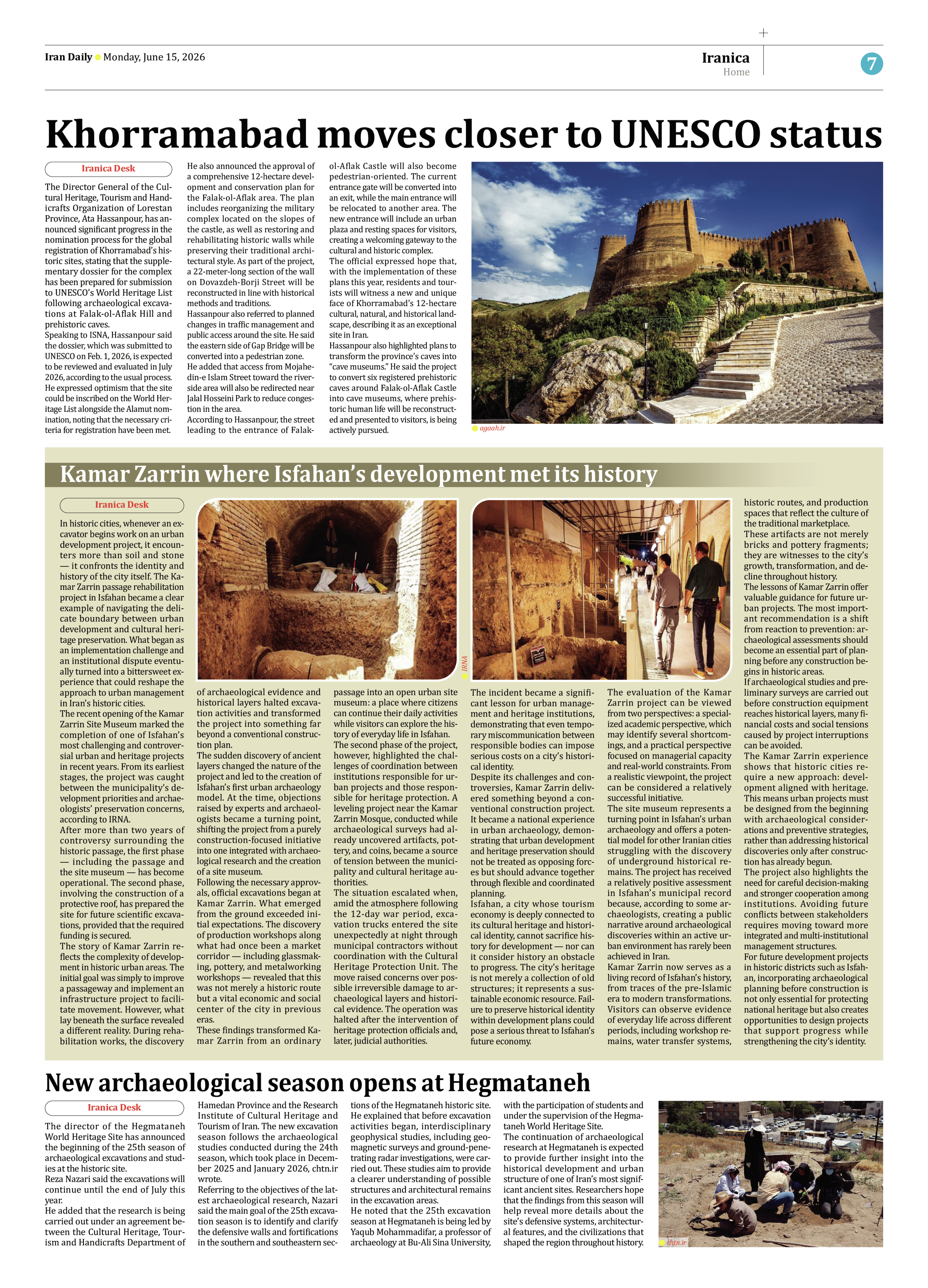
Following the necessary approvals, official excavations began at Kamar Zarrin. What emerged from the ground exceeded initial expectations. The discovery of production workshops along what had once been a market corridor — including glassmaking, pottery, and metalworking workshops — revealed that this was not merely a historic route but a vital economic and social center of the city in previous eras.
These findings transformed Kamar Zarrin from an ordinary passage into an open urban site museum: a place where citizens can continue their daily activities while visitors can explore the history of everyday life in Isfahan.
The second phase of the project, however, highlighted the challenges of coordination between institutions responsible for urban projects and those responsible for heritage protection. A leveling project near the Kamar Zarrin Mosque, conducted while archaeological surveys had already uncovered artifacts, pottery, and coins, became a source of tension between the municipality and cultural heritage authorities.
The situation escalated when, amid the atmosphere following the 12-day war period, excavation trucks entered the site unexpectedly at night through municipal contractors without coordination with the Cultural Heritage Protection Unit. The move raised concerns over possible irreversible damage to archaeological layers and historical evidence. The operation was halted after the intervention of heritage protection officials and, later, judicial authorities.
The incident became a significant lesson for urban management and heritage institutions, demonstrating that even temporary miscommunication between responsible bodies can impose serious costs on a city’s historical identity.
Despite its challenges and controversies, Kamar Zarrin delivered something beyond a conventional construction project. It became a national experience in urban archaeology, demonstrating that urban development and heritage preservation should not be treated as opposing forces but should advance together through flexible and coordinated planning.
Isfahan, a city whose tourism economy is deeply connected to its cultural heritage and historical identity, cannot sacrifice history for development — nor can it consider history an obstacle to progress. The city’s heritage is not merely a collection of old structures; it represents a sustainable economic resource. Failure to preserve historical identity within development plans could pose a serious threat to Isfahan’s future economy.
The evaluation of the Kamar Zarrin project can be viewed from two perspectives: a specialized academic perspective, which may identify several shortcomings, and a practical perspective focused on managerial capacity and real-world constraints. From a realistic viewpoint, the project can be considered a relatively successful initiative.
The site museum represents a turning point in Isfahan’s urban archaeology and offers a potential model for other Iranian cities struggling with the discovery of underground historical remains. The project has received a relatively positive assessment in Isfahan’s municipal record because, according to some archaeologists, creating a public narrative around archaeological discoveries within an active urban environment has rarely been achieved in Iran.
Kamar Zarrin now serves as a living record of Isfahan’s history, from traces of the pre-Islamic era to modern transformations. Visitors can observe evidence of everyday life across different periods, including workshop remains, water transfer systems, historic routes, and production spaces that reflect the culture of the traditional marketplace.
These artifacts are not merely bricks and pottery fragments; they are witnesses to the city’s growth, transformation, and decline throughout history.
The lessons of Kamar Zarrin offer valuable guidance for future urban projects. The most important recommendation is a shift from reaction to prevention: archaeological assessments should become an essential part of planning before any construction begins in historic areas.
If archaeological studies and preliminary surveys are carried out before construction equipment reaches historical layers, many financial costs and social tensions caused by project interruptions can be avoided.
The Kamar Zarrin experience shows that historic cities require a new approach: development aligned with heritage. This means urban projects must be designed from the beginning with archaeological considerations and preventive strategies, rather than addressing historical discoveries only after construction has already begun.
The project also highlights the need for careful decision-making and stronger cooperation among institutions. Avoiding future conflicts between stakeholders requires moving toward more integrated and multi-institutional management structures.
For future development projects in historic districts such as Isfahan, incorporating archaeological planning before construction is not only essential for protecting national heritage but also creates opportunities to design projects that support progress while strengthening the city’s identity.