





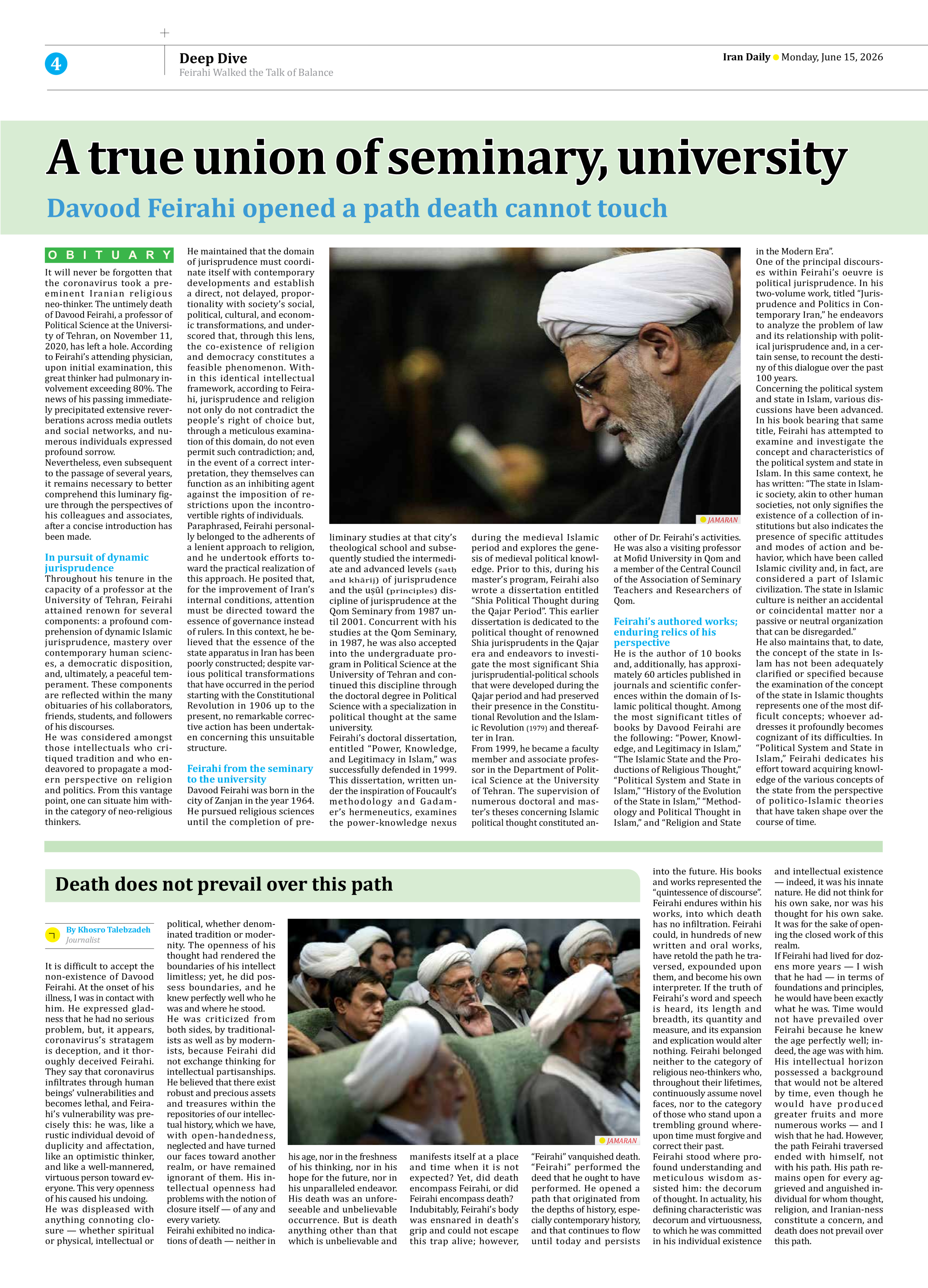


A true union of seminary, university
Davood Feirahi opened a path death cannot touch
It will never be forgotten that the coronavirus took a preeminent Iranian religious neo‑thinker. The untimely death of Davood Feirahi, a professor of Political Science at the University of Tehran, on November 11, 2020, has left a hole. According to Feirahi’s attending physician, upon initial examination, this great thinker had pulmonary involvement exceeding 80%. The news of his passing immediately precipitated extensive reverberations across media outlets and social networks, and numerous individuals expressed profound sorrow.
Nevertheless, even subsequent to the passage of several years, it remains necessary to better comprehend this luminary figure through the perspectives of his colleagues and associates, after a concise introduction has been made.
In pursuit of dynamic jurisprudence
Throughout his tenure in the capacity of a professor at the University of Tehran, Feirahi attained renown for several components: a profound comprehension of dynamic Islamic jurisprudence, mastery over contemporary human sciences, a democratic disposition, and, ultimately, a peaceful temperament. These components are reflected within the many obituaries of his collaborators, friends, students, and followers of his discourses.
He was considered amongst those intellectuals who critiqued tradition and who endeavored to propagate a modern perspective on religion and politics. From this vantage point, one can situate him within the category of neo‑religious thinkers.
He maintained that the domain of jurisprudence must coordinate itself with contemporary developments and establish a direct, not delayed, proportionality with society’s social, political, cultural, and economic transformations, and underscored that, through this lens, the co‑existence of religion and democracy constitutes a feasible phenomenon. Within this identical intellectual framework, according to Feirahi, jurisprudence and religion not only do not contradict the people’s right of choice but, through a meticulous examination of this domain, do not even permit such contradiction; and, in the event of a correct interpretation, they themselves can function as an inhibiting agent against the imposition of restrictions upon the incontrovertible rights of individuals.
Paraphrased, Feirahi personally belonged to the adherents of a lenient approach to religion, and he undertook efforts toward the practical realization of this approach. He posited that, for the improvement of Iran’s internal conditions, attention must be directed toward the essence of governance instead of rulers. In this context, he believed that the essence of the state apparatus in Iran has been poorly constructed; despite various political transformations that have occurred in the period starting with the Constitutional Revolution in 1906 up to the present, no remarkable corrective action has been undertaken concerning this unsuitable structure.
Feirahi from the seminary to the university
Davood Feirahi was born in the city of Zanjan in the year 1964. He pursued religious sciences until the completion of preliminary studies at that city’s theological school and subsequently studied the intermediate and advanced levels (satḥ and khārij) of jurisprudence and the uṣūl (principles) discipline of jurisprudence at the Qom Seminary from 1987 until 2001. Concurrent with his studies at the Qom Seminary, in 1987, he was also accepted into the undergraduate program in Political Science at the University of Tehran and continued this discipline through the doctoral degree in Political Science with a specialization in political thought at the same university.
Feirahi’s doctoral dissertation, entitled “Power, Knowledge, and Legitimacy in Islam,” was successfully defended in 1999. This dissertation, written under the inspiration of Foucault’s methodology and Gadamer’s hermeneutics, examines the power‑knowledge nexus during the medieval Islamic period and explores the genesis of medieval political knowledge. Prior to this, during his master’s program, Feirahi also wrote a dissertation entitled “Shia Political Thought during the Qajar Period”. This earlier dissertation is dedicated to the political thought of renowned Shia jurisprudents in the Qajar era and endeavors to investigate the most significant Shia jurisprudential‑political schools that were developed during the Qajar period and had preserved their presence in the Constitutional Revolution and the Islamic Revolution (1979) and thereafter in Iran.
From 1999, he became a faculty member and associate professor in the Department of Political Science at the University of Tehran. The supervision of numerous doctoral and master’s theses concerning Islamic political thought constituted another of Dr. Feirahi’s activities. He was also a visiting professor at Mofid University in Qom and a member of the Central Council of the Association of Seminary Teachers and Researchers of Qom.
Feirahi’s authored works; enduring relics of his perspective
He is the author of 10 books and, additionally, has approximately 60 articles published in journals and scientific conferences within the domain of Islamic political thought. Among the most significant titles of books by Davood Feirahi are the following: “Power, Knowledge, and Legitimacy in Islam,” “The Islamic State and the Productions of Religious Thought,” “Political System and State in Islam,” “History of the Evolution of the State in Islam,” “Methodology and Political Thought in Islam,” and “Religion and State in the Modern Era”.
One of the principal discourses within Feirahi’s oeuvre is political jurisprudence. In his two‑volume work, titled “Jurisprudence and Politics in Contemporary Iran,” he endeavors to analyze the problem of law and its relationship with political jurisprudence and, in a certain sense, to recount the destiny of this dialogue over the past 100 years.
Concerning the political system and state in Islam, various discussions have been advanced. In his book bearing that same title, Feirahi has attempted to examine and investigate the concept and characteristics of the political system and state in Islam. In this same context, he has written: “The state in Islamic society, akin to other human societies, not only signifies the existence of a collection of institutions but also indicates the presence of specific attitudes and modes of action and behavior, which have been called Islamic civility and, in fact, are considered a part of Islamic civilization. The state in Islamic culture is neither an accidental or coincidental matter nor a passive or neutral organization that can be disregarded.”
He also maintains that, to date, the concept of the state in Islam has not been adequately clarified or specified because the examination of the concept of the state in Islamic thoughts represents one of the most difficult concepts; whoever addresses it profoundly becomes cognizant of its difficulties. In “Political System and State in Islam,” Feirahi dedicates his effort toward acquiring knowledge of the various concepts of the state from the perspective of politico‑Islamic theories that have taken shape over the course of time.
Death does not prevail over this path
By Khosro Talebzadeh
Journalist
It is difficult to accept the non‑existence of Davood Feirahi. At the onset of his illness, I was in contact with him. He expressed gladness that he had no serious problem, but, it appears, coronavirus’s stratagem is deception, and it thoroughly deceived Feirahi. They say that coronavirus infiltrates through human beings’ vulnerabilities and becomes lethal, and Feirahi’s vulnerability was precisely this: he was, like a rustic individual devoid of duplicity and affectation, like an optimistic thinker, and like a well‑mannered, virtuous person toward everyone. This very openness of his caused his undoing.
He was displeased with anything connoting closure — whether spiritual or physical, intellectual or political, whether denominated tradition or modernity. The openness of his thought had rendered the boundaries of his intellect limitless; yet, he did possess boundaries, and he knew perfectly well who he was and where he stood.
He was criticized from both sides, by traditionalists as well as by modernists, because Feirahi did not exchange thinking for intellectual partisanships. He believed that there exist robust and precious assets and treasures within the repositories of our intellectual history, which we have, with open‑handedness, neglected and have turned our faces toward another realm, or have remained ignorant of them. His intellectual openness had problems with the notion of closure itself — of any and every variety.
Feirahi exhibited no indications of death — neither in his age, nor in the freshness of his thinking, nor in his hope for the future, nor in his unparalleled endeavor. His death was an unforeseeable and unbelievable occurrence. But is death anything other than that which is unbelievable and manifests itself at a place and time when it is not expected? Yet, did death encompass Feirahi, or did Feirahi encompass death?
Indubitably, Feirahi’s body was ensnared in death’s grip and could not escape this trap alive; however, “Feirahi” vanquished death. “Feirahi” performed the deed that he ought to have performed. He opened a path that originated from the depths of history, especially contemporary history, and that continues to flow until today and persists into the future. His books and works represented the “quintessence of discourse”.
Feirahi endures within his works, into which death has no infiltration. Feirahi could, in hundreds of new written and oral works, have retold the path he traversed, expounded upon them, and become his own interpreter. If the truth of Feirahi’s word and speech is heard, its length and breadth, its quantity and measure, and its expansion and explication would alter nothing. Feirahi belonged neither to the category of religious neo‑thinkers who, throughout their lifetimes, continuously assume novel faces, nor to the category of those who stand upon a trembling ground whereupon time must forgive and correct their past.
Feirahi stood where profound understanding and meticulous wisdom assisted him: the decorum of thought. In actuality, his defining characteristic was decorum and virtuousness, to which he was committed in his individual existence and intellectual existence — indeed, it was his innate nature. He did not think for his own sake, nor was his thought for his own sake. It was for the sake of opening the closed work of this realm.
If Feirahi had lived for dozens more years — I wish that he had — in terms of foundations and principles, he would have been exactly what he was. Time would not have prevailed over Feirahi because he knew the age perfectly well; indeed, the age was with him. His intellectual horizon possessed a background that would not be altered by time, even though he would have produced greater fruits and more numerous works — and I wish that he had. However, the path Feirahi traversed ended with himself, not with his path. His path remains open for every aggrieved and anguished individual for whom thought, religion, and Iranian‑ness constitute a concern, and death does not prevail over this path.
He insisted upon teaching in religious attire
By Rahim Abolhasani
Professor of Political Science at the University of Tehran
We lost one of the prominent, distinguished, and influential professors of the University of Tehran: Dr. Davood Feirahi — addressing the various dimensions of whose personality cannot be summarized within these few words. Nevertheless, in addressing some of his most manifest characteristics, it must be said that, upon first encounter, it was the professor’s behavioral demeanor and ethical decorum that attracted everyone. As a colleague, I must state that I never, not even once, witnessed this kind and polite personality commit the slightest disrespect toward anyone. Analogous to what the late Professor Motahari articulated concerning the co‑existence of attraction and repulsion within personalities, it must be said that even Dr. Feirahi’s repulsion was accompanied by decorum and ethics and, consequently, was a cause of attraction.
Another dimension is that he was a profound thinker who endeavored, in addressing the whatness, whys, and hows of a subject, to benefit from numerous and diverse currents of thought. Any form of dogmatism was absent from the realm of his thought. Feirahi was among the rare clerical figures who possessed, in perfection, an acquaintance with Western thought; and, although he was an informed individual and a defender of Islamic principles and thought, he utilized, in his authored works, the thoughts of Western political science thinkers in the finest manner.
He was not a mere political thinker. Rather, he adopted an active and responsible stance toward the reform of society and the political system and the resolution of the country’s political problems, and he paid the price for that stance as well. We do not forget that, in 2009, he was elected as the head of the political department at the Faculty of Law and Political Science of the University of Tehran; but, unfortunately, the officials of the University of Tehran at that time refused to confirm his qualifications and to issue his appointment decree as department head.
I wish to state that Professor Feirahi was not a reclusive thinker. On the contrary, he was present on the scene and was perpetually concerned with the people, the reformation of the country, and the legitimacy of religious identity. Based on his mastery over the history, thought, and political philosophy of the religion of Islam, Dr. Feirahi, in his last years, engaged with society’s political issues with sensitivity and endeavored, in confronting the deviations that he observed being perpetrated in the name of religion within the political sphere, to communicate with society what was necessary and to defend the domain of religion.
He consistently attempted to articulate society’s problems within religious attire. At the peak of the pressures that existed, over his last three decades, within academic spaces against enlightened clerics — pressures that compelled some thinking clerics to remove their religious attire — he insisted upon teaching at the university in religious attire and upon preserving the sanctity of religion. Professor Feirahi, through his kind ethics and his excellent teaching method, was able to offer highly fruitful and beneficial classes. He was not only a reputable author but also a highly skilled pedagogue, whose classes were enthusiastically received by the students of the faculty, to such an extent that, if he offered an elective class, the students would pursue that class even more assiduously than their core courses.
He was an extraordinarily industrious individual. For this reason, within this same short lifespan, he left behind numerous works in the domain of contemporary Iran’s political thought. Although, in my belief, unfortunately, this very quantity of work caused his body to experience premature aging and to succumb easily to illness.
All of us regret his loss. However, Professor Feirahi, to the extent that the opportunity of a lifetime permitted, yielded his fruit. This is the custom of the history of all societies: that the pioneering elites are solitary, but, only later, will they exert influence; and, God willing, our society will also benefit from his opinions in the future.
A thinker who was thinking of Iran
By Alireza
Hosseini Beheshti
Professor of Political Science at Tarbiat Modares University
Neither your awareness that death constitutes the conclusion of a stage of our existence — which all of us will, by necessity, traverse — nor your knowledge that, these days, many of your compatriots and fellow humans are embarking upon a journey without return, nor your cognizance that you have reached an age wherein those whom you knew and who knew you are abandoning you and departing, none of these provide consolation upon hearing the news of the passing of a beloved one among your beloveds. This grief, it seems, is perpetually alive. In a fear born of reluctance to check one’s mobile phone — lest you learn of the death of another friend or relative — you bury your head in a book and grant your eyes the indulgence of gazing upon the beautiful autumnal nature, so as to experience moments of unawareness; but, again, you err, and you behold the news.
Yet another friend, another colleague, another companion in conversations, Hojjatoleslam Dr. Davood Feirahi, professor of political thought at the University of Tehran, has passed away. In the effusion of friendship, he was open‑handed, and, in confronting adversities, he was open‑countenanced. When he spoke of the books he had written and the books he was in the process of writing, the radiances of the fervor of a concerned and profound thinker would ripple across his countenance. When he spoke of his anxieties concerning the future of the country and the nation, he would assume the stance of a committed intellectual and a compassionate critic. He never denied his knowledge nor his affection to any student, seminarian, professor, or researcher.
Many times, he spoke to me about adopting the late Martyr Beheshti as a model for simultaneous study in the seminary and the university from the earliest years of his youth; and how well and steadfastly he had trodden this path. And, above all, there was the purity that, in this era of impurity, filled every moment of the hours of your companionship with him.
We are all destined to depart, and no reality more naked than death exists in human life; yet, blessed are those who considered the world a bridge and crossed it safely, without committing injustice against another or against themselves. Blessed are those who lived in such a manner that every moment of their life serves as a reminder of goodness, and whose death leaves behind irreplaceable losses. I cannot write beyond this. This is the time for silence.
What a premature flight
By Hamidreza Jalaeipour
Assistant professor of Sociology at the University of Tehran
With profound sorrow, we witnessed the unexpected passing of Dr. Davood Feirahi, a neo‑thinking cleric and professor of political thought at the University of Tehran. Alas! Alas!
He was a person of knowledge and thought as well as an ethical researcher in the public sphere. His research program, for which he labored for 30 years, was “the rational reconciliation between the science of jurisprudence and the science of politics”. He was not merely a university professor; he frequently brought his intellectual products into the public sphere and into society and supported democracy and the co‑existence of Iranians with one another. He had a responsible patriotism, and, on this path, he did not fall into the abyss of genealogical, racial, and divergent perspectives.
Beyond his attention to the science of jurisprudence and political thought, he paid special and illuminating attention to the history of Islam, the political experience of Islamic countries — especially the experience of Egypt — and, finally, to the contemporary politics of Iran. Dr. Feirahi, while being a person of knowledge, was extremely humble and a person of dialogue. He endured the hardship of travel and participated in all intellectual gatherings in every corner of the country. He was committed to writing down and publishing his intellectual products, and, in this respect, he left behind a valuable legacy.
He absolutely did not commodify his scientific and professional competence for himself and his family, and he lived as a liberated and light‑spirited individual. Alas, he suddenly flew away from among us at the zenith of his intellectual fertility. I offer my condolences for his untimely and agonizing death to his honorable family and to all people of culture and thought.
In eulogy for my lost friend
By Ahmad Naghibzadeh
Professor of Political Science at the University of Tehran
It is difficult and painful for me to speak in mourning for Feirahi. I shall keep those sentiments for myself and shall introduce him to you as I knew him. From an ethical standpoint, he was a man of integrity, good‑tempered, and possessed of forbearance, and he conducted himself with people in the manner that one expects from a cleric in the precise sense of the word. I never, not once, witnessed him engage in backbiting or wish ill upon anyone. He was devoid of prejudice and was extremely humble and modest toward the professors with whom he had studied during his student years. It was impossible for him to walk ahead of them. From a scientific standpoint, he was highly capable and correctly apprehended key concepts. He was an exemplary embodiment of the unity of the seminary and the university. He taught Islamic subjects in such a manner that they ranked among the most attractive courses.
In my opinion, he rendered a great service to the culture of the Islamic Republic of Iran, even though some benighted individuals committed injustice against him.
In addition to theoretical courses, in the practical domain, he constantly sought a solution that would be simultaneously Islamic and feasible and practicable in today’s world. He was concerned with the intractable problems confronting the Islamic Republic: how to conjoin theocracy with democracy, what significance a political party possesses from the perspective of Islam, and how it can be justified.
May he rest in peace.
The article first appeared in Persian in Iran Newspaper.