





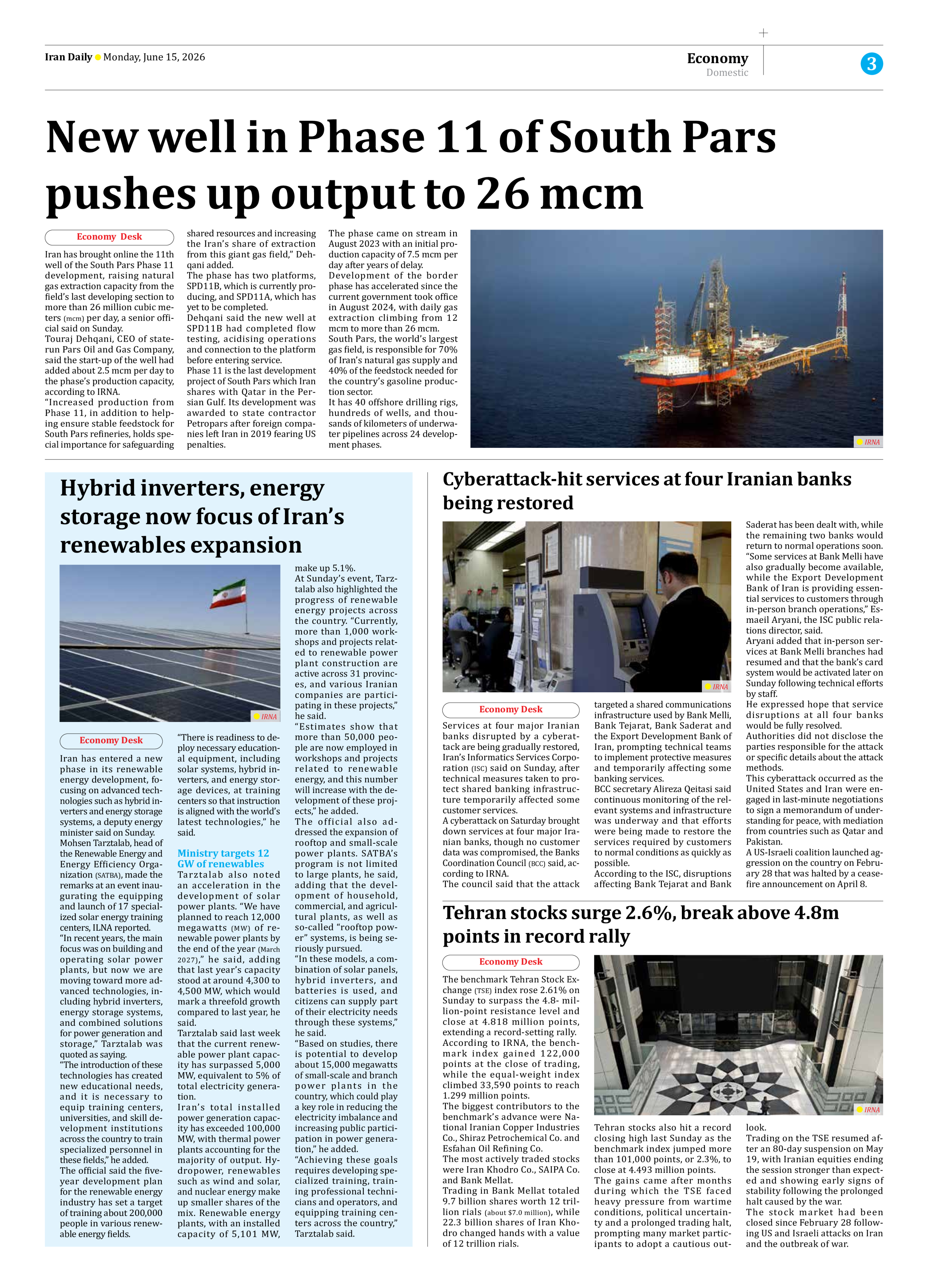


Hybrid inverters, energy storage now focus of Iran’s renewables expansion
Iran has entered a new phase in its renewable energy development, focusing on advanced technologies such as hybrid inverters and energy storage systems, a deputy energy minister said on Sunday.
Mohsen Tarztalab, head of the Renewable Energy and Energy Efficiency Organization (SATBA), made the remarks at an event inaugurating the equipping and launch of 17 specialized solar energy training centers, ILNA reported.
“In recent years, the main focus was on building and operating solar power plants, but now we are moving toward more advanced technologies, including hybrid inverters, energy storage systems, and combined solutions for power generation and storage,” Tarztalab was quoted as saying.
“The introduction of these technologies has created new educational needs, and it is necessary to equip training centers, universities, and skill development institutions across the country to train specialized personnel in these fields,” he added.
The official said the five-year development plan for the renewable energy industry has set a target of training about 200,000 people in various renewable energy fields.
“There is readiness to deploy necessary educational equipment, including solar systems, hybrid inverters, and energy storage devices, at training centers so that instruction is aligned with the world’s latest technologies,” he said.
Ministry targets 12 GW of renewables
Tarztalab also noted an acceleration in the development of solar power plants. “We have planned to reach 12,000 megawatts (MW) of renewable power plants by the end of the year (March 2027),” he said, adding that last year’s capacity stood at around 4,300 to 4,500 MW, which would mark a threefold growth compared to last year, he said.
Tarztalab said last week that the current renewable power plant capacity has surpassed 5,000 MW, equivalent to 5% of total electricity generation.
Iran’s total installed power generation capacity has exceeded 100,000 MW, with thermal power plants accounting for the majority of output. Hydropower, renewables such as wind and solar, and nuclear energy make up smaller shares of the mix. Renewable energy plants, with an installed capacity of 5,101 MW, make up 5.1%.
At Sunday’s event, Tarztalab also highlighted the progress of renewable energy projects across the country. “Currently, more than 1,000 workshops and projects related to renewable power plant construction are active across 31 provinces, and various Iranian companies are participating in these projects,” he said.
“Estimates show that more than 50,000 people are now employed in workshops and projects related to renewable energy, and this number will increase with the development of these projects,” he added.
The official also addressed the expansion of rooftop and small-scale power plants. SATBA’s program is not limited to large plants, he said, adding that the development of household, commercial, and agricultural plants, as well as so-called “rooftop power” systems, is being seriously pursued.
“In these models, a combination of solar panels, hybrid inverters, and batteries is used, and citizens can supply part of their electricity needs through these systems,” he said.
“Based on studies, there is potential to develop about 15,000 megawatts of small-scale and branch power plants in the country, which could play a key role in reducing the electricity imbalance and increasing public participation in power generation,” he added.
“Achieving these goals requires developing specialized training, training professional technicians and operators, and equipping training centers across the country,” Tarztalab said.