







Se-Kuhe Castle stands tall in Sistan’s historic landscape
Sistan and Baluchestan Province is one of Iran’s most valuable provinces, a region holding important historical treasures within its heart. Shahr-e Sukhteh (Burnt City), Dahaneh-ye Gholaman, Arg-e Jalaliabad, and many other sites form just a part of the province’s remarkable attractions.
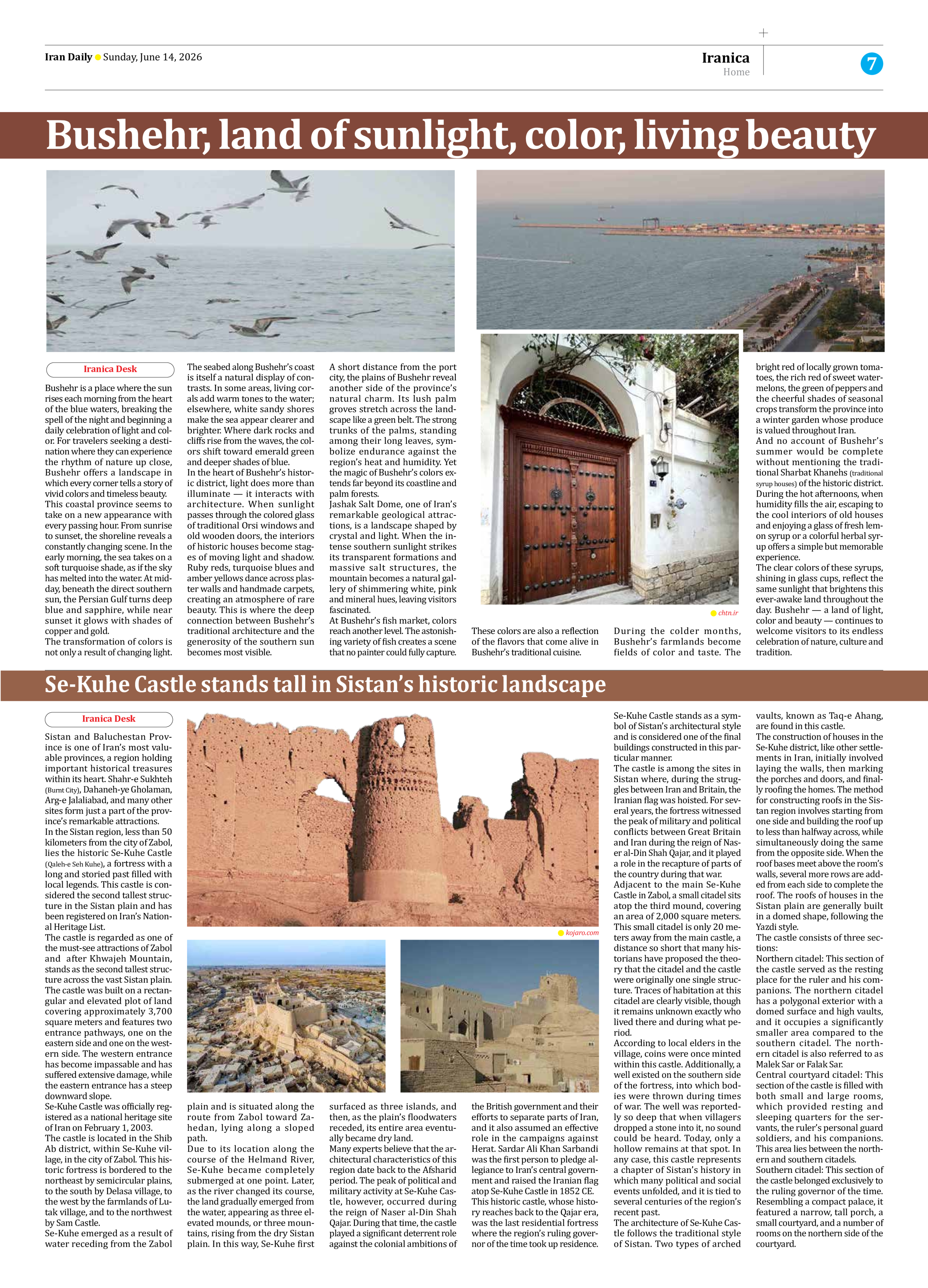
In the Sistan region, less than 50 kilometers from the city of Zabol, lies the historic Se-Kuhe Castle (Qaleh-e Seh Kuhe), a fortress with a long and storied past filled with local legends. This castle is considered the second tallest structure in the Sistan plain and has been registered on Iran’s National Heritage List.
The castle is regarded as one of the must-see attractions of Zabol and after Khwajeh Mountain, stands as the second tallest structure across the vast Sistan plain. The castle was built on a rectangular and elevated plot of land covering approximately 3,700 square meters and features two entrance pathways, one on the eastern side and one on the western side. The western entrance has become impassable and has suffered extensive damage, while the eastern entrance has a steep downward slope.
Se-Kuhe Castle was officially registered as a national heritage site of Iran on February 1, 2003.
The castle is located in the Shib Ab district, within Se-Kuhe village, in the city of Zabol. This historic fortress is bordered to the northeast by semicircular plains, to the south by Delasa village, to the west by the farmlands of Lutak village, and to the northwest by Sam Castle.
Se-Kuhe emerged as a result of water receding from the Zabol plain and is situated along the route from Zabol toward Zahedan, lying along a sloped path.
Due to its location along the course of the Helmand River, Se-Kuhe became completely submerged at one point. Later, as the river changed its course, the land gradually emerged from the water, appearing as three elevated mounds, or three mountains, rising from the dry Sistan plain. In this way, Se-Kuhe first surfaced as three islands, and then, as the plain’s floodwaters receded, its entire area eventually became dry land.
Many experts believe that the architectural characteristics of this region date back to the Afsharid period. The peak of political and military activity at Se-Kuhe Castle, however, occurred during the reign of Naser al-Din Shah Qajar. During that time, the castle played a significant deterrent role against the colonial ambitions of the British government and their efforts to separate parts of Iran, and it also assumed an effective role in the campaigns against Herat. Sardar Ali Khan Sarbandi was the first person to pledge allegiance to Iran’s central government and raised the Iranian flag atop Se-Kuhe Castle in 1852 CE.
This historic castle, whose history reaches back to the Qajar era, was the last residential fortress where the region’s ruling governor of the time took up residence.
Se-Kuhe Castle stands as a symbol of Sistan’s architectural style and is considered one of the final buildings constructed in this particular manner.
The castle is among the sites in Sistan where, during the struggles between Iran and Britain, the Iranian flag was hoisted. For several years, the fortress witnessed the peak of military and political conflicts between Great Britain and Iran during the reign of Naser al-Din Shah Qajar, and it played a role in the recapture of parts of the country during that war.
Adjacent to the main Se-Kuhe Castle in Zabol, a small citadel sits atop the third mound, covering an area of 2,000 square meters. This small citadel is only 20 meters away from the main castle, a distance so short that many historians have proposed the theory that the citadel and the castle were originally one single structure. Traces of habitation at this citadel are clearly visible, though it remains unknown exactly who lived there and during what period.
According to local elders in the village, coins were once minted within this castle. Additionally, a well existed on the southern side of the fortress, into which bodies were thrown during times of war. The well was reportedly so deep that when villagers dropped a stone into it, no sound could be heard. Today, only a hollow remains at that spot. In any case, this castle represents a chapter of Sistan’s history in which many political and social events unfolded, and it is tied to several centuries of the region’s recent past.
The architecture of Se-Kuhe Castle follows the traditional style of Sistan. Two types of arched vaults, known as Taq-e Ahang, are found in this castle.
The construction of houses in the Se-Kuhe district, like other settlements in Iran, initially involved laying the walls, then marking the porches and doors, and finally roofing the homes. The method for constructing roofs in the Sistan region involves starting from one side and building the roof up to less than halfway across, while simultaneously doing the same from the opposite side. When the roof bases meet above the room’s walls, several more rows are added from each side to complete the roof. The roofs of houses in the Sistan plain are generally built in a domed shape, following the Yazdi style.
The castle consists of three sections:
Northern citadel: This section of the castle served as the resting place for the ruler and his companions. The northern citadel has a polygonal exterior with a domed surface and high vaults, and it occupies a significantly smaller area compared to the southern citadel. The northern citadel is also referred to as Malek Sar or Falak Sar.
Central courtyard citadel: This section of the castle is filled with both small and large rooms, which provided resting and sleeping quarters for the servants, the ruler’s personal guard soldiers, and his companions. This area lies between the northern and southern citadels.
Southern citadel: This section of the castle belonged exclusively to the ruling governor of the time. Resembling a compact palace, it featured a narrow, tall porch, a small courtyard, and a number of rooms on the northern side of the courtyard.