







118 Lamerd citizens become victims of American missile test: Hospital chief
By Mohadese Jafari
Staff writer
More than 100 days have elapsed since the commencement of the wicked Zionist-American assaults upon Iran. With each passing day, new dimensions of American atrocities inflicted upon the life and body of our motherland during this imposed war are still unveiled.
On the first day of the war — specifically on February 28, at approximately 16:00 to 17:00 local time, shortly after the bombardment of the Shajareh Tayyebeh Elementary School in Minab — the Americans tested, for the first time, a novel prohibited weapon of mass destruction of their own construction upon the heads of a small town’s populace. This military catastrophe transpired in four points within Lamerd County, southern Iran, namely: a sports hall, two residential zones, and a hall adjacent to the Dabestaneh School. Lamerd is a small city in the southern part of Fars Province which, according to foreign media outlets, turned within a few seconds into a laboratory for one of the most lethal methodologies of mass extermination. This missile barrage occurred not above a military installation, nor upon a battlefield; rather, it transpired above houses wherein people resided.
According to the chief of Lamerd Hospital, each of these missiles carried 180,000 fragments composed of tungsten shot. Four missiles — that is, 720,000 metallic projectiles — descended upon a small expanse of a city with a population of approximately 30,000 inhabitants. In effect, on that day, 24 projectiles rained down upon every man and woman, irrespective of their age; a military experiment for which the citizens of Lamerd became victims on that ominous day.
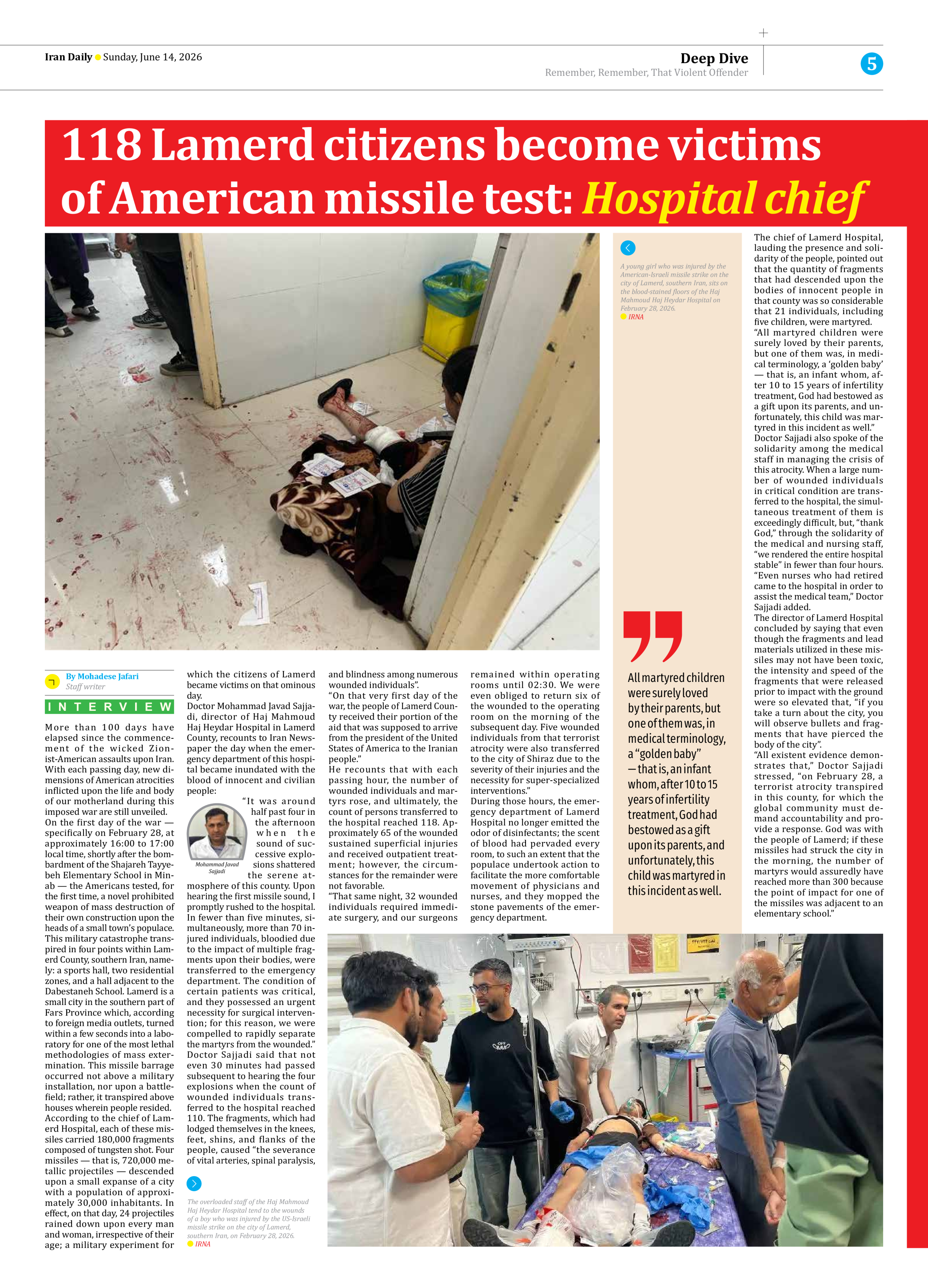
Doctor Mohammad Javad Sajjadi, director of Haj Mahmoud Haj Heydar Hospital in Lamerd County, recounts to Iran Newspaper the day when the emergency department of this hospital became inundated with the blood of innocent and civilian people:
“It was around half past four in the afternoon when the sound of successive explosions shattered the serene atmosphere of this county. Upon hearing the first missile sound, I promptly rushed to the hospital. In fewer than five minutes, simultaneously, more than 70 injured individuals, bloodied due to the impact of multiple fragments upon their bodies, were transferred to the emergency department. The condition of certain patients was critical, and they possessed an urgent necessity for surgical intervention; for this reason, we were compelled to rapidly separate the martyrs from the wounded.”
Doctor Sajjadi said that not even 30 minutes had passed subsequent to hearing the four explosions when the count of wounded individuals transferred to the hospital reached 110. The fragments, which had lodged themselves in the knees, feet, shins, and flanks of the people, caused “the severance of vital arteries, spinal paralysis, and blindness among numerous wounded individuals”.
“On that very first day of the war, the people of Lamerd County received their portion of the aid that was supposed to arrive from the president of the United States of America to the Iranian people.”
He recounts that with each passing hour, the number of wounded individuals and martyrs rose, and ultimately, the count of persons transferred to the hospital reached 118. Approximately 65 of the wounded sustained superficial injuries and received outpatient treatment; however, the circumstances for the remainder were not favorable.
“That same night, 32 wounded individuals required immediate surgery, and our surgeons remained within operating rooms until 02:30. We were even obliged to return six of the wounded to the operating room on the morning of the subsequent day. Five wounded individuals from that terrorist atrocity were also transferred to the city of Shiraz due to the severity of their injuries and the necessity for super-specialized interventions.”
During those hours, the emergency department of Lamerd Hospital no longer emitted the odor of disinfectants; the scent of blood had pervaded every room, to such an extent that the populace undertook action to facilitate the more comfortable movement of physicians and nurses, and they mopped the stone pavements of the emergency department.
The chief of Lamerd Hospital, lauding the presence and solidarity of the people, pointed out that the quantity of fragments that had descended upon the bodies of innocent people in that county was so considerable that 21 individuals, including five children, were martyred.
“All martyred children were surely loved by their parents, but one of them was, in medical terminology, a ‘golden baby’ — that is, an infant whom, after 10 to 15 years of infertility treatment, God had bestowed as a gift upon its parents, and unfortunately, this child was martyred in this incident as well.”
Doctor Sajjadi also spoke of the solidarity among the medical staff in managing the crisis of this atrocity. When a large number of wounded individuals in critical condition are transferred to the hospital, the simultaneous treatment of them is exceedingly difficult, but, “thank God,” through the solidarity of the medical and nursing staff, “we rendered the entire hospital stable” in fewer than four hours. “Even nurses who had retired came to the hospital in order to assist the medical team,” Doctor Sajjadi added.
The director of Lamerd Hospital concluded by saying that even though the fragments and lead materials utilized in these missiles may not have been toxic, the intensity and speed of the fragments that were released prior to impact with the ground were so elevated that, “if you take a turn about the city, you will observe bullets and fragments that have pierced the body of the city”.
“All existent evidence demonstrates that,” Doctor Sajjadi stressed, “on February 28, a terrorist atrocity transpired in this county, for which the global community must demand accountability and provide a response. God was with the people of Lamerd; if these missiles had struck the city in the morning, the number of martyrs would assuredly have reached more than 300 because the point of impact for one of the missiles was adjacent to an elementary school.”