







Harrowing details from bloody day of Lamerd
City’s governor elucidates dimensions of US attack on noncombatant citizens
By Bita Mir-Azimi
Staff writer
On February 28, 2026, merely seven hours after the terroristic assault by the United States and the Zionist regime upon the Shajareh Tayyebeh School in Minab, the county of Lamerd, situated in the southern reaches of Iran’s Fars Province, became the theater for one of the most unprecedented, yet simultaneously one of the most sparsely narrated, war crimes of those days; an assault whose significance derives not exclusively from the number of casualties, but rather from the character of the weaponry employed and the methodology of operational execution.
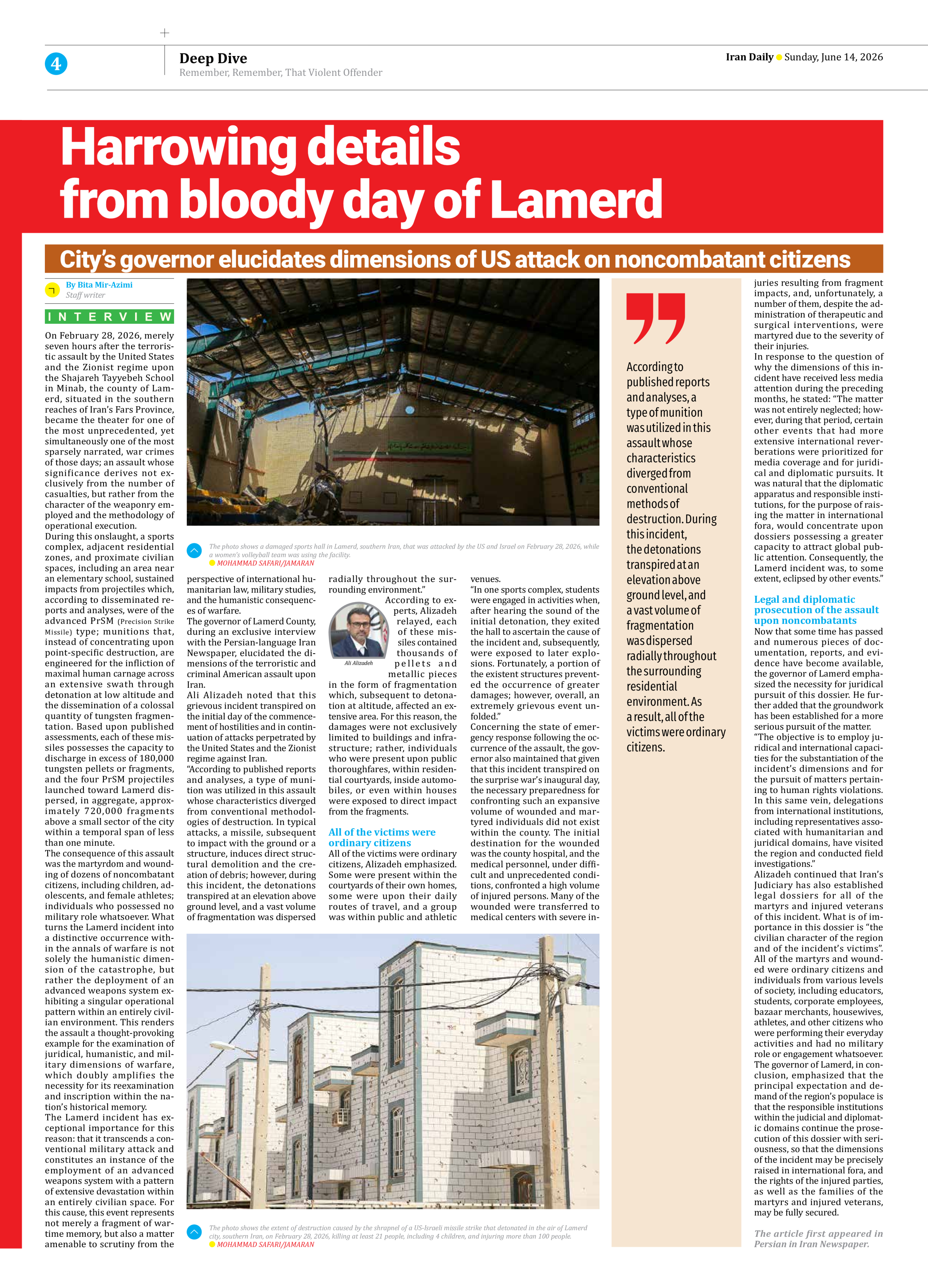
During this onslaught, a sports complex, adjacent residential zones, and proximate civilian spaces, including an area near an elementary school, sustained impacts from projectiles which, according to disseminated reports and analyses, were of the advanced PrSM (Precision Strike Missile) type; munitions that, instead of concentrating upon point-specific destruction, are engineered for the infliction of maximal human carnage across an extensive swath through detonation at low altitude and the dissemination of a colossal quantity of tungsten fragmentation. Based upon published assessments, each of these missiles possesses the capacity to discharge in excess of 180,000 tungsten pellets or fragments, and the four PrSM projectiles launched toward Lamerd dispersed, in aggregate, approximately 720,000 fragments above a small sector of the city within a temporal span of less than one minute.
The consequence of this assault was the martyrdom and wounding of dozens of noncombatant citizens, including children, adolescents, and female athletes; individuals who possessed no military role whatsoever. What turns the Lamerd incident into a distinctive occurrence within the annals of warfare is not solely the humanistic dimension of the catastrophe, but rather the deployment of an advanced weapons system exhibiting a singular operational pattern within an entirely civilian environment. This renders the assault a thought-provoking example for the examination of juridical, humanistic, and military dimensions of warfare, which doubly amplifies the necessity for its reexamination and inscription within the nation’s historical memory.
The Lamerd incident has exceptional importance for this reason: that it transcends a conventional military attack and constitutes an instance of the employment of an advanced weapons system with a pattern of extensive devastation within an entirely civilian space. For this cause, this event represents not merely a fragment of wartime memory, but also a matter amenable to scrutiny from the perspective of international humanitarian law, military studies, and the humanistic consequences of warfare.
The governor of Lamerd County, during an exclusive interview with the Persian-language Iran Newspaper, elucidated the dimensions of the terroristic and criminal American assault upon Iran.
Ali Alizadeh noted that this grievous incident transpired on the initial day of the commencement of hostilities and in continuation of attacks perpetrated by the United States and the Zionist regime against Iran.
“According to published reports and analyses, a type of munition was utilized in this assault whose characteristics diverged from conventional methodologies of destruction. In typical attacks, a missile, subsequent to impact with the ground or a structure, induces direct structural demolition and the creation of debris; however, during this incident, the detonations transpired at an elevation above ground level, and a vast volume of fragmentation was dispersed radially throughout the surrounding environment.”
According to experts, Alizadeh relayed, each of these missiles contained thousands of pellets and metallic pieces in the form of fragmentation which, subsequent to detonation at altitude, affected an extensive area. For this reason, the damages were not exclusively limited to buildings and infrastructure; rather, individuals who were present upon public thoroughfares, within residential courtyards, inside automobiles, or even within houses were exposed to direct impact from the fragments.
All of the victims were ordinary citizens
All of the victims were ordinary citizens, Alizadeh emphasized. Some were present within the courtyards of their own homes, some were upon their daily routes of travel, and a group was within public and athletic venues.
“In one sports complex, students were engaged in activities when, after hearing the sound of the initial detonation, they exited the hall to ascertain the cause of the incident and, subsequently, were exposed to later explosions. Fortunately, a portion of the existent structures prevented the occurrence of greater damages; however, overall, an extremely grievous event unfolded.”
Concerning the state of emergency response following the occurrence of the assault, the governor also maintained that given that this incident transpired on the surprise war’s inaugural day, the necessary preparedness for confronting such an expansive volume of wounded and martyred individuals did not exist within the county. The initial destination for the wounded was the county hospital, and the medical personnel, under difficult and unprecedented conditions, confronted a high volume of injured persons. Many of the wounded were transferred to medical centers with severe injuries resulting from fragment impacts, and, unfortunately, a number of them, despite the administration of therapeutic and surgical interventions, were martyred due to the severity of their injuries.
In response to the question of why the dimensions of this incident have received less media attention during the preceding months, he stated: “The matter was not entirely neglected; however, during that period, certain other events that had more extensive international reverberations were prioritized for media coverage and for juridical and diplomatic pursuits. It was natural that the diplomatic apparatus and responsible institutions, for the purpose of raising the matter in international fora, would concentrate upon dossiers possessing a greater capacity to attract global public attention. Consequently, the Lamerd incident was, to some extent, eclipsed by other events.”
Legal and diplomatic prosecution of the assault upon noncombatants
Now that some time has passed and numerous pieces of documentation, reports, and evidence have become available, the governor of Lamerd emphasized the necessity for juridical pursuit of this dossier. He further added that the groundwork has been established for a more serious pursuit of the matter.
“The objective is to employ juridical and international capacities for the substantiation of the incident’s dimensions and for the pursuit of matters pertaining to human rights violations. In this same vein, delegations from international institutions, including representatives associated with humanitarian and juridical domains, have visited the region and conducted field investigations.”
Alizadeh continued that Iran’s Judiciary has also established legal dossiers for all of the martyrs and injured veterans of this incident. What is of importance in this dossier is “the civilian character of the region and of the incident’s victims”. All of the martyrs and wounded were ordinary citizens and individuals from various levels of society, including educators, students, corporate employees, bazaar merchants, housewives, athletes, and other citizens who were performing their everyday activities and had no military role or engagement whatsoever.
The governor of Lamerd, in conclusion, emphasized that the principal expectation and demand of the region’s populace is that the responsible institutions within the judicial and diplomatic domains continue the prosecution of this dossier with seriousness, so that the dimensions of the incident may be precisely raised in international fora, and the rights of the injured parties, as well as the families of the martyrs and injured veterans, may be fully secured.
The article first appeared in Persian in Iran Newspaper.