





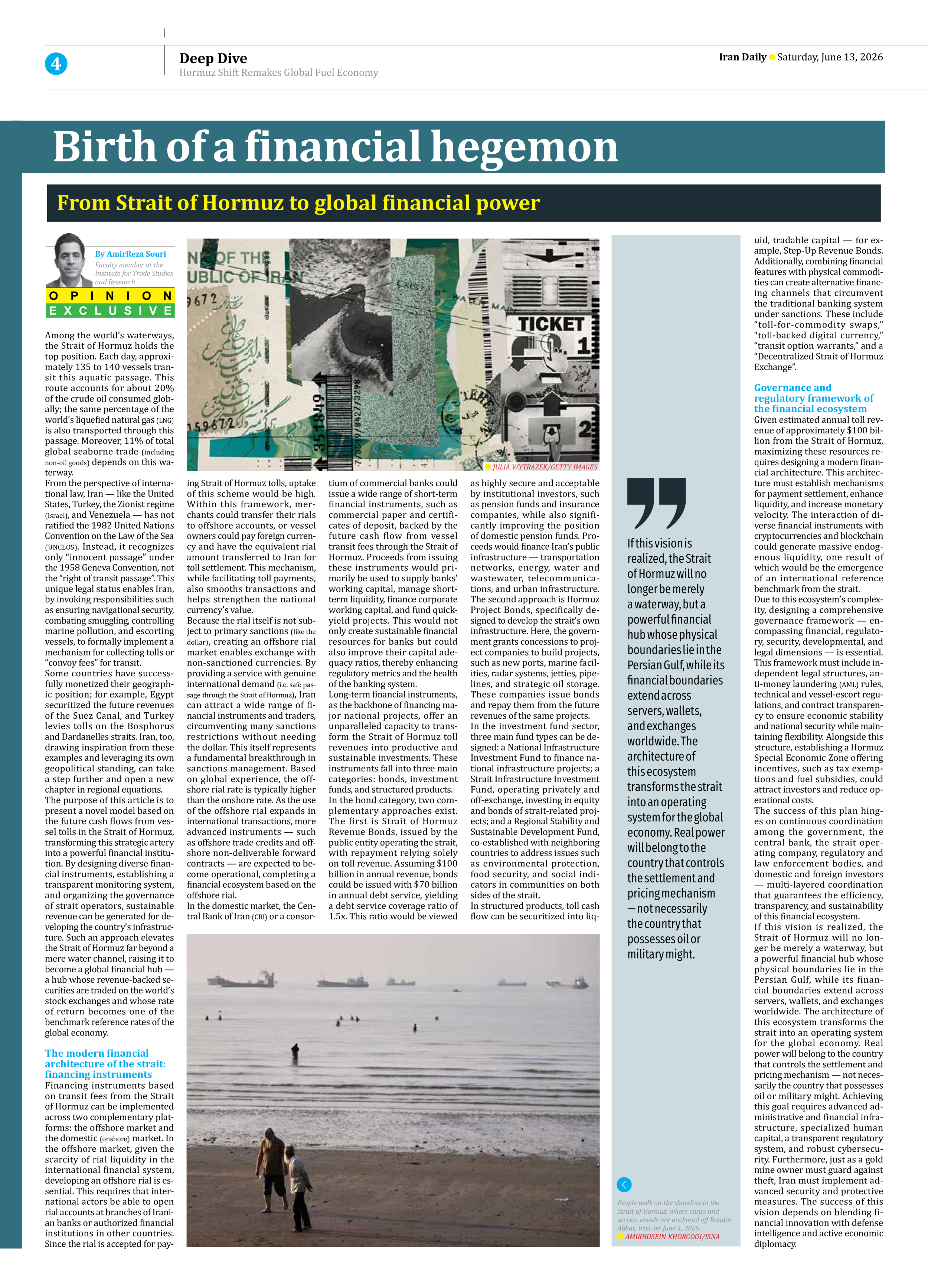


Birth of a financial hegemon
From Strait of Hormuz to global financial power
By AmirReza Souri
Faculty member at the Institute for Trade Studies and Research
Among the world’s waterways, the Strait of Hormuz holds the top position. Each day, approximately 135 to 140 vessels transit this aquatic passage. This route accounts for about 20% of the crude oil consumed globally; the same percentage of the world’s liquefied natural gas (LNG) is also transported through this passage. Moreover, 11% of total global seaborne trade (including non-oil goods) depends on this waterway.
From the perspective of international law, Iran — like the United States, Turkey, the Zionist regime (Israel), and Venezuela — has not ratified the 1982 United Nations Convention on the Law of the Sea (UNCLOS). Instead, it recognizes only “innocent passage” under the 1958 Geneva Convention, not the “right of transit passage”. This unique legal status enables Iran, by invoking responsibilities such as ensuring navigational security, combating smuggling, controlling marine pollution, and escorting vessels, to formally implement a mechanism for collecting tolls or “convoy fees” for transit.
Some countries have successfully monetized their geographic position; for example, Egypt securitized the future revenues of the Suez Canal, and Turkey levies tolls on the Bosphorus and Dardanelles straits. Iran, too, drawing inspiration from these examples and leveraging its own geopolitical standing, can take a step further and open a new chapter in regional equations.
The purpose of this article is to present a novel model based on the future cash flows from vessel tolls in the Strait of Hormuz, transforming this strategic artery into a powerful financial institution. By designing diverse financial instruments, establishing a transparent monitoring system, and organizing the governance of strait operators, sustainable revenue can be generated for developing the country’s infrastructure. Such an approach elevates the Strait of Hormuz far beyond a mere water channel, raising it to become a global financial hub — a hub whose revenue-backed securities are traded on the world’s stock exchanges and whose rate of return becomes one of the benchmark reference rates of the global economy.
The modern financial architecture of the strait: financing instruments
Financing instruments based on transit fees from the Strait of Hormuz can be implemented across two complementary platforms: the offshore market and the domestic (onshore) market. In the offshore market, given the scarcity of rial liquidity in the international financial system, developing an offshore rial is essential. This requires that international actors be able to open rial accounts at branches of Iranian banks or authorized financial institutions in other countries. Since the rial is accepted for paying Strait of Hormuz tolls, uptake of this scheme would be high. Within this framework, merchants could transfer their rials to offshore accounts, or vessel owners could pay foreign currency and have the equivalent rial amount transferred to Iran for toll settlement. This mechanism, while facilitating toll payments, also smooths transactions and helps strengthen the national currency’s value.
Because the rial itself is not subject to primary sanctions (like the dollar), creating an offshore rial market enables exchange with non-sanctioned currencies. By providing a service with genuine international demand (i.e. safe passage through the Strait of Hormuz), Iran can attract a wide range of financial instruments and traders, circumventing many sanctions restrictions without needing the dollar. This itself represents a fundamental breakthrough in sanctions management. Based on global experience, the offshore rial rate is typically higher than the onshore rate. As the use of the offshore rial expands in international transactions, more advanced instruments — such as offshore trade credits and offshore non-deliverable forward contracts — are expected to become operational, completing a financial ecosystem based on the offshore rial.
In the domestic market, the Central Bank of Iran (CBI) or a consortium of commercial banks could issue a wide range of short-term financial instruments, such as commercial paper and certificates of deposit, backed by the future cash flow from vessel transit fees through the Strait of Hormuz. Proceeds from issuing these instruments would primarily be used to supply banks’ working capital, manage short-term liquidity, finance corporate working capital, and fund quick-yield projects. This would not only create sustainable financial resources for banks but could also improve their capital adequacy ratios, thereby enhancing regulatory metrics and the health of the banking system.
Long-term financial instruments, as the backbone of financing major national projects, offer an unparalleled capacity to transform the Strait of Hormuz toll revenues into productive and sustainable investments. These instruments fall into three main categories: bonds, investment funds, and structured products.
In the bond category, two complementary approaches exist. The first is Strait of Hormuz Revenue Bonds, issued by the public entity operating the strait, with repayment relying solely on toll revenue. Assuming $100 billion in annual revenue, bonds could be issued with $70 billion in annual debt service, yielding a debt service coverage ratio of 1.5x. This ratio would be viewed as highly secure and acceptable by institutional investors, such as pension funds and insurance companies, while also significantly improving the position of domestic pension funds. Proceeds would finance Iran’s public infrastructure — transportation networks, energy, water and wastewater, telecommunications, and urban infrastructure. The second approach is Hormuz Project Bonds, specifically designed to develop the strait’s own infrastructure. Here, the government grants concessions to project companies to build projects, such as new ports, marine facilities, radar systems, jetties, pipelines, and strategic oil storage. These companies issue bonds and repay them from the future revenues of the same projects.
In the investment fund sector, three main fund types can be designed: a National Infrastructure Investment Fund to finance national infrastructure projects; a Strait Infrastructure Investment Fund, operating privately and off-exchange, investing in equity and bonds of strait-related projects; and a Regional Stability and Sustainable Development Fund, co-established with neighboring countries to address issues such as environmental protection, food security, and social indicators in communities on both sides of the strait.
In structured products, toll cash flow can be securitized into liquid, tradable capital — for example, Step-Up Revenue Bonds. Additionally, combining financial features with physical commodities can create alternative financing channels that circumvent the traditional banking system under sanctions. These include “toll-for-commodity swaps,” “toll-backed digital currency,” “transit option warrants,” and a “Decentralized Strait of Hormuz Exchange”.
Governance and regulatory framework of the financial ecosystem
Given estimated annual toll revenue of approximately $100 billion from the Strait of Hormuz, maximizing these resources requires designing a modern financial architecture. This architecture must establish mechanisms for payment settlement, enhance liquidity, and increase monetary velocity. The interaction of diverse financial instruments with cryptocurrencies and blockchain could generate massive endogenous liquidity, one result of which would be the emergence of an international reference benchmark from the strait.
Due to this ecosystem’s complexity, designing a comprehensive governance framework — encompassing financial, regulatory, security, developmental, and legal dimensions — is essential. This framework must include independent legal structures, anti-money laundering (AML) rules, technical and vessel-escort regulations, and contract transparency to ensure economic stability and national security while maintaining flexibility. Alongside this structure, establishing a Hormuz Special Economic Zone offering incentives, such as tax exemptions and fuel subsidies, could attract investors and reduce operational costs.
The success of this plan hinges on continuous coordination among the government, the central bank, the strait operating company, regulatory and law enforcement bodies, and domestic and foreign investors — multi-layered coordination that guarantees the efficiency, transparency, and sustainability of this financial ecosystem.
If this vision is realized, the Strait of Hormuz will no longer be merely a waterway, but a powerful financial hub whose physical boundaries lie in the Persian Gulf, while its financial boundaries extend across servers, wallets, and exchanges worldwide. The architecture of this ecosystem transforms the strait into an operating system for the global economy. Real power will belong to the country that controls the settlement and pricing mechanism — not necessarily the country that possesses oil or military might. Achieving this goal requires advanced administrative and financial infrastructure, specialized human capital, a transparent regulatory system, and robust cybersecurity. Furthermore, just as a gold mine owner must guard against theft, Iran must implement advanced security and protective measures. The success of this vision depends on blending financial innovation with defense intelligence and active economic diplomacy.