







Iran threatens to suspend World Cup matches over unofficial flags, political chants
Iran will halt matches at the upcoming FIFA World Cup and may refuse to continue playing if unofficial flags are displayed or political chants are heard in the stands, Iranian Sports Minister Ahmad Donyamali has said.
Team Melli will open its Group G campaign at the global showpiece – co-hosted by the United States, Mexico and Canada – against New Zealand on Monday at SoFi Stadium in Los Angeles, California, home to a large Iranian diaspora community. Iran will then face Belgium at the same venue six days later before taking on Egypt at Lumen Field in Seattle, Washington, on June 26.
"We have made it clear that if, in any stadium where we play, we see a flag or symbol other than our own national flag, or hear chants that violate accepted norms, the team manager is bound to halt the match," Donyamali said, referring to the Lion and Sun flag – Iran's national flag before the 1979 Islamic Revolution – as well as possible pro-monarchy chants directed against the Islamic Republic.
"It is the responsibility of the organizers to address and rectify such situations. The security apparatus overseeing the competition is responsible for ensuring suitable conditions for our team and, if necessary, suspending the game. Until these issues are resolved, we reserve the right not to continue playing. I hope such incidents do not occur, as we have been assured that all requirements and regulations will be fully observed," the minister added.
The Iranian national team has faced a series of obstacles in the buildup to what is arguably the most politically charged event in the country's sporting history, as it will be the first FIFA World Cup hosted by a nation receiving the team of a country with which it is at war.
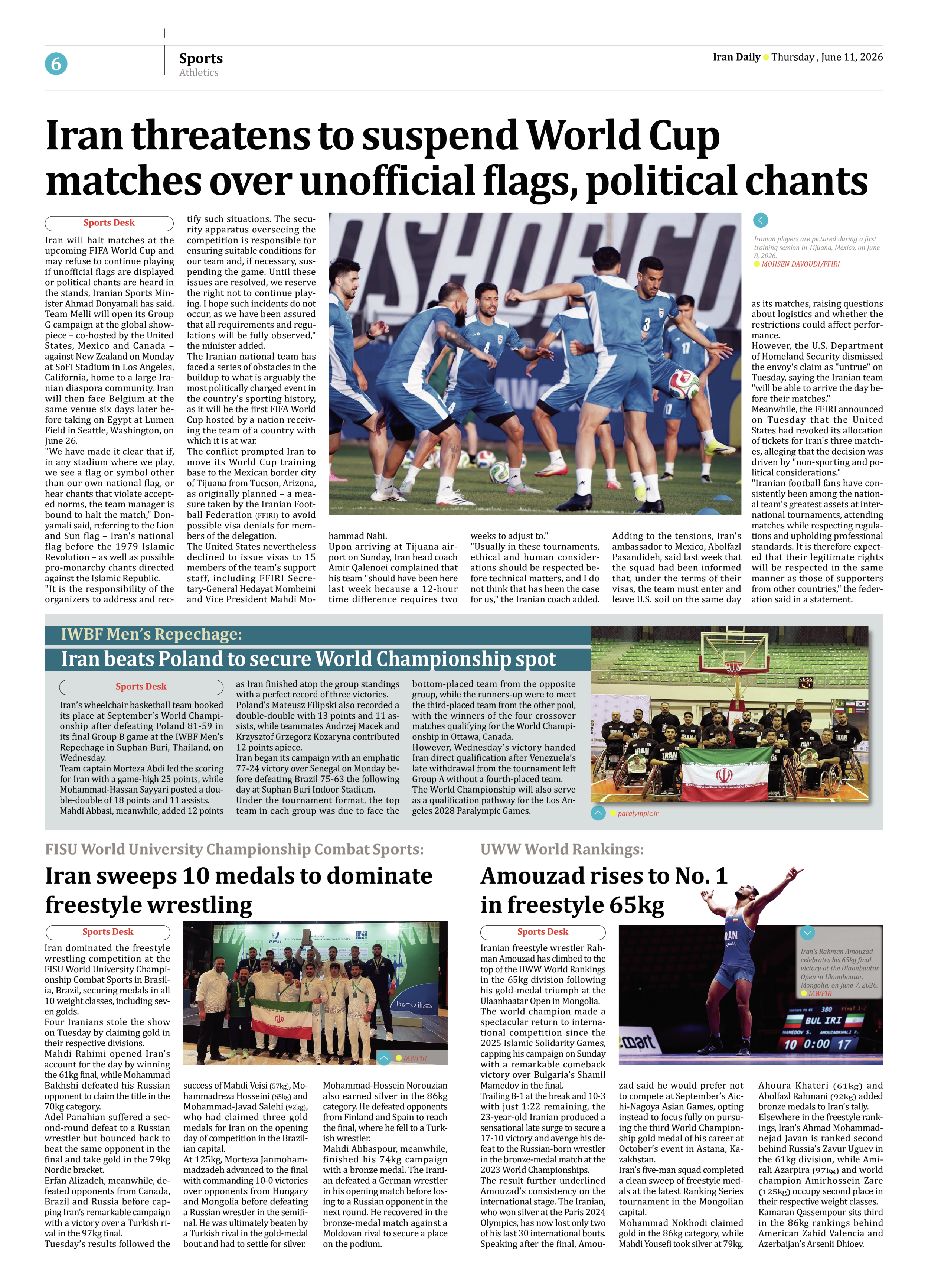
The conflict prompted Iran to move its World Cup training base to the Mexican border city of Tijuana from Tucson, Arizona, as originally planned – a measure taken by the Iranian Football Federation (FFIRI) to avoid possible visa denials for members of the delegation.
The United States nevertheless declined to issue visas to 15 members of the team's support staff, including FFIRI Secretary-General Hedayat Mombeini and Vice President Mahdi Mohammad Nabi.
Upon arriving at Tijuana airport on Sunday, Iran head coach Amir Qalenoei complained that his team "should have been here last week because a 12-hour time difference requires two weeks to adjust to."
"Usually in these tournaments, ethical and human considerations should be respected before technical matters, and I do not think that has been the case for us," the Iranian coach added.
Adding to the tensions, Iran's ambassador to Mexico, Abolfazl Pasandideh, said last week that the squad had been informed that, under the terms of their visas, the team must enter and leave U.S. soil on the same day as its matches, raising questions about logistics and whether the restrictions could affect performance.
However, the U.S. Department of Homeland Security dismissed the envoy's claim as "untrue" on Tuesday, saying the Iranian team "will be able to arrive the day before their matches."
Meanwhile, the FFIRI announced on Tuesday that the United States had revoked its allocation of tickets for Iran's three matches, alleging that the decision was driven by "non-sporting and political considerations."
"Iranian football fans have consistently been among the national team's greatest assets at international tournaments, attending matches while respecting regulations and upholding professional standards. It is therefore expected that their legitimate rights will be respected in the same manner as those of supporters from other countries," the federation said in a statement.