







‘We are upset’: Iran players hit out at US visa delay after World Cup arrival
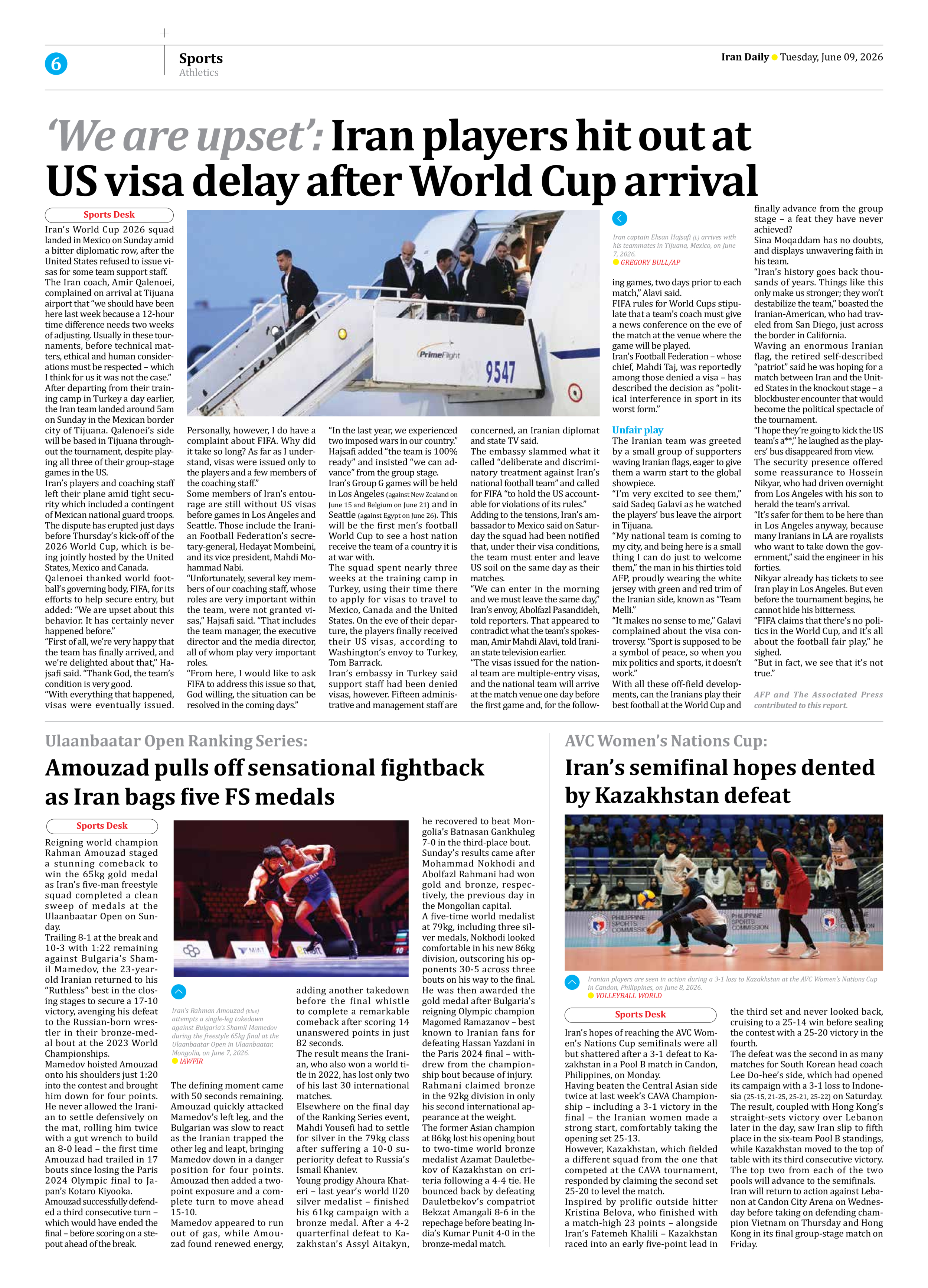
Iran’s World Cup 2026 squad landed in Mexico on Sunday amid a bitter diplomatic row, after the United States refused to issue visas for some team support staff.
The Iran coach, Amir Qalenoei, complained on arrival at Tijuana airport that “we should have been here last week because a 12-hour time difference needs two weeks of adjusting. Usually in these tournaments, before technical matters, ethical and human considerations must be respected – which I think for us it was not the case.”
After departing from their training camp in Turkey a day earlier, the Iran team landed around 5am on Sunday in the Mexican border city of Tijuana. Qalenoei’s side will be based in Tijuana throughout the tournament, despite playing all three of their group-stage games in the US.
Iran’s players and coaching staff left their plane amid tight security which included a contingent of Mexican national guard troops.
The dispute has erupted just days before Thursday’s kick-off of the 2026 World Cup, which is being jointly hosted by the United States, Mexico and Canada.
Qalenoei thanked world football’s governing body, FIFA, for its efforts to help secure entry, but added: “We are upset about this behavior. It has certainly never happened before.”
“First of all, we’re very happy that the team has finally arrived, and we’re delighted about that,” Hajsafi said. “Thank God, the team’s condition is very good.
“With everything that happened, visas were eventually issued. Personally, however, I do have a complaint about FIFA. Why did it take so long? As far as I understand, visas were issued only to the players and a few members of the coaching staff.”
Some members of Iran’s entourage are still without US visas before games in Los Angeles and Seattle. Those include the Iranian Football Federation’s secretary-general, Hedayat Mombeini, and its vice president, Mahdi Mohammad Nabi.
“Unfortunately, several key members of our coaching staff, whose roles are very important within the team, were not granted visas,” Hajsafi said. “That includes the team manager, the executive director and the media director, all of whom play very important roles.
“From here, I would like to ask FIFA to address this issue so that, God willing, the situation can be resolved in the coming days.”
“In the last year, we experienced two imposed wars in our country.” Hajsafi added “the team is 100% ready” and insisted “we can advance” from the group stage.
Iran’s Group G games will be held in Los Angeles (against New Zealand on June 15 and Belgium on June 21) and in Seattle (against Egypt on June 26). This will be the first men’s football World Cup to see a host nation receive the team of a country it is at war with.
The squad spent nearly three weeks at the training camp in Turkey, using their time there to apply for visas to travel to Mexico, Canada and the United States. On the eve of their departure, the players finally received their US visas, according to Washington’s envoy to Turkey, Tom Barrack.
Iran’s embassy in Turkey said support staff had been denied visas, however. Fifteen administrative and management staff are concerned, an Iranian diplomat and state TV said.
The embassy slammed what it called “deliberate and discriminatory treatment against Iran’s national football team” and called for FIFA “to hold the US accountable for violations of its rules.”
Adding to the tensions, Iran’s ambassador to Mexico said on Saturday the squad had been notified that, under their visa conditions, the team must enter and leave US soil on the same day as their matches.
“We can enter in the morning and we must leave the same day,” Iran’s envoy, Abolfazl Pasandideh, told reporters. That appeared to contradict what the team’s spokesman, Amir Mahdi Alavi, told Iranian state television earlier.
“The visas issued for the national team are multiple-entry visas, and the national team will arrive at the match venue one day before the first game and, for the following games, two days prior to each match,” Alavi said.
FIFA rules for World Cups stipulate that a team’s coach must give a news conference on the eve of the match at the venue where the game will be played.
Iran’s Football Federation – whose chief, Mahdi Taj, was reportedly among those denied a visa – has described the decision as “political interference in sport in its worst form.”
Unfair play
The Iranian team was greeted by a small group of supporters waving Iranian flags, eager to give them a warm start to the global showpiece.
“I’m very excited to see them,” said Sadeq Galavi as he watched the players’ bus leave the airport in Tijuana.
“My national team is coming to my city, and being here is a small thing I can do just to welcome them,” the man in his thirties told AFP, proudly wearing the white jersey with green and red trim of the Iranian side, known as “Team Melli.”
“It makes no sense to me,” Galavi complained about the visa controversy. “Sport is supposed to be a symbol of peace, so when you mix politics and sports, it doesn’t work.”
With all these off-field developments, can the Iranians play their best football at the World Cup and finally advance from the group stage – a feat they have never achieved?
Sina Moqaddam has no doubts, and displays unwavering faith in his team.
“Iran’s history goes back thousands of years. Things like this only make us stronger; they won’t destabilize the team,” boasted the Iranian-American, who had traveled from San Diego, just across the border in California.
Waving an enormous Iranian flag, the retired self-described “patriot” said he was hoping for a match between Iran and the United States in the knockout stage – a blockbuster encounter that would become the political spectacle of the tournament.
“I hope they’re going to kick the US team’s a**,” he laughed as the players’ bus disappeared from view.
The security presence offered some reassurance to Hossein Nikyar, who had driven overnight from Los Angeles with his son to herald the team’s arrival.
“It’s safer for them to be here than in Los Angeles anyway, because many Iranians in LA are royalists who want to take down the government,” said the engineer in his forties.
Nikyar already has tickets to see Iran play in Los Angeles. But even before the tournament begins, he cannot hide his bitterness.
“FIFA claims that there’s no politics in the World Cup, and it’s all about the football fair play,” he sighed.
“But in fact, we see that it’s not true.”
AFP and The Associated Press
contributed to this report.