





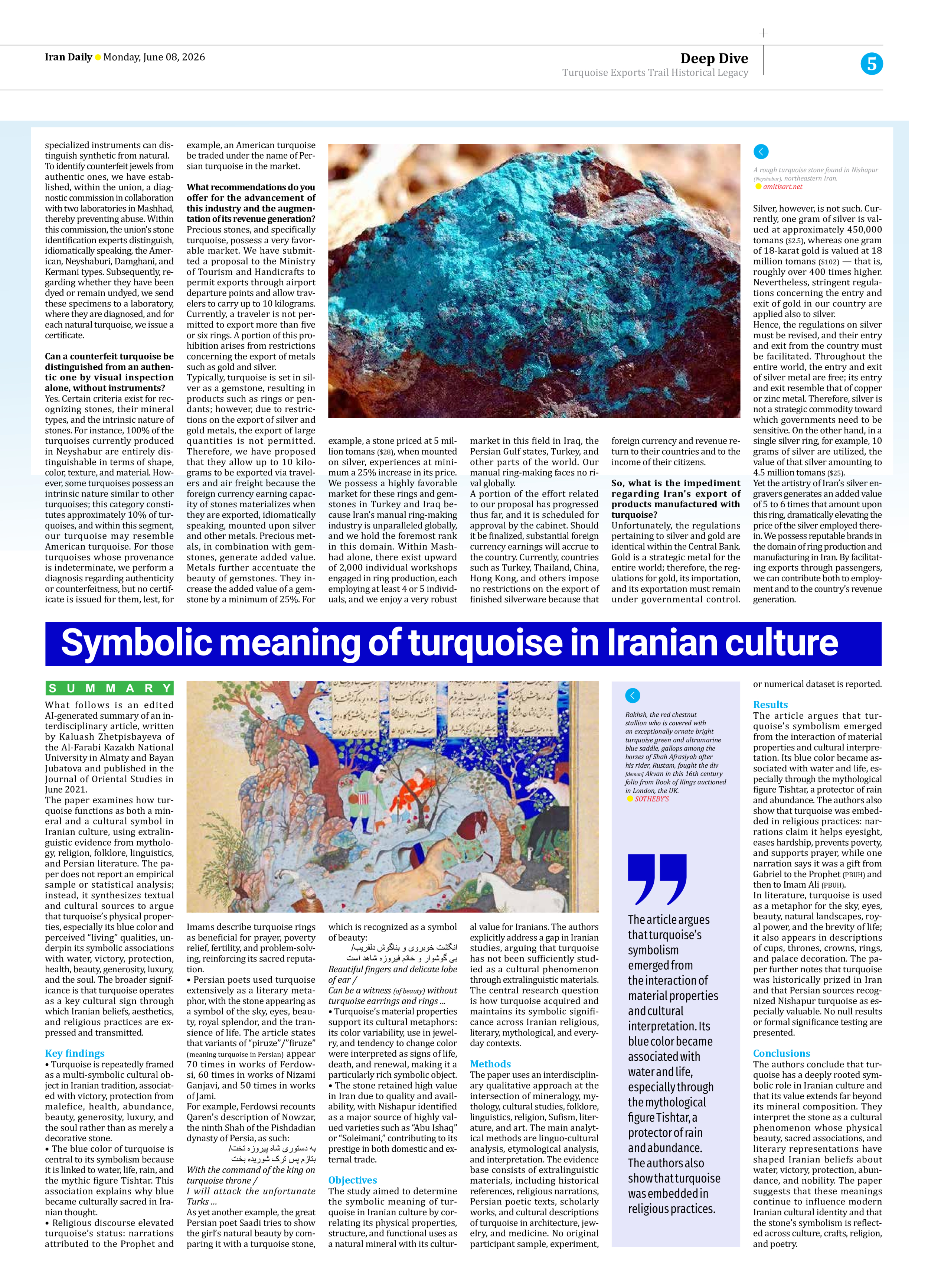


Symbolic meaning of turquoise in Iranian culture
What follows is an edited AI-generated summary of an interdisciplinary article, written by Kaluash Zhetpisbayeva of the Al-Farabi Kazakh National University in Almaty and Bayan Jubatova and published in the Journal of Oriental Studies in June 2021.
The paper examines how turquoise functions as both a mineral and a cultural symbol in Iranian culture, using extralinguistic evidence from mythology, religion, folklore, linguistics, and Persian literature. The paper does not report an empirical sample or statistical analysis; instead, it synthesizes textual and cultural sources to argue that turquoise’s physical properties, especially its blue color and perceived “living” qualities, underpin its symbolic associations with water, victory, protection, health, beauty, generosity, luxury, and the soul. The broader significance is that turquoise operates as a key cultural sign through which Iranian beliefs, aesthetics, and religious practices are expressed and transmitted.
Key findings
• Turquoise is repeatedly framed as a multi-symbolic cultural object in Iranian tradition, associated with victory, protection from malefice, health, abundance, beauty, generosity, luxury, and the soul rather than as merely a decorative stone.
• The blue color of turquoise is central to its symbolism because it is linked to water, life, rain, and the mythic figure Tishtar. This association explains why blue became culturally sacred in Iranian thought.
• Religious discourse elevated turquoise’s status: narrations attributed to the Prophet and Imams describe turquoise rings as beneficial for prayer, poverty relief, fertility, and problem-solving, reinforcing its sacred reputation.
• Persian poets used turquoise extensively as a literary metaphor, with the stone appearing as a symbol of the sky, eyes, beauty, royal splendor, and the transience of life. The article states that variants of “piruze”/”firuze” (meaning turquoise in Persian) appear 70 times in works of Ferdowsi, 60 times in works of Nizami Ganjavi, and 50 times in works of Jami.
For example, Ferdowsi recounts Qaren’s description of Nowzar, the ninth Shah of the Pishdadian dynasty of Persia, as such:
/بھ دستوری شاه پیروزه تخت
بتازم پس ترک شوریده بخت
With the command of the king on turquoise throne /
I will attack the unfortunate Turks …
As yet another example, the great Persian poet Saadi tries to show the girl’s natural beauty by comparing it with a turquoise stone, which is recognized as a symbol of beauty:
/انگشت خوبروی و بناگوش دلفریب
بی گوشوار و خاتم فیروزه شاھد است
Beautiful fingers and delicate lobe of ear /
Can be a witness (of beauty) without turquoise earrings and rings ...
• Turquoise’s material properties support its cultural metaphors: its color variability, use in jewelry, and tendency to change color were interpreted as signs of life, death, and renewal, making it a particularly rich symbolic object.
• The stone retained high value in Iran due to quality and availability, with Nishapur identified as a major source of highly valued varieties such as “Abu Ishaq” or “Soleimani,” contributing to its prestige in both domestic and external trade.
Objectives
The study aimed to determine the symbolic meaning of turquoise in Iranian culture by correlating its physical properties, structure, and functional uses as a natural mineral with its cultural value for Iranians. The authors explicitly address a gap in Iranian studies, arguing that turquoise has not been sufficiently studied as a cultural phenomenon through extralinguistic materials. The central research question is how turquoise acquired and maintains its symbolic significance across Iranian religious, literary, mythological, and everyday contexts.
Methods
The paper uses an interdisciplinary qualitative approach at the intersection of mineralogy, mythology, cultural studies, folklore, linguistics, religion, Sufism, literature, and art. The main analytical methods are linguo-cultural analysis, etymological analysis, and interpretation. The evidence base consists of extralinguistic materials, including historical references, religious narrations, Persian poetic texts, scholarly works, and cultural descriptions of turquoise in architecture, jewelry, and medicine. No original participant sample, experiment, or numerical dataset is reported.
Results
The article argues that turquoise’s symbolism emerged from the interaction of material properties and cultural interpretation. Its blue color became associated with water and life, especially through the mythological figure Tishtar, a protector of rain and abundance. The authors also show that turquoise was embedded in religious practices: narrations claim it helps eyesight, eases hardship, prevents poverty, and supports prayer, while one narration says it was a gift from Gabriel to the Prophet (PBUH) and then to Imam Ali (PBUH).
In literature, turquoise is used as a metaphor for the sky, eyes, beauty, natural landscapes, royal power, and the brevity of life; it also appears in descriptions of cups, thrones, crowns, rings, and palace decoration. The paper further notes that turquoise was historically prized in Iran and that Persian sources recognized Nishapur turquoise as especially valuable. No null results or formal significance testing are presented.
Conclusions
The authors conclude that turquoise has a deeply rooted symbolic role in Iranian culture and that its value extends far beyond its mineral composition. They interpret the stone as a cultural phenomenon whose physical beauty, sacred associations, and literary representations have shaped Iranian beliefs about water, victory, protection, abundance, and nobility. The paper suggests that these meanings continue to influence modern Iranian cultural identity and that the stone’s symbolism is reflected across culture, crafts, religion, and poetry.