





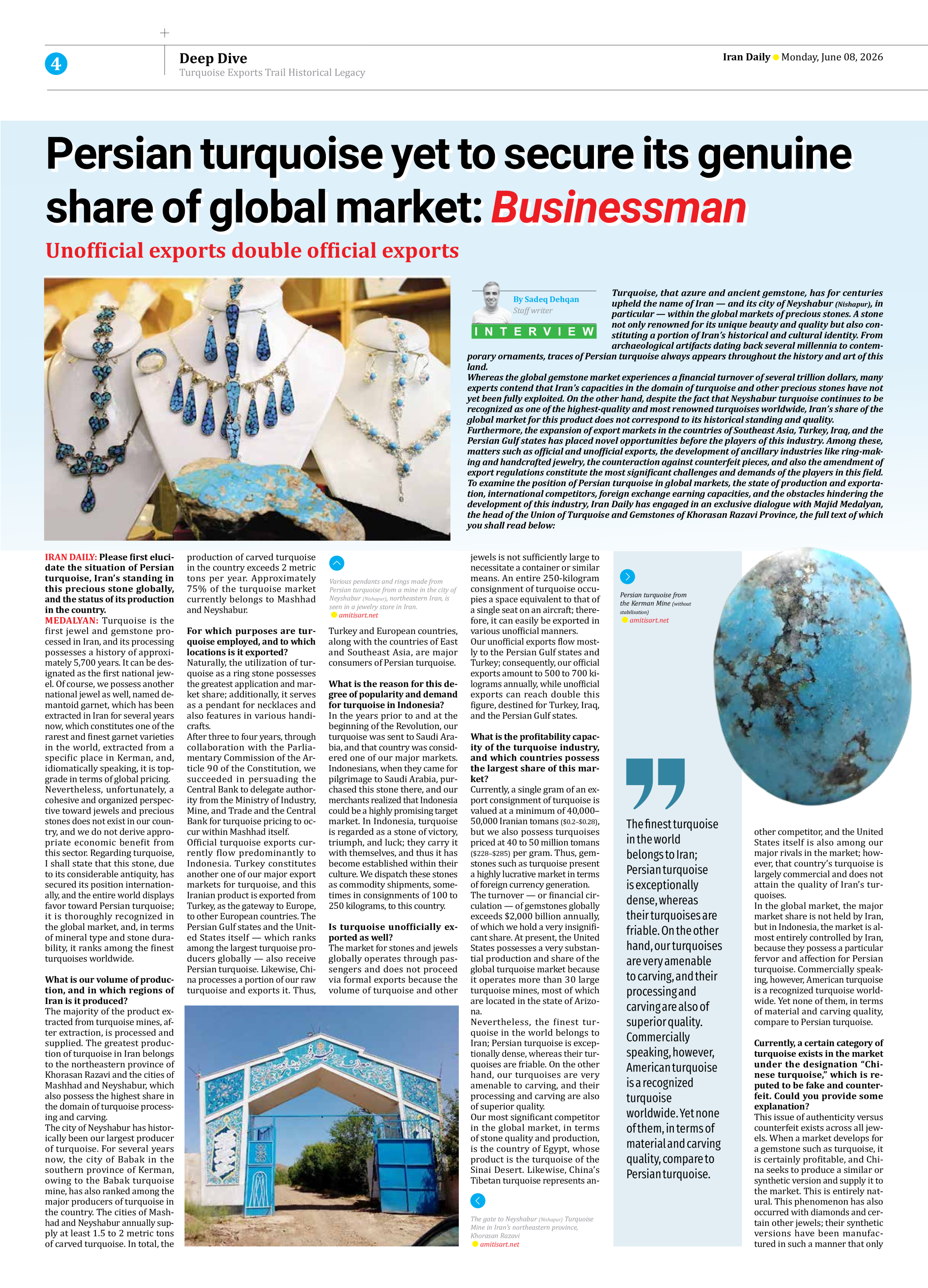


Persian turquoise yet to secure its genuine share of global market: Businessman
Unofficial exports double official exports
Turquoise, that azure and ancient gemstone, has for centuries upheld the name of Iran — and its city of Neyshabur (Nishapur), in particular — within the global markets of precious stones. A stone not only renowned for its unique beauty and quality but also constituting a portion of Iran’s historical and cultural identity. From archaeological artifacts dating back several millennia to contemporary ornaments, traces of Persian turquoise always appears throughout the history and art of this land. Whereas the global gemstone market experiences a financial turnover of several trillion dollars, many experts contend that Iran’s capacities in the domain of turquoise and other precious stones have not yet been fully exploited. On the other hand, despite the fact that Neyshabur turquoise continues to be recognized as one of the highest-quality and most renowned turquoises worldwide, Iran’s share of the global market for this product does not correspond to its historical standing and quality. Furthermore, the expansion of export markets in the countries of Southeast Asia, Turkey, Iraq, and the Persian Gulf states has placed novel opportunities before the players of this industry. Among these, matters such as official and unofficial exports, the development of ancillary industries like ring-making and handcrafted jewelry, the counteraction against counterfeit pieces, and also the amendment of export regulations constitute the most significant challenges and demands of the players in this field. To examine the position of Persian turquoise in global markets, the state of production and exportation, international competitors, foreign exchange earning capacities, and the obstacles hindering the development of this industry, Iran Daily has engaged in an exclusive dialogue with Majid Medalyan, the head of the Union of Turquoise and Gemstones of Khorasan Razavi Province, the full text of which you shall read below:
By Sadeq Dehqan
Staff writer
IRAN DAILY: Please first elucidate the situation of Persian turquoise, Iran’s standing in this precious stone globally, and the status of its production in the country.
MEDALYAN: Turquoise is the first jewel and gemstone processed in Iran, and its processing possesses a history of approximately 5,700 years. It can be designated as the first national jewel. Of course, we possess another national jewel as well, named demantoid garnet, which has been extracted in Iran for several years now, which constitutes one of the rarest and finest garnet varieties in the world, extracted from a specific place in Kerman, and, idiomatically speaking, it is top-grade in terms of global pricing.
Nevertheless, unfortunately, a cohesive and organized perspective toward jewels and precious stones does not exist in our country, and we do not derive appropriate economic benefit from this sector. Regarding turquoise, I shall state that this stone, due to its considerable antiquity, has secured its position internationally, and the entire world displays favor toward Persian turquoise; it is thoroughly recognized in the global market, and, in terms of mineral type and stone durability, it ranks among the finest turquoises worldwide.
What is our volume of production, and in which regions of Iran is it produced?
The majority of the product extracted from turquoise mines, after extraction, is processed and supplied. The greatest production of turquoise in Iran belongs to the northeastern province of Khorasan Razavi and the cities of Mashhad and Neyshabur, which also possess the highest share in the domain of turquoise processing and carving.
The city of Neyshabur has historically been our largest producer of turquoise. For several years now, the city of Babak in the southern province of Kerman, owing to the Babak turquoise mine, has also ranked among the major producers of turquoise in the country. The cities of Mashhad and Neyshabur annually supply at least 1.5 to 2 metric tons of carved turquoise. In total, the production of carved turquoise in the country exceeds 2 metric tons per year. Approximately 75% of the turquoise market currently belongs to Mashhad and Neyshabur.
For which purposes are turquoise employed, and to which locations is it exported?
Naturally, the utilization of turquoise as a ring stone possesses the greatest application and market share; additionally, it serves as a pendant for necklaces and also features in various handicrafts.
After three to four years, through collaboration with the Parliamentary Commission of the Article 90 of the Constitution, we succeeded in persuading the Central Bank to delegate authority from the Ministry of Industry, Mine, and Trade and the Central Bank for turquoise pricing to occur within Mashhad itself.
Official turquoise exports currently flow predominantly to Indonesia. Turkey constitutes another one of our major export markets for turquoise, and this Iranian product is exported from Turkey, as the gateway to Europe, to other European countries. The Persian Gulf states and the United States itself — which ranks among the largest turquoise producers globally — also receive Persian turquoise. Likewise, China processes a portion of our raw turquoise and exports it. Thus, Turkey and European countries, along with the countries of East and Southeast Asia, are major consumers of Persian turquoise.
What is the reason for this degree of popularity and demand for turquoise in Indonesia?
In the years prior to and at the beginning of the Revolution, our turquoise was sent to Saudi Arabia, and that country was considered one of our major markets. Indonesians, when they came for pilgrimage to Saudi Arabia, purchased this stone there, and our merchants realized that Indonesia could be a highly promising target market. In Indonesia, turquoise is regarded as a stone of victory, triumph, and luck; they carry it with themselves, and thus it has become established within their culture. We dispatch these stones as commodity shipments, sometimes in consignments of 100 to 250 kilograms, to this country.
Is turquoise unofficially exported as well?
The market for stones and jewels globally operates through passengers and does not proceed via formal exports because the volume of turquoise and other jewels is not sufficiently large to necessitate a container or similar means. An entire 250-kilogram consignment of turquoise occupies a space equivalent to that of a single seat on an aircraft; therefore, it can easily be exported in various unofficial manners.
Our unofficial exports flow mostly to the Persian Gulf states and Turkey; consequently, our official exports amount to 500 to 700 kilograms annually, while unofficial exports can reach double this figure, destined for Turkey, Iraq, and the Persian Gulf states.
What is the profitability capacity of the turquoise industry, and which countries possess the largest share of this market?
Currently, a single gram of an export consignment of turquoise is valued at a minimum of 40,000–50,000 Iranian tomans ($0.2–$0.28), but we also possess turquoises priced at 40 to 50 million tomans ($228–$285) per gram. Thus, gemstones such as turquoise present a highly lucrative market in terms of foreign currency generation.
The turnover — or financial circulation — of gemstones globally exceeds $2,000 billion annually, of which we hold a very insignificant share. At present, the United States possesses a very substantial production and share of the global turquoise market because it operates more than 30 large turquoise mines, most of which are located in the state of Arizona.
Nevertheless, the finest turquoise in the world belongs to Iran; Persian turquoise is exceptionally dense, whereas their turquoises are friable. On the other hand, our turquoises are very amenable to carving, and their processing and carving are also of superior quality.
Our most significant competitor in the global market, in terms of stone quality and production, is the country of Egypt, whose product is the turquoise of the Sinai Desert. Likewise, China’s Tibetan turquoise represents another competitor, and the United States itself is also among our major rivals in the market; however, that country’s turquoise is largely commercial and does not attain the quality of Iran’s turquoises.
In the global market, the major market share is not held by Iran, but in Indonesia, the market is almost entirely controlled by Iran, because they possess a particular fervor and affection for Persian turquoise. Commercially speaking, however, American turquoise is a recognized turquoise worldwide. Yet none of them, in terms of material and carving quality, compare to Persian turquoise.
Currently, a certain category of turquoise exists in the market under the designation “Chinese turquoise,” which is reputed to be fake and counterfeit. Could you provide some explanation?
This issue of authenticity versus counterfeit exists across all jewels. When a market develops for a gemstone such as turquoise, it is certainly profitable, and China seeks to produce a similar or synthetic version and supply it to the market. This is entirely natural. This phenomenon has also occurred with diamonds and certain other jewels; their synthetic versions have been manufactured in such a manner that only specialized instruments can distinguish synthetic from natural.
To identify counterfeit jewels from authentic ones, we have established, within the union, a diagnostic commission in collaboration with two laboratories in Mashhad, thereby preventing abuse. Within this commission, the union’s stone identification experts distinguish, idiomatically speaking, the American, Neyshaburi, Damghani, and Kermani types. Subsequently, regarding whether they have been dyed or remain undyed, we send these specimens to a laboratory, where they are diagnosed, and for each natural turquoise, we issue a certificate.
Can a counterfeit turquoise be distinguished from an authentic one by visual inspection alone, without instruments?
Yes. Certain criteria exist for recognizing stones, their mineral types, and the intrinsic nature of stones. For instance, 100% of the turquoises currently produced in Neyshabur are entirely distinguishable in terms of shape, color, texture, and material. However, some turquoises possess an intrinsic nature similar to other turquoises; this category constitutes approximately 10% of turquoises, and within this segment, our turquoise may resemble American turquoise. For those turquoises whose provenance is indeterminate, we perform a diagnosis regarding authenticity or counterfeitness, but no certificate is issued for them, lest, for example, an American turquoise be traded under the name of Persian turquoise in the market.
What recommendations do you offer for the advancement of this industry and the augmentation of its revenue generation?
Precious stones, and specifically turquoise, possess a very favorable market. We have submitted a proposal to the Ministry of Tourism and Handicrafts to permit exports through airport departure points and allow travelers to carry up to 10 kilograms. Currently, a traveler is not permitted to export more than five or six rings. A portion of this prohibition arises from restrictions concerning the export of metals such as gold and silver.
Typically, turquoise is set in silver as a gemstone, resulting in products such as rings or pendants; however, due to restrictions on the export of silver and gold metals, the export of large quantities is not permitted. Therefore, we have proposed that they allow up to 10 kilograms to be exported via travelers and air freight because the foreign currency earning capacity of stones materializes when they are exported, idiomatically speaking, mounted upon silver and other metals. Precious metals, in combination with gemstones, generate added value. Metals further accentuate the beauty of gemstones. They increase the added value of a gemstone by a minimum of 25%. For example, a stone priced at 5 million tomans ($28), when mounted on silver, experiences at minimum a 25% increase in its price.
We possess a highly favorable market for these rings and gemstones in Turkey and Iraq because Iran’s manual ring-making industry is unparalleled globally, and we hold the foremost rank in this domain. Within Mashhad alone, there exist upward of 2,000 individual workshops engaged in ring production, each employing at least 4 or 5 individuals, and we enjoy a very robust market in this field in Iraq, the Persian Gulf states, Turkey, and other parts of the world. Our manual ring-making faces no rival globally.
A portion of the effort related to our proposal has progressed thus far, and it is scheduled for approval by the cabinet. Should it be finalized, substantial foreign currency earnings will accrue to the country. Currently, countries such as Turkey, Thailand, China, Hong Kong, and others impose no restrictions on the export of finished silverware because that foreign currency and revenue return to their countries and to the income of their citizens.
So, what is the impediment regarding Iran’s export of products manufactured with turquoise?
Unfortunately, the regulations pertaining to silver and gold are identical within the Central Bank. Gold is a strategic metal for the entire world; therefore, the regulations for gold, its importation, and its exportation must remain under governmental control. Silver, however, is not such. Currently, one gram of silver is valued at approximately 450,000 tomans ($2.5), whereas one gram of 18-karat gold is valued at 18 million tomans ($102) — that is, roughly over 400 times higher. Nevertheless, stringent regulations concerning the entry and exit of gold in our country are applied also to silver.
Hence, the regulations on silver must be revised, and their entry and exit from the country must be facilitated. Throughout the entire world, the entry and exit of silver metal are free; its entry and exit resemble that of copper or zinc metal. Therefore, silver is not a strategic commodity toward which governments need to be sensitive. On the other hand, in a single silver ring, for example, 10 grams of silver are utilized, the value of that silver amounting to 4.5 million tomans ($25).
Yet the artistry of Iran’s silver engravers generates an added value of 5 to 6 times that amount upon this ring, dramatically elevating the price of the silver employed therein. We possess reputable brands in the domain of ring production and manufacturing in Iran. By facilitating exports through passengers, we can contribute both to employment and to the country’s revenue generation.