





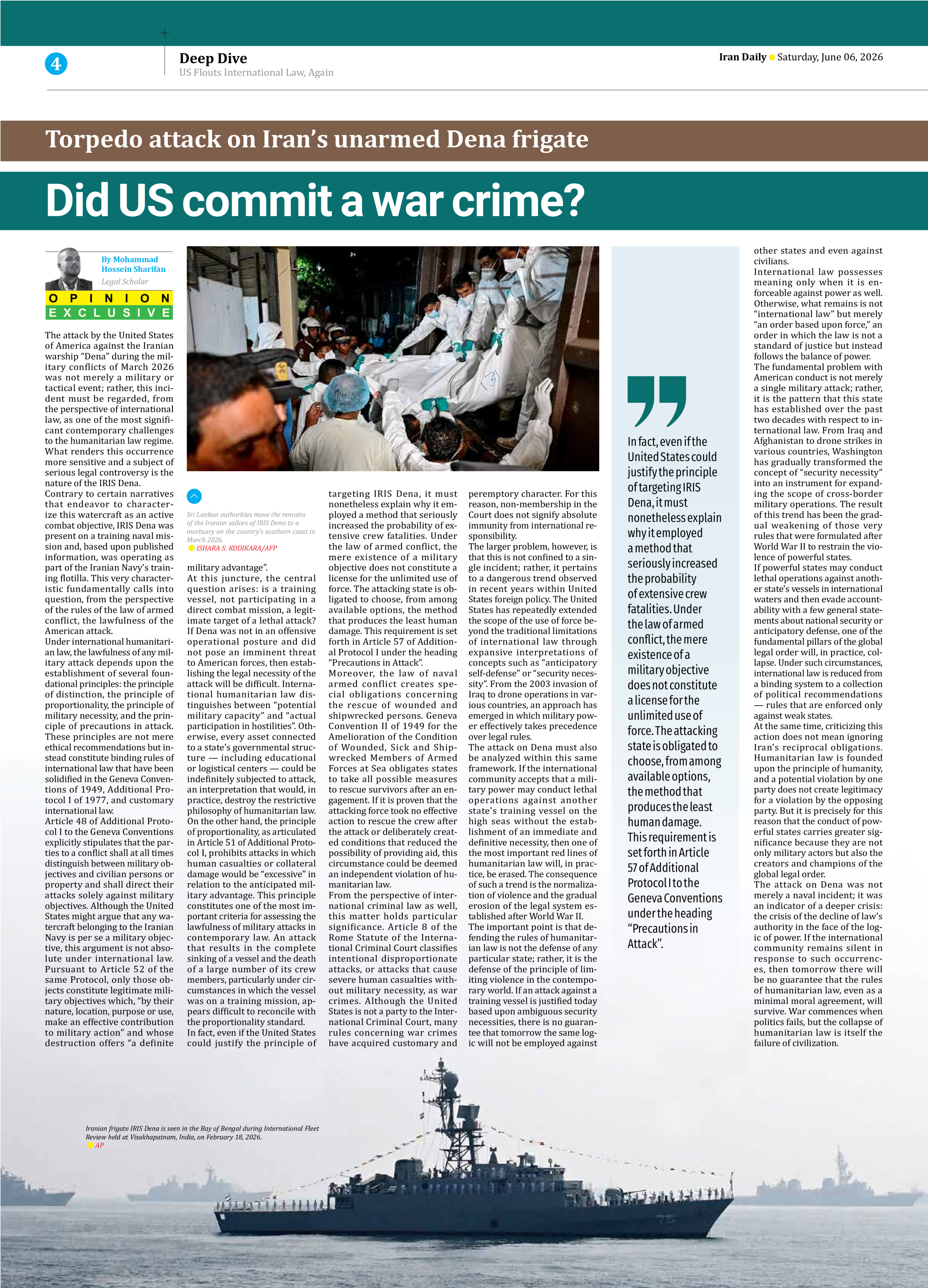


Torpedo attack on Iran’s unarmed Dena frigate
Did US commit a war crime?
By Mohammad Hossein Sharifan
Legal Scholar
The attack by the United States of America against the Iranian warship “Dena” during the military conflicts of March 2026 was not merely a military or tactical event; rather, this incident must be regarded, from the perspective of international law, as one of the most significant contemporary challenges to the humanitarian law regime. What renders this occurrence more sensitive and a subject of serious legal controversy is the nature of the IRIS Dena.
Contrary to certain narratives that endeavor to characterize this watercraft as an active combat objective, IRIS Dena was present on a training naval mission and, based upon published information, was operating as part of the Iranian Navy’s training flotilla. This very characteristic fundamentally calls into question, from the perspective of the rules of the law of armed conflict, the lawfulness of the American attack.
Under international humanitarian law, the lawfulness of any military attack depends upon the establishment of several foundational principles: the principle of distinction, the principle of proportionality, the principle of military necessity, and the principle of precautions in attack. These principles are not mere ethical recommendations but instead constitute binding rules of international law that have been solidified in the Geneva Conventions of 1949, Additional Protocol I of 1977, and customary international law.
Article 48 of Additional Protocol I to the Geneva Conventions explicitly stipulates that the parties to a conflict shall at all times distinguish between military objectives and civilian persons or property and shall direct their attacks solely against military objectives. Although the United States might argue that any watercraft belonging to the Iranian Navy is per se a military objective, this argument is not absolute under international law. Pursuant to Article 52 of the same Protocol, only those objects constitute legitimate military objectives which, “by their nature, location, purpose or use, make an effective contribution to military action” and whose destruction offers “a definite military advantage”.
At this juncture, the central question arises: is a training vessel, not participating in a direct combat mission, a legitimate target of a lethal attack? If Dena was not in an offensive operational posture and did not pose an imminent threat to American forces, then establishing the legal necessity of the attack will be difficult. International humanitarian law distinguishes between “potential military capacity” and “actual participation in hostilities”. Otherwise, every asset connected to a state’s governmental structure — including educational or logistical centers — could be indefinitely subjected to attack, an interpretation that would, in practice, destroy the restrictive philosophy of humanitarian law.
On the other hand, the principle of proportionality, as articulated in Article 51 of Additional Protocol I, prohibits attacks in which human casualties or collateral damage would be “excessive” in relation to the anticipated military advantage. This principle constitutes one of the most important criteria for assessing the lawfulness of military attacks in contemporary law. An attack that results in the complete sinking of a vessel and the death of a large number of its crew members, particularly under circumstances in which the vessel was on a training mission, appears difficult to reconcile with the proportionality standard.
In fact, even if the United States could justify the principle of targeting IRIS Dena, it must nonetheless explain why it employed a method that seriously increased the probability of extensive crew fatalities. Under the law of armed conflict, the mere existence of a military objective does not constitute a license for the unlimited use of force. The attacking state is obligated to choose, from among available options, the method that produces the least human damage. This requirement is set forth in Article 57 of Additional Protocol I under the heading “Precautions in Attack”.
Moreover, the law of naval armed conflict creates special obligations concerning the rescue of wounded and shipwrecked persons. Geneva Convention II of 1949 for the Amelioration of the Condition of Wounded, Sick and Shipwrecked Members of Armed Forces at Sea obligates states to take all possible measures to rescue survivors after an engagement. If it is proven that the attacking force took no effective action to rescue the crew after the attack or deliberately created conditions that reduced the possibility of providing aid, this circumstance could be deemed an independent violation of humanitarian law.
From the perspective of international criminal law as well, this matter holds particular significance. Article 8 of the Rome Statute of the International Criminal Court classifies intentional disproportionate attacks, or attacks that cause severe human casualties without military necessity, as war crimes. Although the United States is not a party to the International Criminal Court, many rules concerning war crimes have acquired customary and peremptory character. For this reason, non-membership in the Court does not signify absolute immunity from international responsibility.
The larger problem, however, is that this is not confined to a single incident; rather, it pertains to a dangerous trend observed in recent years within United States foreign policy. The United States has repeatedly extended the scope of the use of force beyond the traditional limitations of international law through expansive interpretations of concepts such as “anticipatory self-defense” or “security necessity”. From the 2003 invasion of Iraq to drone operations in various countries, an approach has emerged in which military power effectively takes precedence over legal rules.
The attack on Dena must also be analyzed within this same framework. If the international community accepts that a military power may conduct lethal operations against another state’s training vessel on the high seas without the establishment of an immediate and definitive necessity, then one of the most important red lines of humanitarian law will, in practice, be erased. The consequence of such a trend is the normalization of violence and the gradual erosion of the legal system established after World War II.
The important point is that defending the rules of humanitarian law is not the defense of any particular state; rather, it is the defense of the principle of limiting violence in the contemporary world. If an attack against a training vessel is justified today based upon ambiguous security necessities, there is no guarantee that tomorrow the same logic will not be employed against other states and even against civilians.
International law possesses meaning only when it is enforceable against power as well. Otherwise, what remains is not “international law” but merely “an order based upon force,” an order in which the law is not a standard of justice but instead follows the balance of power.
The fundamental problem with American conduct is not merely a single military attack; rather, it is the pattern that this state has established over the past two decades with respect to international law. From Iraq and Afghanistan to drone strikes in various countries, Washington has gradually transformed the concept of “security necessity” into an instrument for expanding the scope of cross-border military operations. The result of this trend has been the gradual weakening of those very rules that were formulated after World War II to restrain the violence of powerful states.
If powerful states may conduct lethal operations against another state’s vessels in international waters and then evade accountability with a few general statements about national security or anticipatory defense, one of the fundamental pillars of the global legal order will, in practice, collapse. Under such circumstances, international law is reduced from a binding system to a collection of political recommendations — rules that are enforced only against weak states.
At the same time, criticizing this action does not mean ignoring Iran’s reciprocal obligations. Humanitarian law is founded upon the principle of humanity, and a potential violation by one party does not create legitimacy for a violation by the opposing party. But it is precisely for this reason that the conduct of powerful states carries greater significance because they are not only military actors but also the creators and champions of the global legal order.
The attack on Dena was not merely a naval incident; it was an indicator of a deeper crisis: the crisis of the decline of law’s authority in the face of the logic of power. If the international community remains silent in response to such occurrences, then tomorrow there will be no guarantee that the rules of humanitarian law, even as a minimal moral agreement, will survive. War commences when politics fails, but the collapse of humanitarian law is itself the failure of civilization.