







New discoveries shed light on ancient sanctuary at Vigol site
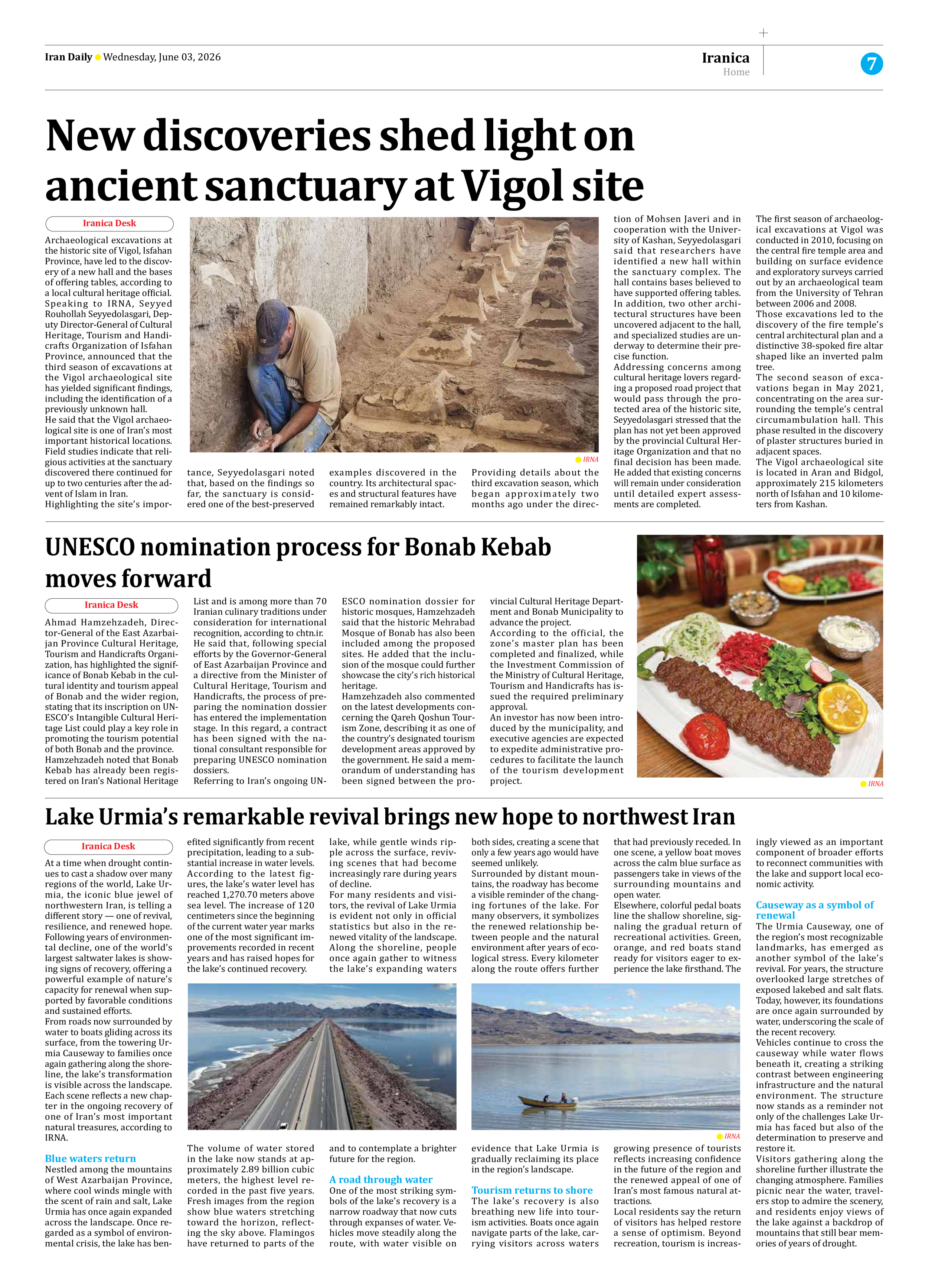
Archaeological excavations at the historic site of Vigol, Isfahan Province, have led to the discovery of a new hall and the bases of offering tables, according to a local cultural heritage official.
Speaking to IRNA, Seyyed Rouhollah Seyyedolasgari, Deputy Director-General of Cultural Heritage, Tourism and Handicrafts Organization of Isfahan Province, announced that the third season of excavations at the Vigol archaeological site has yielded significant findings, including the identification of a previously unknown hall.
He said that the Vigol archaeological site is one of Iran’s most important historical locations. Field studies indicate that religious activities at the sanctuary discovered there continued for up to two centuries after the advent of Islam in Iran.
Highlighting the site’s importance, Seyyedolasgari noted that, based on the findings so far, the sanctuary is considered one of the best-preserved examples discovered in the country. Its architectural spaces and structural features have remained remarkably intact.
Providing details about the third excavation season, which began approximately two months ago under the direction of Mohsen Javeri and in cooperation with the University of Kashan, Seyyedolasgari said that researchers have identified a new hall within the sanctuary complex. The hall contains bases believed to have supported offering tables. In addition, two other architectural structures have been uncovered adjacent to the hall, and specialized studies are underway to determine their precise function.
Addressing concerns among cultural heritage lovers regarding a proposed road project that would pass through the protected area of the historic site, Seyyedolasgari stressed that the plan has not yet been approved by the provincial Cultural Heritage Organization and that no final decision has been made. He added that existing concerns will remain under consideration until detailed expert assessments are completed.
The first season of archaeological excavations at Vigol was conducted in 2010, focusing on the central fire temple area and building on surface evidence and exploratory surveys carried out by an archaeological team from the University of Tehran between 2006 and 2008.
Those excavations led to the discovery of the fire temple’s central architectural plan and a distinctive 38-spoked fire altar shaped like an inverted palm tree.
The second season of excavations began in May 2021, concentrating on the area surrounding the temple’s central circumambulation hall. This phase resulted in the discovery of plaster structures buried in adjacent spaces.
The Vigol archaeological site is located in Aran and Bidgol, approximately 215 kilometers north of Isfahan and 10 kilometers from Kashan.