







Iran banking on experience in bid for historic World Cup breakthrough
Iran will head to the 2026 FIFA World Cup – starting June 11 in North America, betting on experience rather than youth as it seeks to reach the knockout stage for the first time in its seventh appearance at the global showpiece.
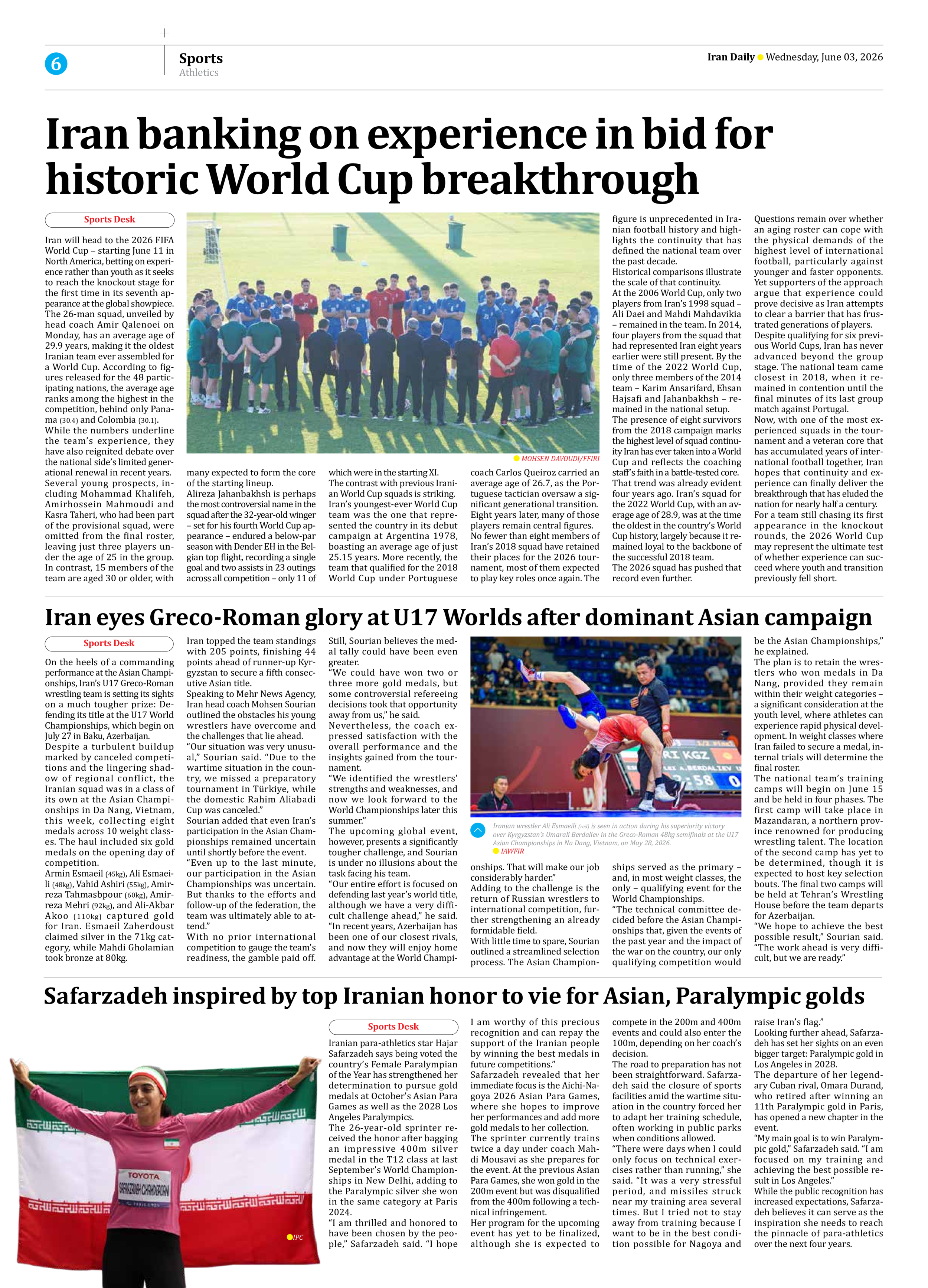
The 26-man squad, unveiled by head coach Amir Qalenoei on Monday, has an average age of 29.9 years, making it the oldest Iranian team ever assembled for a World Cup. According to figures released for the 48 participating nations, the average age ranks among the highest in the competition, behind only Panama (30.4) and Colombia (30.1).
While the numbers underline the team’s experience, they have also reignited debate over the national side’s limited generational renewal in recent years.
Several young prospects, including Mohammad Khalifeh, Amirhossein Mahmoudi and Kasra Taheri, who had been part of the provisional squad, were omitted from the final roster, leaving just three players under the age of 25 in the group. In contrast, 15 members of the team are aged 30 or older, with many expected to form the core of the starting lineup.
Alireza Jahanbakhsh is perhaps the most controversial name in the squad after the 32-year-old winger – set for his fourth World Cup appearance – endured a below-par season with Dender EH in the Belgian top flight, recording a single goal and two assists in 23 outings across all competition – only 11 of which were in the starting XI.
The contrast with previous Iranian World Cup squads is striking.
Iran’s youngest-ever World Cup team was the one that represented the country in its debut campaign at Argentina 1978, boasting an average age of just 25.15 years. More recently, the team that qualified for the 2018 World Cup under Portuguese coach Carlos Queiroz carried an average age of 26.7, as the Portuguese tactician oversaw a significant generational transition.
Eight years later, many of those players remain central figures.
No fewer than eight members of Iran’s 2018 squad have retained their places for the 2026 tournament, most of them expected to play key roles once again. The figure is unprecedented in Iranian football history and highlights the continuity that has defined the national team over the past decade.
Historical comparisons illustrate the scale of that continuity.
At the 2006 World Cup, only two players from Iran’s 1998 squad – Ali Daei and Mahdi Mahdavikia – remained in the team. In 2014, four players from the squad that had represented Iran eight years earlier were still present. By the time of the 2022 World Cup, only three members of the 2014 team – Karim Ansarifard, Ehsan Hajsafi and Jahanbakhsh – remained in the national setup.
The presence of eight survivors from the 2018 campaign marks the highest level of squad continuity Iran has ever taken into a World Cup and reflects the coaching staff’s faith in a battle-tested core.
That trend was already evident four years ago. Iran’s squad for the 2022 World Cup, with an average age of 28.9, was at the time the oldest in the country’s World Cup history, largely because it remained loyal to the backbone of the successful 2018 team.
The 2026 squad has pushed that record even further.
Questions remain over whether an aging roster can cope with the physical demands of the highest level of international football, particularly against younger and faster opponents. Yet supporters of the approach argue that experience could prove decisive as Iran attempts to clear a barrier that has frustrated generations of players.
Despite qualifying for six previous World Cups, Iran has never advanced beyond the group stage. The national team came closest in 2018, when it remained in contention until the final minutes of its last group match against Portugal.
Now, with one of the most experienced squads in the tournament and a veteran core that has accumulated years of international football together, Iran hopes that continuity and experience can finally deliver the breakthrough that has eluded the nation for nearly half a century.
For a team still chasing its first appearance in the knockout rounds, the 2026 World Cup may represent the ultimate test of whether experience can succeed where youth and transition previously fell short.