





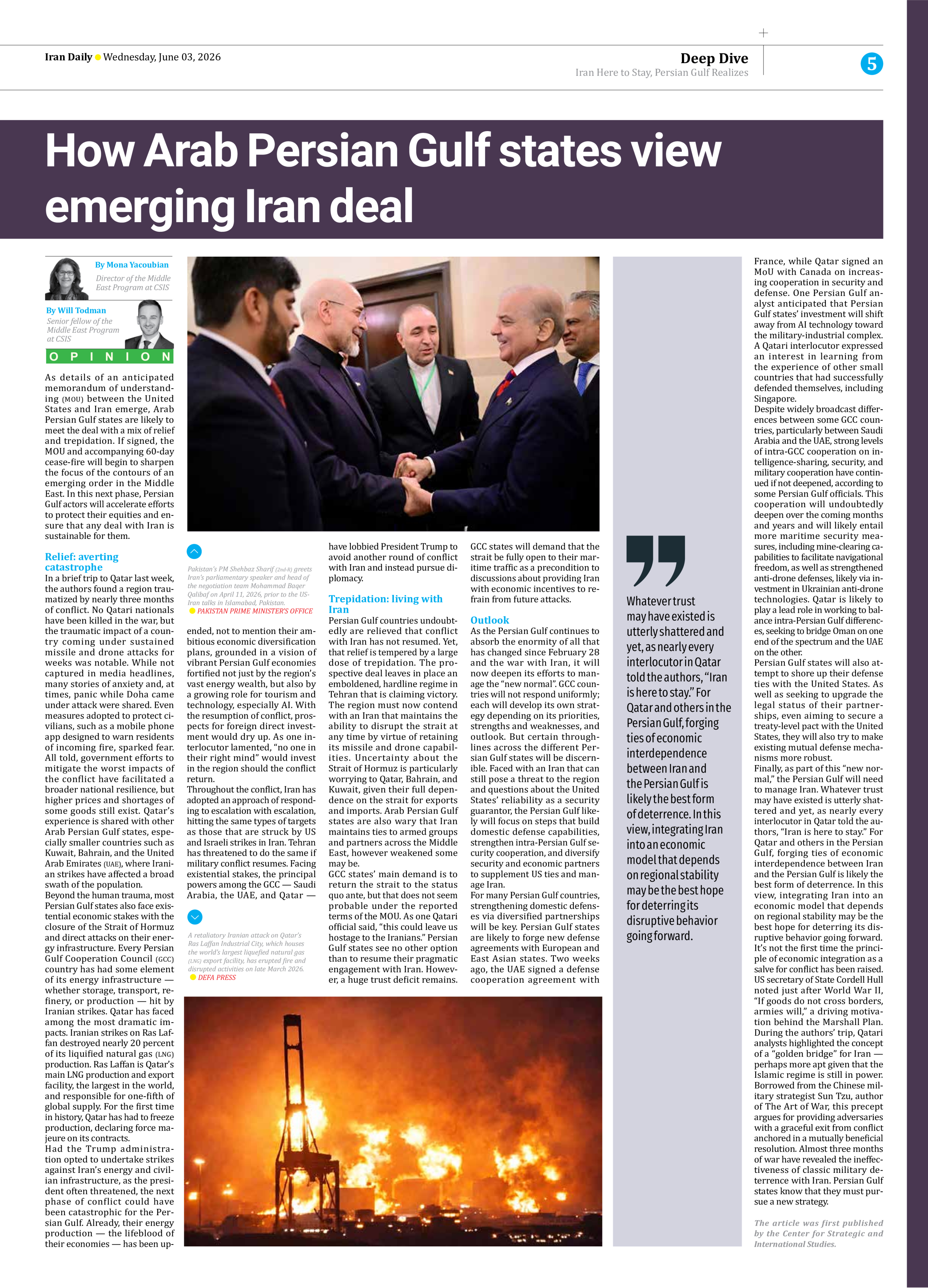


How Arab Persian Gulf states view emerging Iran deal
By Mona Yacoubian
Director of the Middle East Program at CSIS
By Will Todman
Senior fellow of the Middle East Program at CSIS
As details of an anticipated memorandum of understanding (MOU) between the United States and Iran emerge, Arab Persian Gulf states are likely to meet the deal with a mix of relief and trepidation. If signed, the MOU and accompanying 60-day cease-fire will begin to sharpen the focus of the contours of an emerging order in the Middle East. In this next phase, Persian Gulf actors will accelerate efforts to protect their equities and ensure that any deal with Iran is sustainable for them.
Relief: averting catastrophe
In a brief trip to Qatar last week, the authors found a region traumatized by nearly three months of conflict. No Qatari nationals have been killed in the war, but the traumatic impact of a country coming under sustained missile and drone attacks for weeks was notable. While not captured in media headlines, many stories of anxiety and, at times, panic while Doha came under attack were shared. Even measures adopted to protect civilians, such as a mobile phone app designed to warn residents of incoming fire, sparked fear. All told, government efforts to mitigate the worst impacts of the conflict have facilitated a broader national resilience, but higher prices and shortages of some goods still exist. Qatar’s experience is shared with other Arab Persian Gulf states, especially smaller countries such as Kuwait, Bahrain, and the United Arab Emirates (UAE), where Iranian strikes have affected a broad swath of the population.
Beyond the human trauma, most Persian Gulf states also face existential economic stakes with the closure of the Strait of Hormuz and direct attacks on their energy infrastructure. Every Persian Gulf Cooperation Council (GCC) country has had some element of its energy infrastructure — whether storage, transport, refinery, or production — hit by Iranian strikes. Qatar has faced among the most dramatic impacts. Iranian strikes on Ras Laffan destroyed nearly 20 percent of its liquified natural gas (LNG) production. Ras Laffan is Qatar’s main LNG production and export facility, the largest in the world, and responsible for one-fifth of global supply. For the first time in history, Qatar has had to freeze production, declaring force majeure on its contracts.
Had the Trump administration opted to undertake strikes against Iran’s energy and civilian infrastructure, as the president often threatened, the next phase of conflict could have been catastrophic for the Persian Gulf. Already, their energy production — the lifeblood of their economies — has been upended, not to mention their ambitious economic diversification plans, grounded in a vision of vibrant Persian Gulf economies fortified not just by the region’s vast energy wealth, but also by a growing role for tourism and technology, especially AI. With the resumption of conflict, prospects for foreign direct investment would dry up. As one interlocutor lamented, “no one in their right mind” would invest in the region should the conflict return.
Throughout the conflict, Iran has adopted an approach of responding to escalation with escalation, hitting the same types of targets as those that are struck by US and Israeli strikes in Iran. Tehran has threatened to do the same if military conflict resumes. Facing existential stakes, the principal powers among the GCC — Saudi Arabia, the UAE, and Qatar — have lobbied President Trump to avoid another round of conflict with Iran and instead pursue diplomacy.
Trepidation: living with Iran
Persian Gulf countries undoubtedly are relieved that conflict with Iran has not resumed. Yet, that relief is tempered by a large dose of trepidation. The prospective deal leaves in place an emboldened, hardline regime in Tehran that is claiming victory. The region must now contend with an Iran that maintains the ability to disrupt the strait at any time by virtue of retaining its missile and drone capabilities. Uncertainty about the Strait of Hormuz is particularly worrying to Qatar, Bahrain, and Kuwait, given their full dependence on the strait for exports and imports. Arab Persian Gulf states are also wary that Iran maintains ties to armed groups and partners across the Middle East, however weakened some may be.
GCC states’ main demand is to return the strait to the status quo ante, but that does not seem probable under the reported terms of the MOU. As one Qatari official said, “this could leave us hostage to the Iranians.” Persian Gulf states see no other option than to resume their pragmatic engagement with Iran. However, a huge trust deficit remains. GCC states will demand that the strait be fully open to their maritime traffic as a precondition to discussions about providing Iran with economic incentives to refrain from future attacks.
Outlook
As the Persian Gulf continues to absorb the enormity of all that has changed since February 28 and the war with Iran, it will now deepen its efforts to manage the “new normal”. GCC countries will not respond uniformly; each will develop its own strategy depending on its priorities, strengths and weaknesses, and outlook. But certain throughlines across the different Persian Gulf states will be discernible. Faced with an Iran that can still pose a threat to the region and questions about the United States’ reliability as a security guarantor, the Persian Gulf likely will focus on steps that build domestic defense capabilities, strengthen intra-Persian Gulf security cooperation, and diversify security and economic partners to supplement US ties and manage Iran.
For many Persian Gulf countries, strengthening domestic defenses via diversified partnerships will be key. Persian Gulf states are likely to forge new defense agreements with European and East Asian states. Two weeks ago, the UAE signed a defense cooperation agreement with France, while Qatar signed an MoU with Canada on increasing cooperation in security and defense. One Persian Gulf analyst anticipated that Persian Gulf states’ investment will shift away from AI technology toward the military-industrial complex. A Qatari interlocutor expressed an interest in learning from the experience of other small countries that had successfully defended themselves, including Singapore.
Despite widely broadcast differences between some GCC countries, particularly between Saudi Arabia and the UAE, strong levels of intra-GCC cooperation on intelligence-sharing, security, and military cooperation have continued if not deepened, according to some Persian Gulf officials. This cooperation will undoubtedly deepen over the coming months and years and will likely entail more maritime security measures, including mine-clearing capabilities to facilitate navigational freedom, as well as strengthened anti-drone defenses, likely via investment in Ukrainian anti-drone technologies. Qatar is likely to play a lead role in working to balance intra-Persian Gulf differences, seeking to bridge Oman on one end of the spectrum and the UAE on the other.
Persian Gulf states will also attempt to shore up their defense ties with the United States. As well as seeking to upgrade the legal status of their partnerships, even aiming to secure a treaty-level pact with the United States, they will also try to make existing mutual defense mechanisms more robust.
Finally, as part of this “new normal,” the Persian Gulf will need to manage Iran. Whatever trust may have existed is utterly shattered and yet, as nearly every interlocutor in Qatar told the authors, “Iran is here to stay.” For Qatar and others in the Persian Gulf, forging ties of economic interdependence between Iran and the Persian Gulf is likely the best form of deterrence. In this view, integrating Iran into an economic model that depends on regional stability may be the best hope for deterring its disruptive behavior going forward.
It’s not the first time the principle of economic integration as a salve for conflict has been raised. US secretary of State Cordell Hull noted just after World War II, “If goods do not cross borders, armies will,” a driving motivation behind the Marshall Plan. During the authors’ trip, Qatari analysts highlighted the concept of a “golden bridge” for Iran — perhaps more apt given that the Islamic regime is still in power. Borrowed from the Chinese military strategist Sun Tzu, author of The Art of War, this precept argues for providing adversaries with a graceful exit from conflict anchored in a mutually beneficial resolution. Almost three months of war have revealed the ineffectiveness of classic military deterrence with Iran. Persian Gulf states know that they must pursue a new strategy.
The article was first published by the Center for Strategic and
International Studies.