





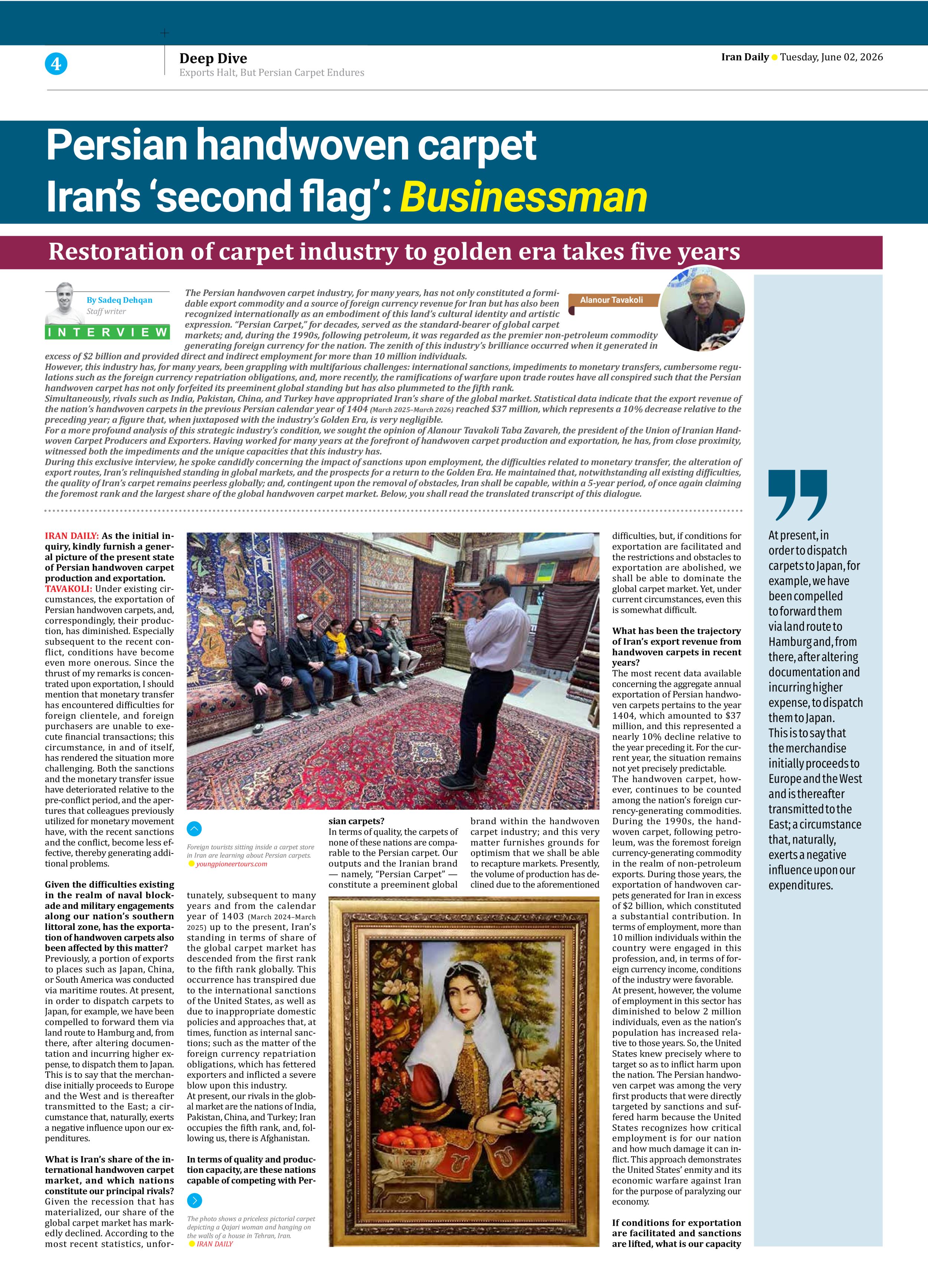


Persian handwoven carpet Iran’s ‘second flag’: Businessman
Restoration of carpet industry to golden era takes five years
The Persian handwoven carpet industry, for many years, has not only constituted a formidable export commodity and a source of foreign currency revenue for Iran but has also been recognized internationally as an embodiment of this land’s cultural identity and artistic expression. “Persian Carpet,” for decades, served as the standard-bearer of global carpet markets; and, during the 1990s, following petroleum, it was regarded as the premier non-petroleum commodity generating foreign currency for the nation. The zenith of this industry’s brilliance occurred when it generated in excess of $2 billion and provided direct and indirect employment for more than 10 million individuals. However, this industry has, for many years, been grappling with multifarious challenges: international sanctions, impediments to monetary transfers, cumbersome regulations such as the foreign currency repatriation obligations, and, more recently, the ramifications of warfare upon trade routes have all conspired such that the Persian handwoven carpet has not only forfeited its preeminent global standing but has also plummeted to the fifth rank. Simultaneously, rivals such as India, Pakistan, China, and Turkey have appropriated Iran’s share of the global market. Statistical data indicate that the export revenue of the nation’s handwoven carpets in the previous Persian calendar year of 1404 (March 2025–March 2026) reached $37 million, which represents a 10% decrease relative to the preceding year; a figure that, when juxtaposed with the industry’s Golden Era, is very negligible. For a more profound analysis of this strategic industry’s condition, we sought the opinion of Alanour Tavakoli Taba Zavareh, the president of the Union of Iranian Handwoven Carpet Producers and Exporters. Having worked for many years at the forefront of handwoven carpet production and exportation, he has, from close proximity, witnessed both the impediments and the unique capacities that this industry has. During this exclusive interview, he spoke candidly concerning the impact of sanctions upon employment, the difficulties related to monetary transfer, the alteration of export routes, Iran’s relinquished standing in global markets, and the prospects for a return to the Golden Era. He maintained that, notwithstanding all existing difficulties, the quality of Iran’s carpet remains peerless globally; and, contingent upon the removal of obstacles, Iran shall be capable, within a 5-year period, of once again claiming the foremost rank and the largest share of the global handwoven carpet market. Below, you shall read the translated transcript of this dialogue.
By Sadeq Dehqan
Staff writer
IRAN DAILY: As the initial inquiry, kindly furnish a general picture of the present state of Persian handwoven carpet production and exportation.
TAVAKOLI: Under existing circumstances, the exportation of Persian handwoven carpets, and, correspondingly, their production, has diminished. Especially subsequent to the recent conflict, conditions have become even more onerous. Since the thrust of my remarks is concentrated upon exportation, I should mention that monetary transfer has encountered difficulties for foreign clientele, and foreign purchasers are unable to execute financial transactions; this circumstance, in and of itself, has rendered the situation more challenging. Both the sanctions and the monetary transfer issue have deteriorated relative to the pre-conflict period, and the apertures that colleagues previously utilized for monetary movement have, with the recent sanctions and the conflict, become less effective, thereby generating additional problems.
Given the difficulties existing in the realm of naval blockade and military engagements along our nation’s southern littoral zone, has the exportation of handwoven carpets also been affected by this matter?
Previously, a portion of exports to places such as Japan, China, or South America was conducted via maritime routes. At present, in order to dispatch carpets to Japan, for example, we have been compelled to forward them via land route to Hamburg and, from there, after altering documentation and incurring higher expense, to dispatch them to Japan. This is to say that the merchandise initially proceeds to Europe and the West and is thereafter transmitted to the East; a circumstance that, naturally, exerts a negative influence upon our expenditures.
What is Iran’s share of the international handwoven carpet market, and which nations constitute our principal rivals?
Given the recession that has materialized, our share of the global carpet market has markedly declined. According to the most recent statistics, unfortunately, subsequent to many years and from the calendar year of 1403 (March 2024–March 2025) up to the present, Iran’s standing in terms of share of the global carpet market has descended from the first rank to the fifth rank globally. This occurrence has transpired due to the international sanctions of the United States, as well as due to inappropriate domestic policies and approaches that, at times, function as internal sanctions; such as the matter of the foreign currency repatriation obligations, which has fettered exporters and inflicted a severe blow upon this industry.
At present, our rivals in the global market are the nations of India, Pakistan, China, and Turkey; Iran occupies the fifth rank, and, following us, there is Afghanistan.
In terms of quality and production capacity, are these nations capable of competing with Persian carpets?
In terms of quality, the carpets of none of these nations are comparable to the Persian carpet. Our outputs and the Iranian brand — namely, “Persian Carpet” — constitute a preeminent global brand within the handwoven carpet industry; and this very matter furnishes grounds for optimism that we shall be able to recapture markets. Presently, the volume of production has declined due to the aforementioned difficulties, but, if conditions for exportation are facilitated and the restrictions and obstacles to exportation are abolished, we shall be able to dominate the global carpet market. Yet, under current circumstances, even this is somewhat difficult.
What has been the trajectory of Iran’s export revenue from handwoven carpets in recent years?
The most recent data available concerning the aggregate annual exportation of Persian handwoven carpets pertains to the year 1404, which amounted to $37 million, and this represented a nearly 10% decline relative to the year preceding it. For the current year, the situation remains not yet precisely predictable.
The handwoven carpet, however, continues to be counted among the nation’s foreign currency-generating commodities. During the 1990s, the handwoven carpet, following petroleum, was the foremost foreign currency-generating commodity in the realm of non-petroleum exports. During those years, the exportation of handwoven carpets generated for Iran in excess of $2 billion, which constituted a substantial contribution. In terms of employment, more than 10 million individuals within the country were engaged in this profession, and, in terms of foreign currency income, conditions of the industry were favorable.
At present, however, the volume of employment in this sector has diminished to below 2 million individuals, even as the nation’s population has increased relative to those years. So, the United States knew precisely where to target so as to inflict harm upon the nation. The Persian handwoven carpet was among the very first products that were directly targeted by sanctions and suffered harm because the United States recognizes how critical employment is for our nation and how much damage it can inflict. This approach demonstrates the United States’ enmity and its economic warfare against Iran for the purpose of paralyzing our economy.
If conditions for exportation are facilitated and sanctions are lifted, what is our capacity for increasing exports and foreign currency revenue?
In the handwoven carpet industry, the potential exists within the nation for us to return to that same Golden Era; that is to say, once again to be the foremost exporting nation and the holder of the largest share of the global market. Admittedly, a return to the Golden Era, contingent upon the removal of export restrictions, might require 5 years for us to recapture markets. This matter is conditional upon the abolition of cumbersome export regulations, such as the foreign currency repatriation obligations, and upon our enjoying the same economic liberties as during those years, so that we may restore carpet exports to their apogee.
Has our prolonged absence from global markets caused a change in consumer tastes, or have other nations appropriated Iranian designs under their own names?
Both. At present, certain nations exploit Iranian designs and the Iranian brand in the market for their own benefit and release products into the market under Iranian names and designs. Unfortunately, such instances do exist. On the other hand, our absence from the market has permitted novel designs to enter and tastes to shift; that is to say, the market’s palate is being altered.
Of course, I must emphasize that the authentic designs of the Persian carpet always possess their own clientele in every nation and that the artistry inherent in our authentic carpet design has no substitute in the market. Furthermore, our nation is also exceptionally strong in the domain of carpet design, and we possess exceedingly talented and renowned designers who are capable of entering the market with novel, popular designs and models and attracting customers toward our products.
Kindly elaborate upon the target markets for the exportation of Persian handwoven carpets.
At present, one of our most favorable markets is China. Additionally, in Europe, Germany constitutes one of our major export markets. The Arab nations of the Persian Gulf region were also among our principal markets; however, with the conflict, the market of those nations for our carpets has been disrupted.
But, if conditions for exportation are facilitated, we have no difficulty regarding clientele; and there exists very robust demand globally for the Persian carpet because the Persian carpet has always enjoyed renown globally and has possessed its own fans. The Persian handwoven carpet possesses such fame and credibility that it is regarded as “Iran’s second flag”.
The Persian carpet is a product that is immortal. As time progresses, it becomes better, more valuable, and more expensive. During past years, however, its price within our nation’s market has lagged behind; and, relative to domestic price increases, the carpet product has remained inexpensive. It would be appropriate for the price of carpets to be significantly higher than these figures, and for the continued activity within this industry to possess economic viability for weavers and stakeholders.