







Pezeshkian: Iran ready to ease maritime transit, safeguard shipping in Hormuz
‘Diplomacy as the most effective way to settle outstanding issues’
President Masoud Pezeshkian emphasized Iran’s readiness to facilitate maritime transit and ensure shipping security in the Strait of Hormuz which has been mostly closed by Iran following the US-Israeli aggression in February.
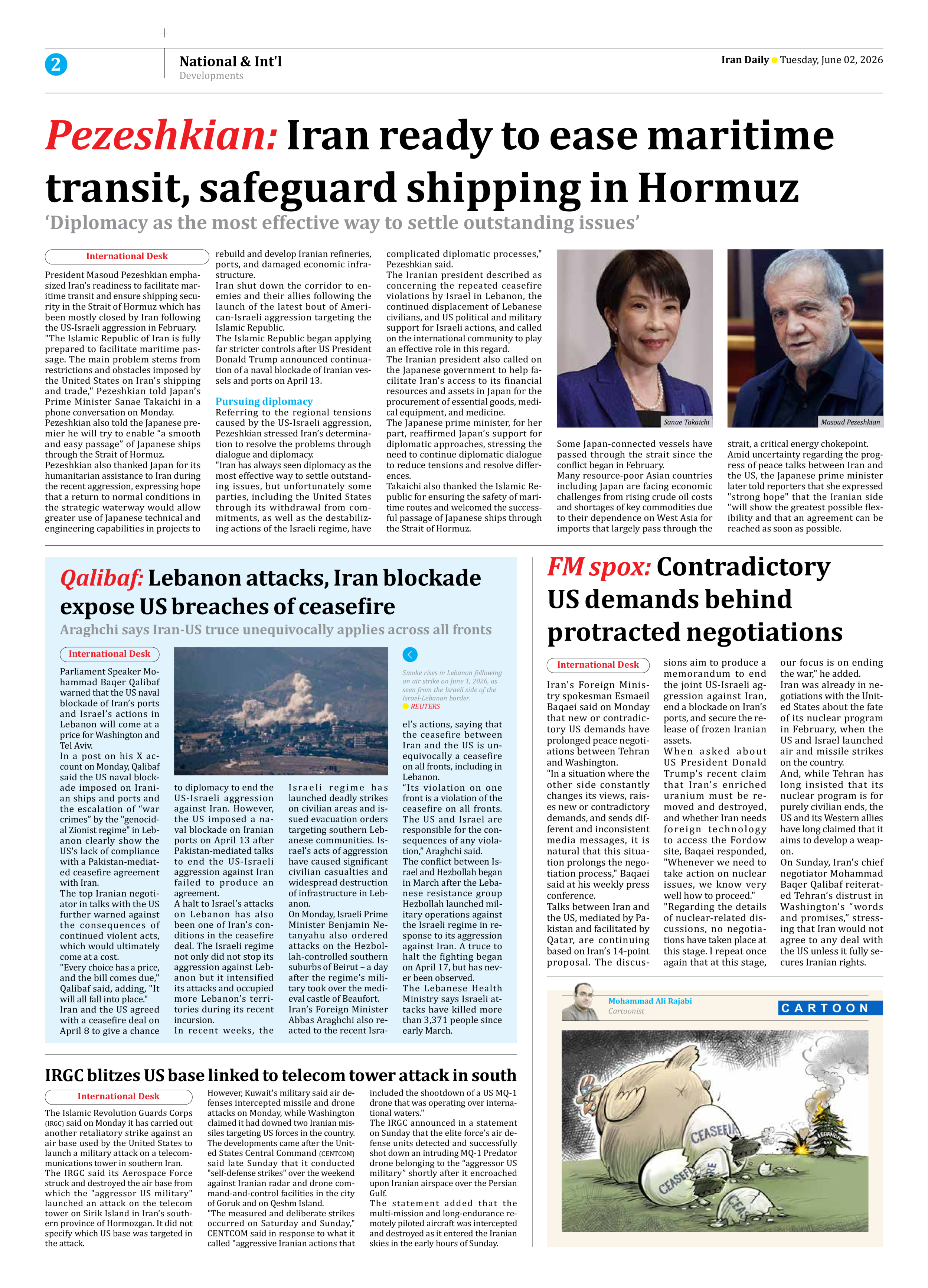
"The Islamic Republic of Iran is fully prepared to facilitate maritime passage. The main problem stems from restrictions and obstacles imposed by the United States on Iran’s shipping and trade," Pezeshkian told Japan’s Prime Minister Sanae Takaichi in a phone conversation on Monday.
Pezeshkian also told the Japanese premier he will try to enable “a smooth and easy passage” of Japanese ships through the Strait of Hormuz.
Pezeshkian also thanked Japan for its humanitarian assistance to Iran during the recent aggression, expressing hope that a return to normal conditions in the strategic waterway would allow greater use of Japanese technical and engineering capabilities in projects to rebuild and develop Iranian refineries, ports, and damaged economic infrastructure.
Iran shut down the corridor to enemies and their allies following the launch of the latest bout of American-Israeli aggression targeting the Islamic Republic.
The Islamic Republic began applying far stricter controls after US President Donald Trump announced continuation of a naval blockade of Iranian vessels and ports on April 13.
Pursuing diplomacy
Referring to the regional tensions caused by the US-Israeli aggression, Pezeshkian stressed Iran’s determination to resolve the problems through dialogue and diplomacy.
"Iran has always seen diplomacy as the most effective way to settle outstanding issues, but unfortunately some parties, including the United States through its withdrawal from commitments, as well as the destabilizing actions of the Israeli regime, have complicated diplomatic processes," Pezeshkian said.
The Iranian president described as concerning the repeated ceasefire violations by Israel in Lebanon, the continued displacement of Lebanese civilians, and US political and military support for Israeli actions, and called on the international community to play an effective role in this regard.
The Iranian president also called on the Japanese government to help facilitate Iran’s access to its financial resources and assets in Japan for the procurement of essential goods, medical equipment, and medicine.
The Japanese prime minister, for her part, reaffirmed Japan’s support for diplomatic approaches, stressing the need to continue diplomatic dialogue to reduce tensions and resolve differences.
Takaichi also thanked the Islamic Republic for ensuring the safety of maritime routes and welcomed the successful passage of Japanese ships through the Strait of Hormuz.
Some Japan-connected vessels have passed through the strait since the conflict began in February.
Many resource-poor Asian countries including Japan are facing economic challenges from rising crude oil costs and shortages of key commodities due to their dependence on West Asia for imports that largely pass through the strait, a critical energy chokepoint.
Amid uncertainty regarding the progress of peace talks between Iran and the US, the Japanese prime minister later told reporters that she expressed "strong hope" that the Iranian side "will show the greatest possible flexibility and that an agreement can be reached as soon as possible.