







Veteran Rafugar warns of challenges facing carpet restoration
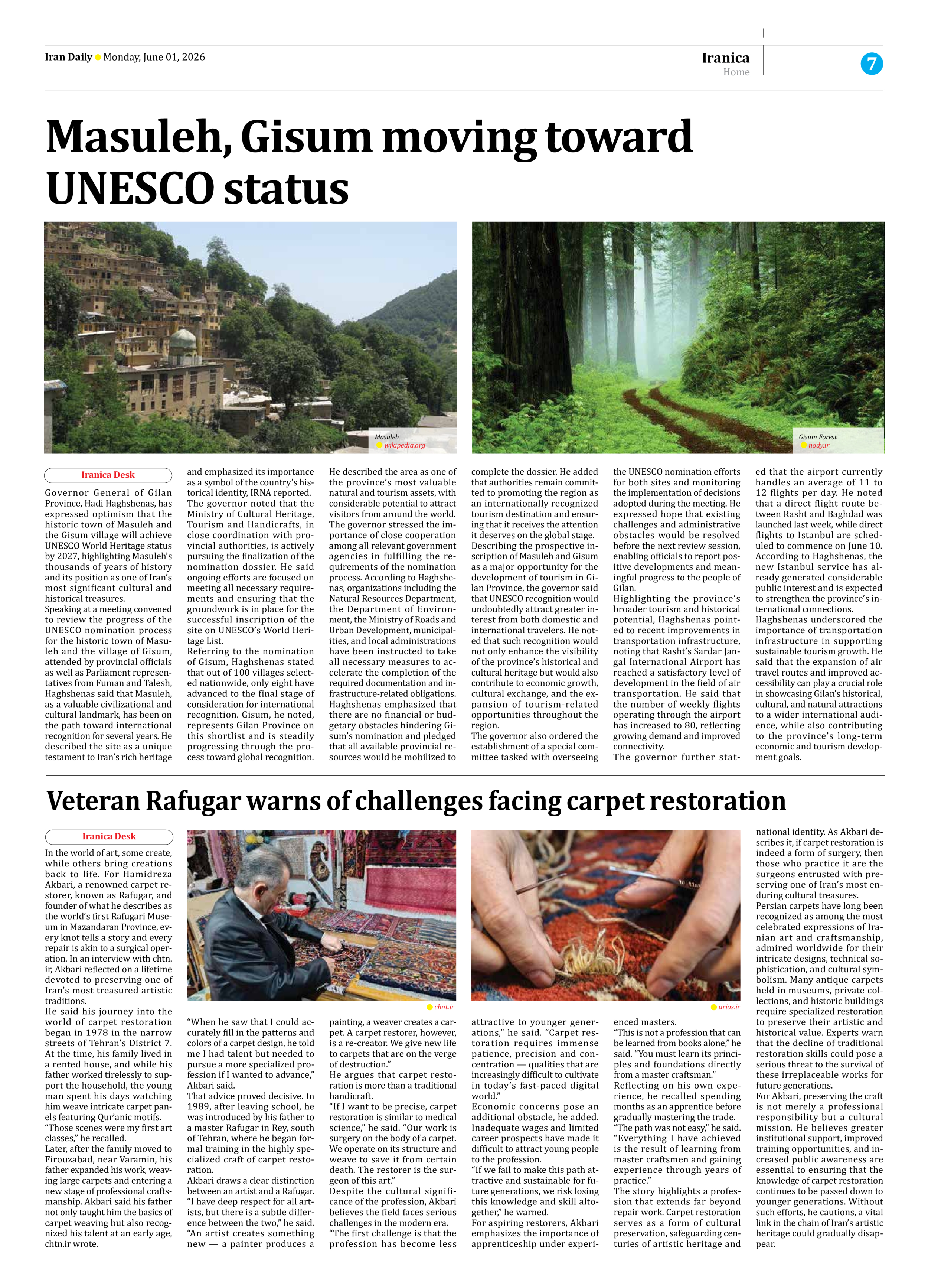
In the world of art, some create, while others bring creations back to life. For Hamidreza Akbari, a renowned carpet restorer, known as Rafugar, and founder of what he describes as the world’s first Rafugari Museum in Mazandaran Province, every knot tells a story and every repair is akin to a surgical operation. In an interview with chtn.ir, Akbari reflected on a lifetime devoted to preserving one of Iran’s most treasured artistic traditions.
He said his journey into the world of carpet restoration began in 1978 in the narrow streets of Tehran’s District 7. At the time, his family lived in a rented house, and while his father worked tirelessly to support the household, the young man spent his days watching him weave intricate carpet panels featuring Qur’anic motifs.
“Those scenes were my first art classes,” he recalled.
Later, after the family moved to Firouzabad, near Varamin, his father expanded his work, weaving large carpets and entering a new stage of professional craftsmanship. Akbari said his father not only taught him the basics of carpet weaving but also recognized his talent at an early age, chtn.ir wrote.
“When he saw that I could accurately fill in the patterns and colors of a carpet design, he told me I had talent but needed to pursue a more specialized profession if I wanted to advance,” Akbari said.
That advice proved decisive. In 1989, after leaving school, he was introduced by his father to a master Rafugar in Rey, south of Tehran, where he began formal training in the highly specialized craft of carpet restoration.
Akbari draws a clear distinction between an artist and a Rafugar.
“I have deep respect for all artists, but there is a subtle difference between the two,” he said. “An artist creates something new — a painter produces a painting, a weaver creates a carpet. A carpet restorer, however, is a re-creator. We give new life to carpets that are on the verge of destruction.”
He argues that carpet restoration is more than a traditional handicraft.
“If I want to be precise, carpet restoration is similar to medical science,” he said. “Our work is surgery on the body of a carpet. We operate on its structure and weave to save it from certain death. The restorer is the surgeon of this art.”
Despite the cultural significance of the profession, Akbari believes the field faces serious challenges in the modern era.
“The first challenge is that the profession has become less attractive to younger generations,” he said. “Carpet restoration requires immense patience, precision and concentration — qualities that are increasingly difficult to cultivate in today’s fast-paced digital world.”
Economic concerns pose an additional obstacle, he added. Inadequate wages and limited career prospects have made it difficult to attract young people to the profession.
“If we fail to make this path attractive and sustainable for future generations, we risk losing this knowledge and skill altogether,” he warned.
For aspiring restorers, Akbari emphasizes the importance of apprenticeship under experienced masters.
“This is not a profession that can be learned from books alone,” he said. “You must learn its principles and foundations directly from a master craftsman.”
Reflecting on his own experience, he recalled spending months as an apprentice before gradually mastering the trade.
“The path was not easy,” he said. “Everything I have achieved is the result of learning from master craftsmen and gaining experience through years of practice.”
The story highlights a profession that extends far beyond repair work. Carpet restoration serves as a form of cultural preservation, safeguarding centuries of artistic heritage and national identity. As Akbari describes it, if carpet restoration is indeed a form of surgery, then those who practice it are the surgeons entrusted with preserving one of Iran’s most enduring cultural treasures.
Persian carpets have long been recognized as among the most celebrated expressions of Iranian art and craftsmanship, admired worldwide for their intricate designs, technical sophistication, and cultural symbolism. Many antique carpets held in museums, private collections, and historic buildings require specialized restoration to preserve their artistic and historical value. Experts warn that the decline of traditional restoration skills could pose a serious threat to the survival of these irreplaceable works for future generations.
For Akbari, preserving the craft is not merely a professional responsibility but a cultural mission. He believes greater institutional support, improved training opportunities, and increased public awareness are essential to ensuring that the knowledge of carpet restoration continues to be passed down to younger generations. Without such efforts, he cautions, a vital link in the chain of Iran’s artistic heritage could gradually disappear.