







15th Conference on Islamic-Iranian Model of Progress
Convergence, justice, and resistance
Muslim luminaries chart path of progress
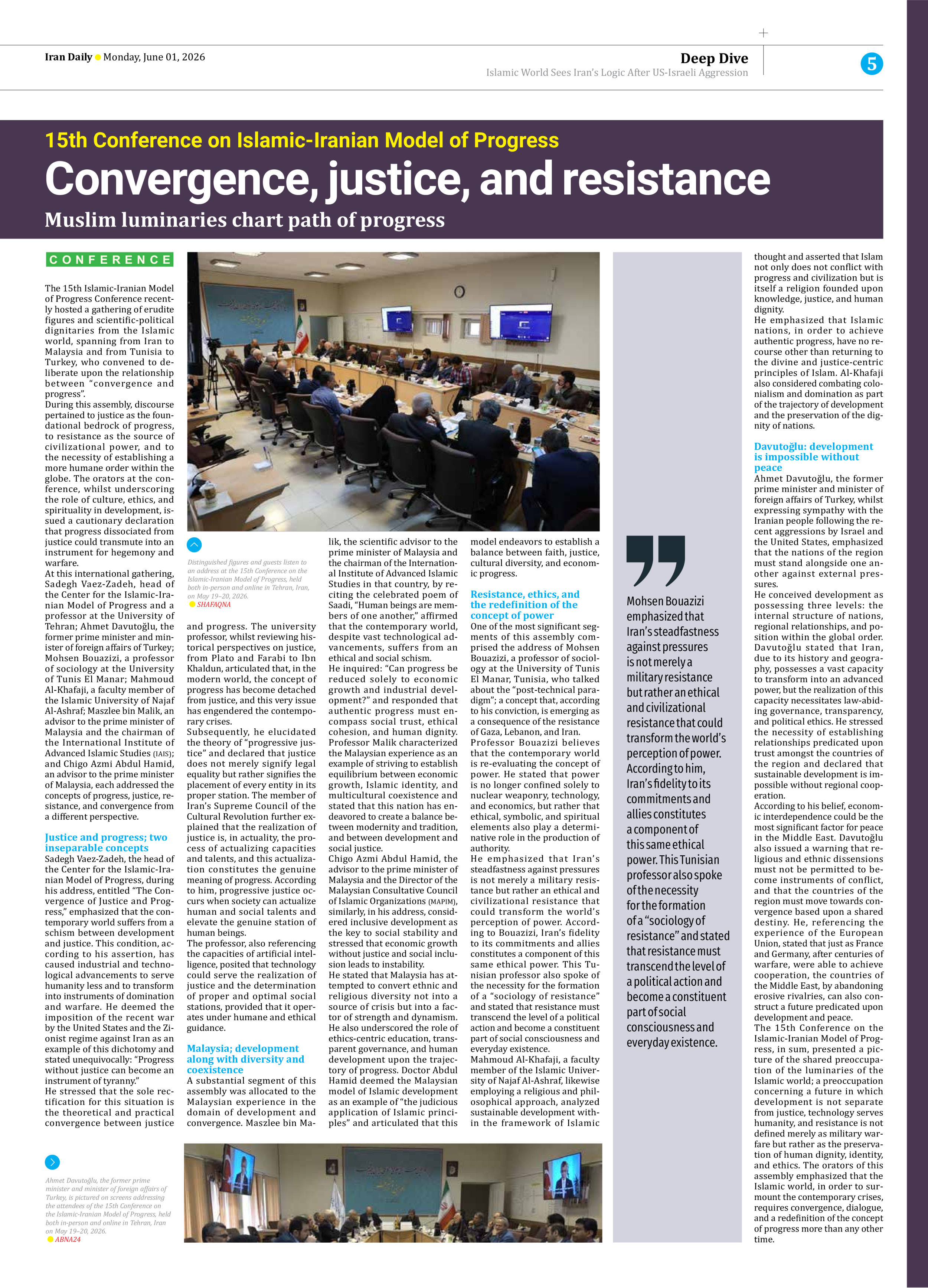
The 15th Islamic-Iranian Model of Progress Conference recently hosted a gathering of erudite figures and scientific-political dignitaries from the Islamic world, spanning from Iran to Malaysia and from Tunisia to Turkey, who convened to deliberate upon the relationship between “convergence and progress”.
During this assembly, discourse pertained to justice as the foundational bedrock of progress, to resistance as the source of civilizational power, and to the necessity of establishing a more humane order within the globe. The orators at the conference, whilst underscoring the role of culture, ethics, and spirituality in development, issued a cautionary declaration that progress dissociated from justice could transmute into an instrument for hegemony and warfare.
At this international gathering, Sadegh Vaez-Zadeh, head of the Center for the Islamic-Iranian Model of Progress and a professor at the University of Tehran; Ahmet Davutoğlu, the former prime minister and minister of foreign affairs of Turkey; Mohsen Bouazizi, a professor of sociology at the University of Tunis El Manar; Mahmoud Al-Khafaji, a faculty member of the Islamic University of Najaf Al-Ashraf; Maszlee bin Malik, an advisor to the prime minister of Malaysia and the chairman of the International Institute of Advanced Islamic Studies (IAIS); and Chigo Azmi Abdul Hamid, an advisor to the prime minister of Malaysia, each addressed the concepts of progress, justice, resistance, and convergence from a different perspective.
Justice and progress; two inseparable concepts
Sadegh Vaez-Zadeh, the head of the Center for the Islamic-Iranian Model of Progress, during his address, entitled “The Convergence of Justice and Progress,” emphasized that the contemporary world suffers from a schism between development and justice. This condition, according to his assertion, has caused industrial and technological advancements to serve humanity less and to transform into instruments of domination and warfare. He deemed the imposition of the recent war by the United States and the Zionist regime against Iran as an example of this dichotomy and stated unequivocally: “Progress without justice can become an instrument of tyranny.”
He stressed that the sole rectification for this situation is the theoretical and practical convergence between justice and progress. The university professor, whilst reviewing historical perspectives on justice, from Plato and Farabi to Ibn Khaldun, articulated that, in the modern world, the concept of progress has become detached from justice, and this very issue has engendered the contemporary crises.
Subsequently, he elucidated the theory of “progressive justice” and declared that justice does not merely signify legal equality but rather signifies the placement of every entity in its proper station. The member of Iran’s Supreme Council of the Cultural Revolution further explained that the realization of justice is, in actuality, the process of actualizing capacities and talents, and this actualization constitutes the genuine meaning of progress. According to him, progressive justice occurs when society can actualize human and social talents and elevate the genuine station of human beings.
The professor, also referencing the capacities of artificial intelligence, posited that technology could serve the realization of justice and the determination of proper and optimal social stations, provided that it operates under humane and ethical guidance.
Malaysia; development along with diversity and coexistence
A substantial segment of this assembly was allocated to the Malaysian experience in the domain of development and convergence. Maszlee bin Malik, the scientific advisor to the prime minister of Malaysia and the chairman of the International Institute of Advanced Islamic Studies in that country, by reciting the celebrated poem of Saadi, “Human beings are members of one another,” affirmed that the contemporary world, despite vast technological advancements, suffers from an ethical and social schism.
He inquired: “Can progress be reduced solely to economic growth and industrial development?” and responded that authentic progress must encompass social trust, ethical cohesion, and human dignity. Professor Malik characterized the Malaysian experience as an example of striving to establish equilibrium between economic growth, Islamic identity, and multicultural coexistence and stated that this nation has endeavored to create a balance between modernity and tradition, and between development and social justice.
Chigo Azmi Abdul Hamid, the advisor to the prime minister of Malaysia and the Director of the Malaysian Consultative Council of Islamic Organizations (MAPIM), similarly, in his address, considered inclusive development as the key to social stability and stressed that economic growth without justice and social inclusion leads to instability.
He stated that Malaysia has attempted to convert ethnic and religious diversity not into a source of crisis but into a factor of strength and dynamism. He also underscored the role of ethics-centric education, transparent governance, and human development upon the trajectory of progress. Doctor Abdul Hamid deemed the Malaysian model of Islamic development as an example of “the judicious application of Islamic principles” and articulated that this model endeavors to establish a balance between faith, justice, cultural diversity, and economic progress.
Resistance, ethics, and the redefinition of the concept of power
One of the most significant segments of this assembly comprised the address of Mohsen Bouazizi, a professor of sociology at the University of Tunis El Manar, Tunisia, who talked about the “post-technical paradigm”; a concept that, according to his conviction, is emerging as a consequence of the resistance of Gaza, Lebanon, and Iran.
Professor Bouazizi believes that the contemporary world is re-evaluating the concept of power. He stated that power is no longer confined solely to nuclear weaponry, technology, and economics, but rather that ethical, symbolic, and spiritual elements also play a determinative role in the production of authority.
He emphasized that Iran’s steadfastness against pressures is not merely a military resistance but rather an ethical and civilizational resistance that could transform the world’s perception of power. According to Bouazizi, Iran’s fidelity to its commitments and allies constitutes a component of this same ethical power. This Tunisian professor also spoke of the necessity for the formation of a “sociology of resistance” and stated that resistance must transcend the level of a political action and become a constituent part of social consciousness and everyday existence.
Mahmoud Al-Khafaji, a faculty member of the Islamic University of Najaf Al-Ashraf, likewise employing a religious and philosophical approach, analyzed sustainable development within the framework of Islamic thought and asserted that Islam not only does not conflict with progress and civilization but is itself a religion founded upon knowledge, justice, and human dignity.
He emphasized that Islamic nations, in order to achieve authentic progress, have no recourse other than returning to the divine and justice-centric principles of Islam. Al-Khafaji also considered combating colonialism and domination as part of the trajectory of development and the preservation of the dignity of nations.
Davutoğlu: development is impossible without peace
Ahmet Davutoğlu, the former prime minister and minister of foreign affairs of Turkey, whilst expressing sympathy with the Iranian people following the recent aggressions by Israel and the United States, emphasized that the nations of the region must stand alongside one another against external pressures.
He conceived development as possessing three levels: the internal structure of nations, regional relationships, and position within the global order. Davutoğlu stated that Iran, due to its history and geography, possesses a vast capacity to transform into an advanced power, but the realization of this capacity necessitates law-abiding governance, transparency, and political ethics. He stressed the necessity of establishing relationships predicated upon trust amongst the countries of the region and declared that sustainable development is impossible without regional cooperation.
According to his belief, economic interdependence could be the most significant factor for peace in the Middle East. Davutoğlu also issued a warning that religious and ethnic dissensions must not be permitted to become instruments of conflict, and that the countries of the region must move towards convergence based upon a shared destiny. He, referencing the experience of the European Union, stated that just as France and Germany, after centuries of warfare, were able to achieve cooperation, the countries of the Middle East, by abandoning erosive rivalries, can also construct a future predicated upon development and peace.
The 15th Conference on the Islamic-Iranian Model of Progress, in sum, presented a picture of the shared preoccupation of the luminaries of the Islamic world; a preoccupation concerning a future in which development is not separate from justice, technology serves humanity, and resistance is not defined merely as military warfare but rather as the preservation of human dignity, identity, and ethics. The orators of this assembly emphasized that the Islamic world, in order to surmount the contemporary crises, requires convergence, dialogue, and a redefinition of the concept of progress more than any other time.