







Evolving security order of Persian Gulf
From Trump’s failed hegemony project to multilateral competition
By Hossein Ajorlou
Middle East security analyst
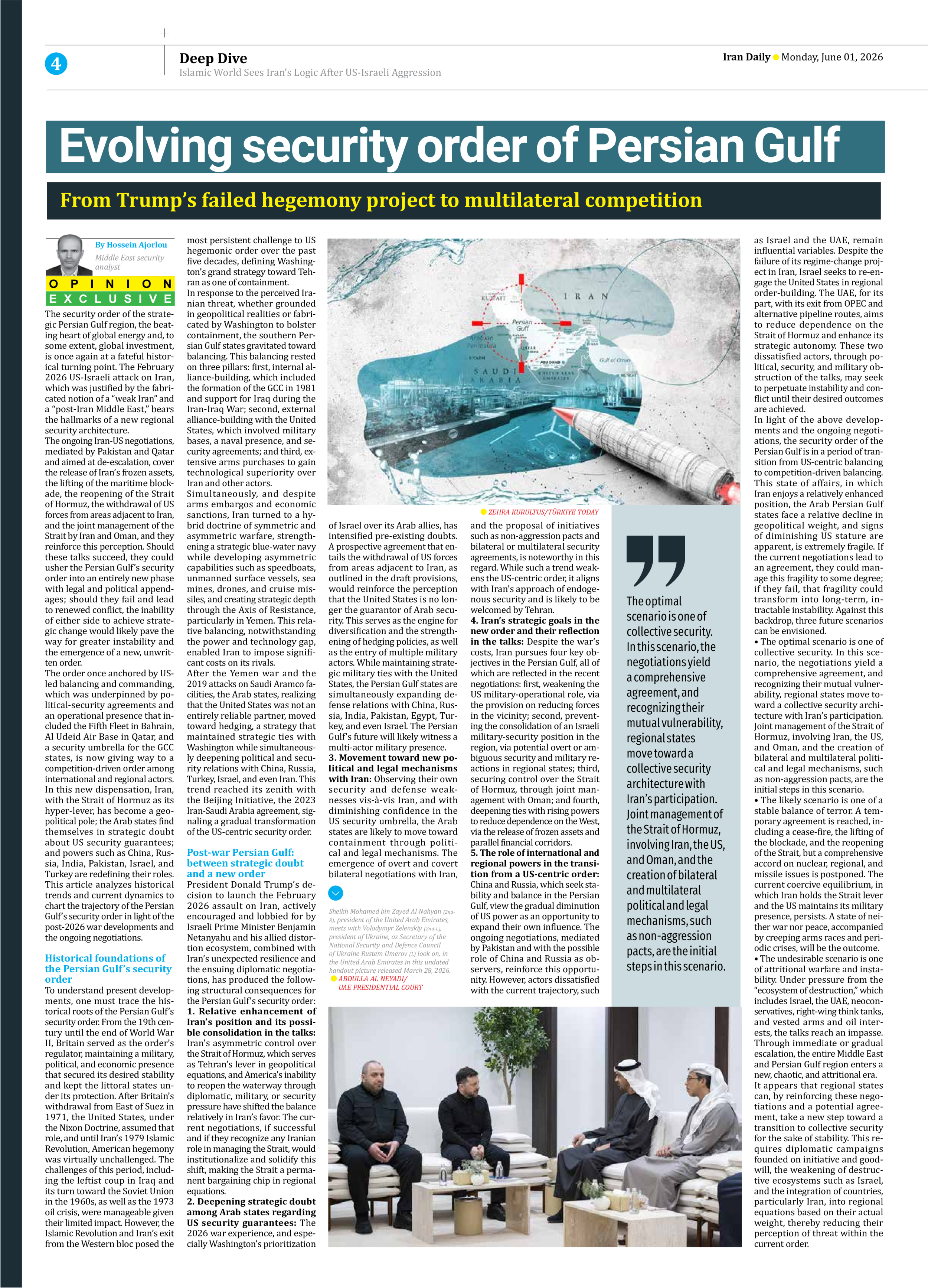
The security order of the strategic Persian Gulf region, the beating heart of global energy and, to some extent, global investment, is once again at a fateful historical turning point. The February 2026 US-Israeli attack on Iran, which was justified by the fabricated notion of a “weak Iran” and a “post-Iran Middle East,” bears the hallmarks of a new regional security architecture.
The ongoing Iran-US negotiations, mediated by Pakistan and Qatar and aimed at de-escalation, cover the release of Iran’s frozen assets, the lifting of the maritime blockade, the reopening of the Strait of Hormuz, the withdrawal of US forces from areas adjacent to Iran, and the joint management of the Strait by Iran and Oman, and they reinforce this perception. Should these talks succeed, they could usher the Persian Gulf’s security order into an entirely new phase with legal and political appendages; should they fail and lead to renewed conflict, the inability of either side to achieve strategic change would likely pave the way for greater instability and the emergence of a new, unwritten order.
The order once anchored by US-led balancing and commanding, which was underpinned by political-security agreements and an operational presence that included the Fifth Fleet in Bahrain, Al Udeid Air Base in Qatar, and a security umbrella for the GCC states, is now giving way to a competition-driven order among international and regional actors. In this new dispensation, Iran, with the Strait of Hormuz as its hyper-lever, has become a geopolitical pole; the Arab states find themselves in strategic doubt about US security guarantees; and powers such as China, Russia, India, Pakistan, Israel, and Turkey are redefining their roles.
This article analyzes historical trends and current dynamics to chart the trajectory of the Persian Gulf’s security order in light of the post-2026 war developments and the ongoing negotiations.
Historical foundations of the Persian Gulf’s security order
To understand present developments, one must trace the historical roots of the Persian Gulf’s security order. From the 19th century until the end of World War II, Britain served as the order’s regulator, maintaining a military, political, and economic presence that secured its desired stability and kept the littoral states under its protection. After Britain’s withdrawal from East of Suez in 1971, the United States, under the Nixon Doctrine, assumed that role, and until Iran’s 1979 Islamic Revolution, American hegemony was virtually unchallenged. The challenges of this period, including the leftist coup in Iraq and its turn toward the Soviet Union in the 1960s, as well as the 1973 oil crisis, were manageable given their limited impact. However, the Islamic Revolution and Iran’s exit from the Western bloc posed the most persistent challenge to US hegemonic order over the past five decades, defining Washington’s grand strategy toward Tehran as one of containment.
In response to the perceived Iranian threat, whether grounded in geopolitical realities or fabricated by Washington to bolster containment, the southern Persian Gulf states gravitated toward balancing. This balancing rested on three pillars: first, internal alliance-building, which included the formation of the GCC in 1981 and support for Iraq during the Iran-Iraq War; second, external alliance-building with the United States, which involved military bases, a naval presence, and security agreements; and third, extensive arms purchases to gain technological superiority over Iran and other actors.
Simultaneously, and despite arms embargos and economic sanctions, Iran turned to a hybrid doctrine of symmetric and asymmetric warfare, strengthening a strategic blue-water navy while developing asymmetric capabilities such as speedboats, unmanned surface vessels, sea mines, drones, and cruise missiles, and creating strategic depth through the Axis of Resistance, particularly in Yemen. This relative balancing, notwithstanding the power and technology gap, enabled Iran to impose significant costs on its rivals.
After the Yemen war and the 2019 attacks on Saudi Aramco facilities, the Arab states, realizing that the United States was not an entirely reliable partner, moved toward hedging, a strategy that maintained strategic ties with Washington while simultaneously deepening political and security relations with China, Russia, Turkey, Israel, and even Iran. This trend reached its zenith with the Beijing Initiative, the 2023 Iran-Saudi Arabia agreement, signaling a gradual transformation of the US-centric security order.
Post-war Persian Gulf: between strategic doubt and a new order
President Donald Trump’s decision to launch the February 2026 assault on Iran, actively encouraged and lobbied for by Israeli Prime Minister Benjamin Netanyahu and his allied distortion ecosystem, combined with Iran’s unexpected resilience and the ensuing diplomatic negotiations, has produced the following structural consequences for the Persian Gulf’s security order:
1. Relative enhancement of Iran’s position and its possible consolidation in the talks: Iran’s asymmetric control over the Strait of Hormuz, which serves as Tehran’s lever in geopolitical equations, and America’s inability to reopen the waterway through diplomatic, military, or security pressure have shifted the balance relatively in Iran’s favor. The current negotiations, if successful and if they recognize any Iranian role in managing the Strait, would institutionalize and solidify this shift, making the Strait a permanent bargaining chip in regional equations.
2. Deepening strategic doubt among Arab states regarding US security guarantees: The 2026 war experience, and especially Washington’s prioritization of Israel over its Arab allies, has intensified pre-existing doubts. A prospective agreement that entails the withdrawal of US forces from areas adjacent to Iran, as outlined in the draft provisions, would reinforce the perception that the United States is no longer the guarantor of Arab security. This serves as the engine for diversification and the strengthening of hedging policies, as well as the entry of multiple military actors. While maintaining strategic military ties with the United States, the Persian Gulf states are simultaneously expanding defense relations with China, Russia, India, Pakistan, Egypt, Turkey, and even Israel. The Persian Gulf’s future will likely witness a multi-actor military presence.
3. Movement toward new political and legal mechanisms with Iran: Observing their own security and defense weaknesses vis-à-vis Iran, and with diminishing confidence in the US security umbrella, the Arab states are likely to move toward containment through political and legal mechanisms. The emergence of overt and covert bilateral negotiations with Iran, and the proposal of initiatives such as non-aggression pacts and bilateral or multilateral security agreements, is noteworthy in this regard. While such a trend weakens the US-centric order, it aligns with Iran’s approach of endogenous security and is likely to be welcomed by Tehran.
4. Iran’s strategic goals in the new order and their reflection in the talks: Despite the war’s costs, Iran pursues four key objectives in the Persian Gulf, all of which are reflected in the recent negotiations: first, weakening the US military-operational role, via the provision on reducing forces in the vicinity; second, preventing the consolidation of an Israeli military-security position in the region, via potential overt or ambiguous security and military reactions in regional states; third, securing control over the Strait of Hormuz, through joint management with Oman; and fourth, deepening ties with rising powers to reduce dependence on the West, via the release of frozen assets and parallel financial corridors.
5. The role of international and regional powers in the transition from a US-centric order: China and Russia, which seek stability and balance in the Persian Gulf, view the gradual diminution of US power as an opportunity to expand their own influence. The ongoing negotiations, mediated by Pakistan and with the possible role of China and Russia as observers, reinforce this opportunity. However, actors dissatisfied with the current trajectory, such as Israel and the UAE, remain influential variables. Despite the failure of its regime-change project in Iran, Israel seeks to re-engage the United States in regional order-building. The UAE, for its part, with its exit from OPEC and alternative pipeline routes, aims to reduce dependence on the Strait of Hormuz and enhance its strategic autonomy. These two dissatisfied actors, through political, security, and military obstruction of the talks, may seek to perpetuate instability and conflict until their desired outcomes are achieved.
In light of the above developments and the ongoing negotiations, the security order of the Persian Gulf is in a period of transition from US-centric balancing to competition-driven balancing. This state of affairs, in which Iran enjoys a relatively enhanced position, the Arab Persian Gulf states face a relative decline in geopolitical weight, and signs of diminishing US stature are apparent, is extremely fragile. If the current negotiations lead to an agreement, they could manage this fragility to some degree; if they fail, that fragility could transform into long-term, intractable instability. Against this backdrop, three future scenarios can be envisioned.
• The optimal scenario is one of collective security. In this scenario, the negotiations yield a comprehensive agreement, and recognizing their mutual vulnerability, regional states move toward a collective security architecture with Iran’s participation. Joint management of the Strait of Hormuz, involving Iran, the US, and Oman, and the creation of bilateral and multilateral political and legal mechanisms, such as non-aggression pacts, are the initial steps in this scenario.
• The likely scenario is one of a stable balance of terror. A temporary agreement is reached, including a cease-fire, the lifting of the blockade, and the reopening of the Strait, but a comprehensive accord on nuclear, regional, and missile issues is postponed. The current coercive equilibrium, in which Iran holds the Strait lever and the US maintains its military presence, persists. A state of neither war nor peace, accompanied by creeping arms races and periodic crises, will be the outcome.
• The undesirable scenario is one of attritional warfare and instability. Under pressure from the “ecosystem of destruction,” which includes Israel, the UAE, neoconservatives, right-wing think tanks, and vested arms and oil interests, the talks reach an impasse. Through immediate or gradual escalation, the entire Middle East and Persian Gulf region enters a new, chaotic, and attritional era.
It appears that regional states can, by reinforcing these negotiations and a potential agreement, take a new step toward a transition to collective security for the sake of stability. This requires diplomatic campaigns founded on initiative and goodwill, the weakening of destructive ecosystems such as Israel, and the integration of countries, particularly Iran, into regional equations based on their actual weight, thereby reducing their perception of threat within the current order.