







Qatar says temporary Hormuz fee negotiable
Iran’s decisions on strait not ‘provisional’: Iranian MP
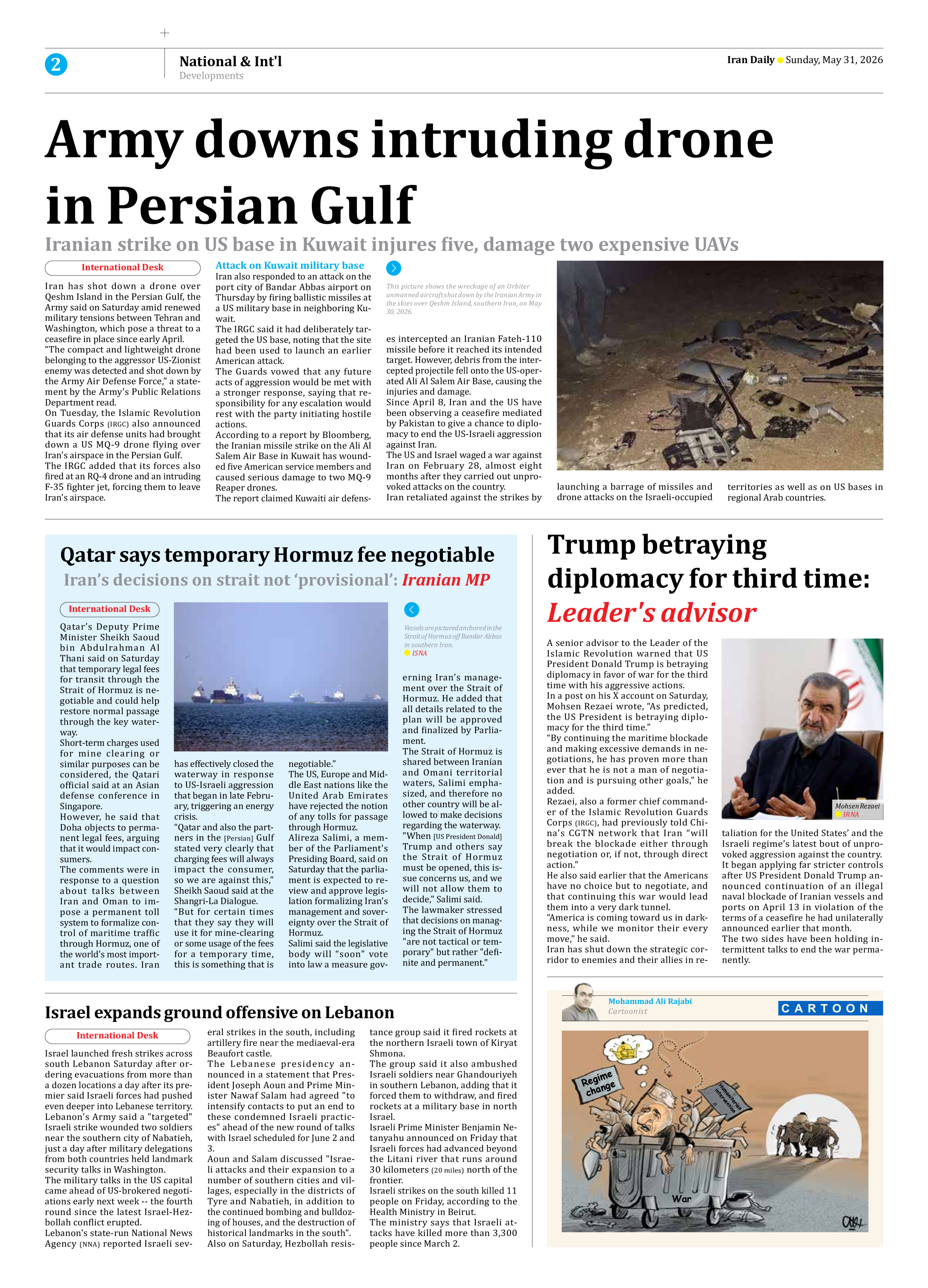
Qatar’s Deputy Prime Minister Sheikh Saoud bin Abdulrahman Al Thani said on Saturday that temporary legal fees for transit through the Strait of Hormuz is negotiable and could help restore normal passage through the key waterway.
Short-term charges used for mine clearing or similar purposes can be considered, the Qatari official said at an Asian defense conference in Singapore.
However, he said that Doha objects to permanent legal fees, arguing that it would impact consumers.
The comments were in response to a question about talks between Iran and Oman to impose a permanent toll system to formalize control of maritime traffic through Hormuz, one of the world’s most important trade routes. Iran has effectively closed the waterway in response to US-Israeli aggression that began in late February, triggering an energy crisis.
“Qatar and also the partners in the [Persian] Gulf stated very clearly that charging fees will always impact the consumer, so we are against this,” Sheikh Saoud said at the Shangri-La Dialogue.
“But for certain times that they say they will use it for mine-clearing or some usage of the fees for a temporary time, this is something that is negotiable.”
The US, Europe and Middle East nations like the United Arab Emirates have rejected the notion of any tolls for passage through Hormuz.
Alireza Salimi, a member of the Parliament's Presiding Board, said on Saturday that the parliament is expected to review and approve legislation formalizing Iran’s management and sovereignty over the Strait of Hormuz.
Salimi said the legislative body will “soon” vote into law a measure governing Iran’s management over the Strait of Hormuz. He added that all details related to the plan will be approved and finalized by Parliament.
The Strait of Hormuz is shared between Iranian and Omani territorial waters, Salimi emphasized, and therefore no other country will be allowed to make decisions regarding the waterway.
"When [US President Donald] Trump and others say the Strait of Hormuz must be opened, this issue concerns us, and we will not allow them to decide," Salimi said.
The lawmaker stressed that decisions on managing the Strait of Hormuz "are not tactical or temporary" but rather "definite and permanent."