







Why Washington misread Iran
Contradictions in 2025 US National Security Strategy
Political analyst
Recent geopolitical developments suggest that the Middle East is entering a new phase of strategic transformation in which power, security and regional political economy are being fundamentally redefined. In this context, the 2025 US National Security Strategy can be regarded as one of Washington’s most important strategic documents for understanding America’s evolving perception of the international system — and particularly the Middle East.
The document attempts to portray an America moving away from costly military entanglements in the region and redirecting its strategic focus toward competition with China, technological supremacy, artificial intelligence, critical supply chains and the Indo-Pacific. Yet despite this declared shift, a major contradiction remains between the strategy outlined in the document and Washington’s practical approach toward Iran. This contradiction not only weakens the coherence of US foreign policy, but also risks reproducing instability across an already fragile regional order.
At its core, the strategy reflects an unresolved tension within American grand strategy itself. Washington simultaneously seeks to reduce the Middle East’s strategic weight while continuing to preserve the same security architecture that historically defined US regional engagement. The result is a policy framework trapped between geopolitical retrenchment and geopolitical persistence.
Contradiction between strategic retrenchment and continued confrontation
The 2025 strategy explicitly argues that the United States is no longer structurally dependent on Middle Eastern oil. As a result of America’s transformation into one of the world’s largest energy producers and exporters, the Middle East is increasingly framed not as a core energy-security imperative but rather as a region of investment opportunities, technological partnerships and emerging geo-economic projects.
At least theoretically, this signals the end of a historical era in which the security of the Persian Gulf was considered indispensable to US national security. During much of the 20th century, Washington’s Middle East policy was fundamentally shaped by the need to guarantee uninterrupted energy flows to global markets. Today, however, American strategic documents increasingly emphasize resilience, technological competition and economic diversification over direct military dominance.
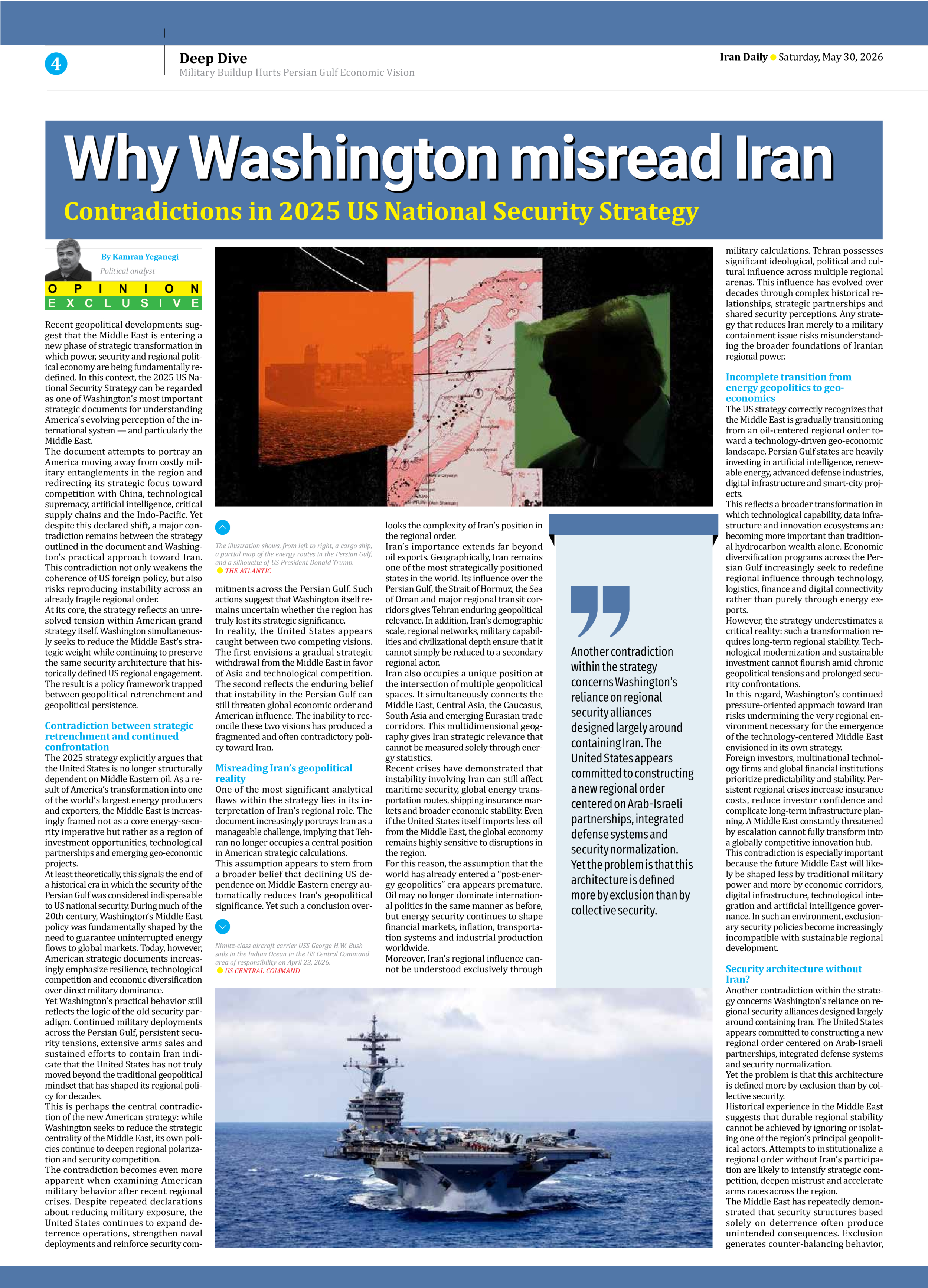
Yet Washington’s practical behavior still reflects the logic of the old security paradigm. Continued military deployments across the Persian Gulf, persistent security tensions, extensive arms sales and sustained efforts to contain Iran indicate that the United States has not truly moved beyond the traditional geopolitical mindset that has shaped its regional policy for decades.
This is perhaps the central contradiction of the new American strategy: while Washington seeks to reduce the strategic centrality of the Middle East, its own policies continue to deepen regional polarization and security competition.
The contradiction becomes even more apparent when examining American military behavior after recent regional crises. Despite repeated declarations about reducing military exposure, the United States continues to expand deterrence operations, strengthen naval deployments and reinforce security commitments across the Persian Gulf. Such actions suggest that Washington itself remains uncertain whether the region has truly lost its strategic significance.
In reality, the United States appears caught between two competing visions. The first envisions a gradual strategic withdrawal from the Middle East in favor of Asia and technological competition. The second reflects the enduring belief that instability in the Persian Gulf can still threaten global economic order and American influence. The inability to reconcile these two visions has produced a fragmented and often contradictory policy toward Iran.
Misreading Iran’s geopolitical reality
One of the most significant analytical flaws within the strategy lies in its interpretation of Iran’s regional role. The document increasingly portrays Iran as a manageable challenge, implying that Tehran no longer occupies a central position in American strategic calculations.
This assumption appears to stem from a broader belief that declining US dependence on Middle Eastern energy automatically reduces Iran’s geopolitical significance. Yet such a conclusion overlooks the complexity of Iran’s position in the regional order.
Iran’s importance extends far beyond oil exports. Geographically, Iran remains one of the most strategically positioned states in the world. Its influence over the Persian Gulf, the Strait of Hormuz, the Sea of Oman and major regional transit corridors gives Tehran enduring geopolitical relevance. In addition, Iran’s demographic scale, regional networks, military capabilities and civilizational depth ensure that it cannot simply be reduced to a secondary regional actor.
Iran also occupies a unique position at the intersection of multiple geopolitical spaces. It simultaneously connects the Middle East, Central Asia, the Caucasus, South Asia and emerging Eurasian trade corridors. This multidimensional geography gives Iran strategic relevance that cannot be measured solely through energy statistics.
Recent crises have demonstrated that instability involving Iran can still affect maritime security, global energy transportation routes, shipping insurance markets and broader economic stability. Even if the United States itself imports less oil from the Middle East, the global economy remains highly sensitive to disruptions in the region.
For this reason, the assumption that the world has already entered a “post-energy geopolitics” era appears premature. Oil may no longer dominate international politics in the same manner as before, but energy security continues to shape financial markets, inflation, transportation systems and industrial production worldwide.
Moreover, Iran’s regional influence cannot be understood exclusively through military calculations. Tehran possesses significant ideological, political and cultural influence across multiple regional arenas. This influence has evolved over decades through complex historical relationships, strategic partnerships and shared security perceptions. Any strategy that reduces Iran merely to a military containment issue risks misunderstanding the broader foundations of Iranian regional power.
Incomplete transition from energy geopolitics to geo-economics
The US strategy correctly recognizes that the Middle East is gradually transitioning from an oil-centered regional order toward a technology-driven geo-economic landscape. Persian Gulf states are heavily investing in artificial intelligence, renewable energy, advanced defense industries, digital infrastructure and smart-city projects.
This reflects a broader transformation in which technological capability, data infrastructure and innovation ecosystems are becoming more important than traditional hydrocarbon wealth alone. Economic diversification programs across the Persian Gulf increasingly seek to redefine regional influence through technology, logistics, finance and digital connectivity rather than purely through energy exports.
However, the strategy underestimates a critical reality: such a transformation requires long-term regional stability. Technological modernization and sustainable investment cannot flourish amid chronic geopolitical tensions and prolonged security confrontations.
In this regard, Washington’s continued pressure-oriented approach toward Iran risks undermining the very regional environment necessary for the emergence of the technology-centered Middle East envisioned in its own strategy.
Foreign investors, multinational technology firms and global financial institutions prioritize predictability and stability. Persistent regional crises increase insurance costs, reduce investor confidence and complicate long-term infrastructure planning. A Middle East constantly threatened by escalation cannot fully transform into a globally competitive innovation hub.
This contradiction is especially important because the future Middle East will likely be shaped less by traditional military power and more by economic corridors, digital infrastructure, technological integration and artificial intelligence governance. In such an environment, exclusionary security policies become increasingly incompatible with sustainable regional development.
Security architecture without Iran?
Another contradiction within the strategy concerns Washington’s reliance on regional security alliances designed largely around containing Iran. The United States appears committed to constructing a new regional order centered on Arab-Israeli partnerships, integrated defense systems and security normalization.
Yet the problem is that this architecture is defined more by exclusion than by collective security.
Historical experience in the Middle East suggests that durable regional stability cannot be achieved by ignoring or isolating one of the region’s principal geopolitical actors. Attempts to institutionalize a regional order without Iran’s participation are likely to intensify strategic competition, deepen mistrust and accelerate arms races across the region.
The Middle East has repeatedly demonstrated that security structures based solely on deterrence often produce unintended consequences. Exclusion generates counter-balancing behavior, strengthens hardline security thinking and reduces opportunities for regional diplomacy.
A sustainable regional security framework requires inclusive diplomacy rather than permanent geopolitical exclusion.
This does not necessarily imply the absence of competition between regional powers. Rivalries will continue to exist. However, effective regional order requires mechanisms capable of managing competition rather than endlessly escalating it. Without such mechanisms, instability becomes structurally embedded within the regional system itself.
The long-term challenge for Washington is that military alliances alone cannot provide political legitimacy for regional order. Stability ultimately depends on whether regional actors themselves perceive the security architecture as balanced, inclusive and sustainable.
The missing element: intellectual and academic diplomacy
Perhaps one of the most overlooked dimensions of the 2025 US National Security Strategy is its limited attention to intellectual, academic and societal dialogue in regional conflict management.
The crises of the Middle East are not purely military or security-related. They are also rooted in mutual mistrust, competing historical narratives, weak communication channels and the absence of sustainable regional dialogue mechanisms.
Military deterrence alone cannot create lasting stability.
The region increasingly requires what may be described as “elite diplomacy” — a framework in which universities, think tanks, scholars and intellectuals contribute to confidence-building, conflict reduction and regional understanding. Without such mechanisms, geopolitical tensions are likely to reproduce themselves regardless of shifting military balances.
Academic diplomacy can serve as an important bridge where formal political negotiations fail. Intellectual engagement helps reduce strategic misperceptions, promotes communication among regional elites and creates space for long-term confidence-building initiatives.
Historically, many major geopolitical rivalries were eventually moderated not only through military balance but also through sustained intellectual and institutional dialogue. The Middle East today suffers from a severe deficit of such dialogue mechanisms.
A future-oriented regional strategy should therefore invest not only in military alliances and economic projects, but also in educational exchanges, regional research institutions and platforms for sustained policy dialogue among regional actors.
A strategic reality Washington cannot ignore
Ultimately, Iran cannot simply be defined as a manageable security challenge. Iran constitutes an integral part of the Middle East’s geopolitical, historical and civilizational structure. Any future regional order that attempts to marginalize Iran or reduce its role to a containment problem will inevitably face structural limitations.
The central issue is not whether Washington agrees with Iranian regional policies. Rather, the issue is whether American strategy is prepared to recognize that durable regional stability requires acknowledging geopolitical realities instead of attempting to bypass them.
The Middle East is no longer entering an era defined exclusively by oil geopolitics or traditional military competition. The region is gradually evolving toward a more complex environment shaped by technology, connectivity, economics and strategic interdependence. Yet this transition cannot succeed under conditions of permanent confrontation and strategic exclusion.
The future stability of the region will depend not only on military deterrence, but also on whether regional and global actors can construct a more inclusive security framework capable of balancing competition with cooperation.
The fundamental question today is whether Washington is prepared to fundamentally reconsider its understanding of Iran and the Middle East — or whether it will continue attempting to manage an increasingly complex region through outdated geopolitical assumptions.
The future of regional stability may depend largely on the answer.