





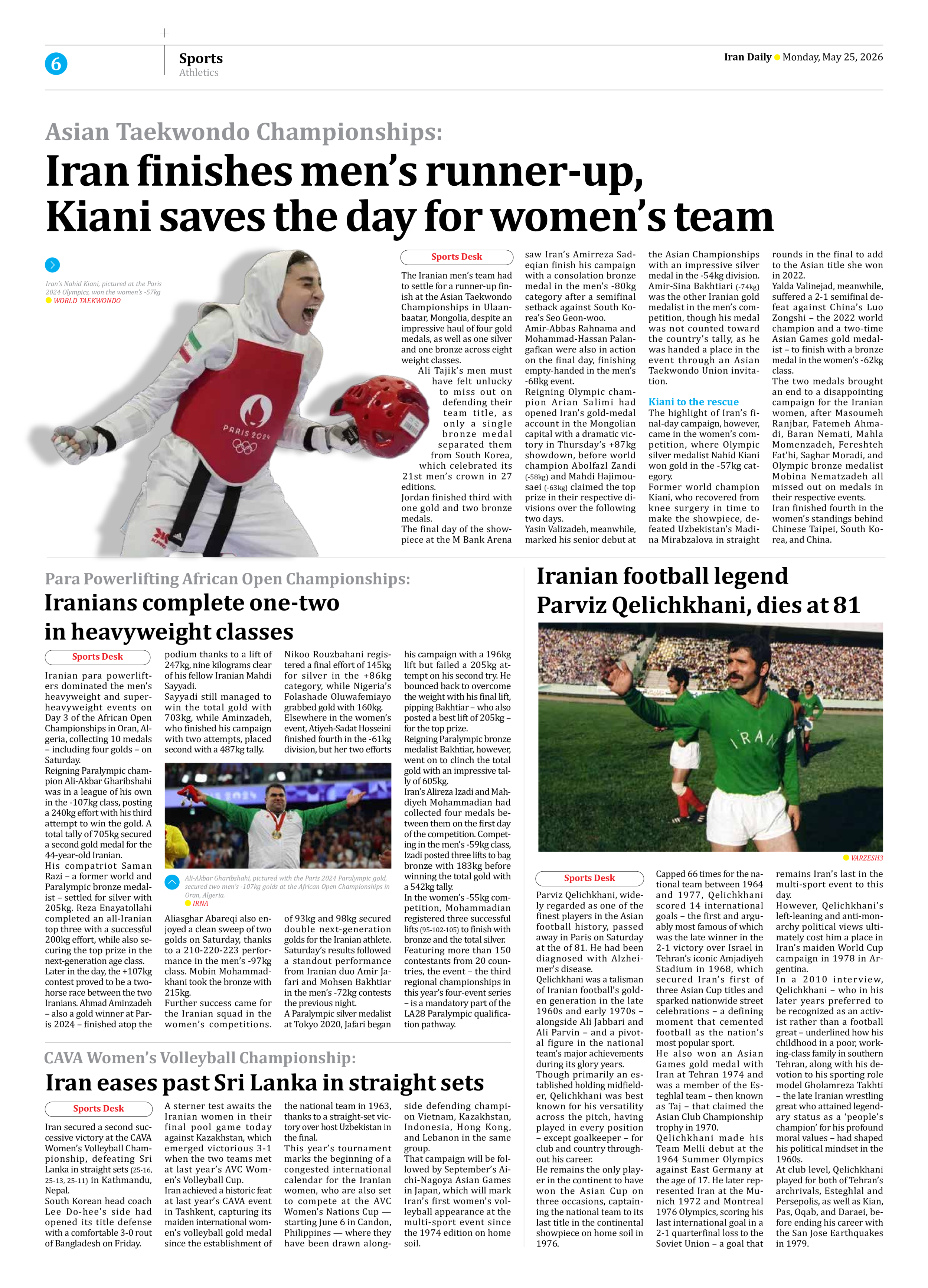


Iranian football legend Parviz Qelichkhani, dies at 81
Parviz Qelichkhani, widely regarded as one of the finest players in the Asian football history, passed away in Paris on Saturday at the of 81. He had been diagnosed with Alzheimer’s disease.
Qelichkhani was a talisman of Iranian football’s golden generation in the late 1960s and early 1970s – alongside Ali Jabbari and Ali Parvin – and a pivotal figure in the national team’s major achievements during its glory years.
Though primarily an established holding midfielder, Qelichkhani was best known for his versatility across the pitch, having played in every position – except goalkeeper – for club and country throughout his career.
He remains the only player in the continent to have won the Asian Cup on three occasions, captaining the national team to its last title in the continental showpiece on home soil in 1976.
Capped 66 times for the national team between 1964 and 1977, Qelichkhani scored 14 international goals – the first and arguably most famous of which was the late winner in the 2-1 victory over Israel in Tehran’s iconic Amjadiyeh Stadium in 1968, which secured Iran’s first of three Asian Cup titles and sparked nationwide street celebrations – a defining moment that cemented football as the nation’s most popular sport.
He also won an Asian Games gold medal with Iran at Tehran 1974 and was a member of the Esteghlal team – then known as Taj – that claimed the Asian Club Championship trophy in 1970.
Qelichkhani made his Team Melli debut at the 1964 Summer Olympics against East Germany at the age of 17. He later represented Iran at the Munich 1972 and Montreal 1976 Olympics, scoring his last international goal in a 2-1 quarterfinal loss to the Soviet Union – a goal that remains Iran’s last in the multi-sport event to this day.
However, Qelichkhani’s left-leaning and anti-monarchy political views ultimately cost him a place in Iran’s maiden World Cup campaign in 1978 in Argentina.
In a 2010 interview, Qelichkhani – who in his later years preferred to be recognized as an activist rather than a football great – underlined how his childhood in a poor, working-class family in southern Tehran, along with his devotion to his sporting role model Gholamreza Takhti – the late Iranian wrestling great who attained legendary status as a ‘people’s champion’ for his profound moral values – had shaped his political mindset in the 1960s.
At club level, Qelichkhani played for both of Tehran’s archrivals, Esteghlal and Persepolis, as well as Kian, Pas, Oqab, and Daraei, before ending his career with the San Jose Earthquakes in 1979.