







In parks, on rooftops
Urban beekeeping takes flight in US
Freelance journalist
Pick any commercial office building in DC this summer and there’s a decent chance that at least 50,000 winged insects call the rooftop their home. That’s the typical size of a single honeybee hive. Some are self-managed; others are maintained by companies that specialize in urban apiculture.
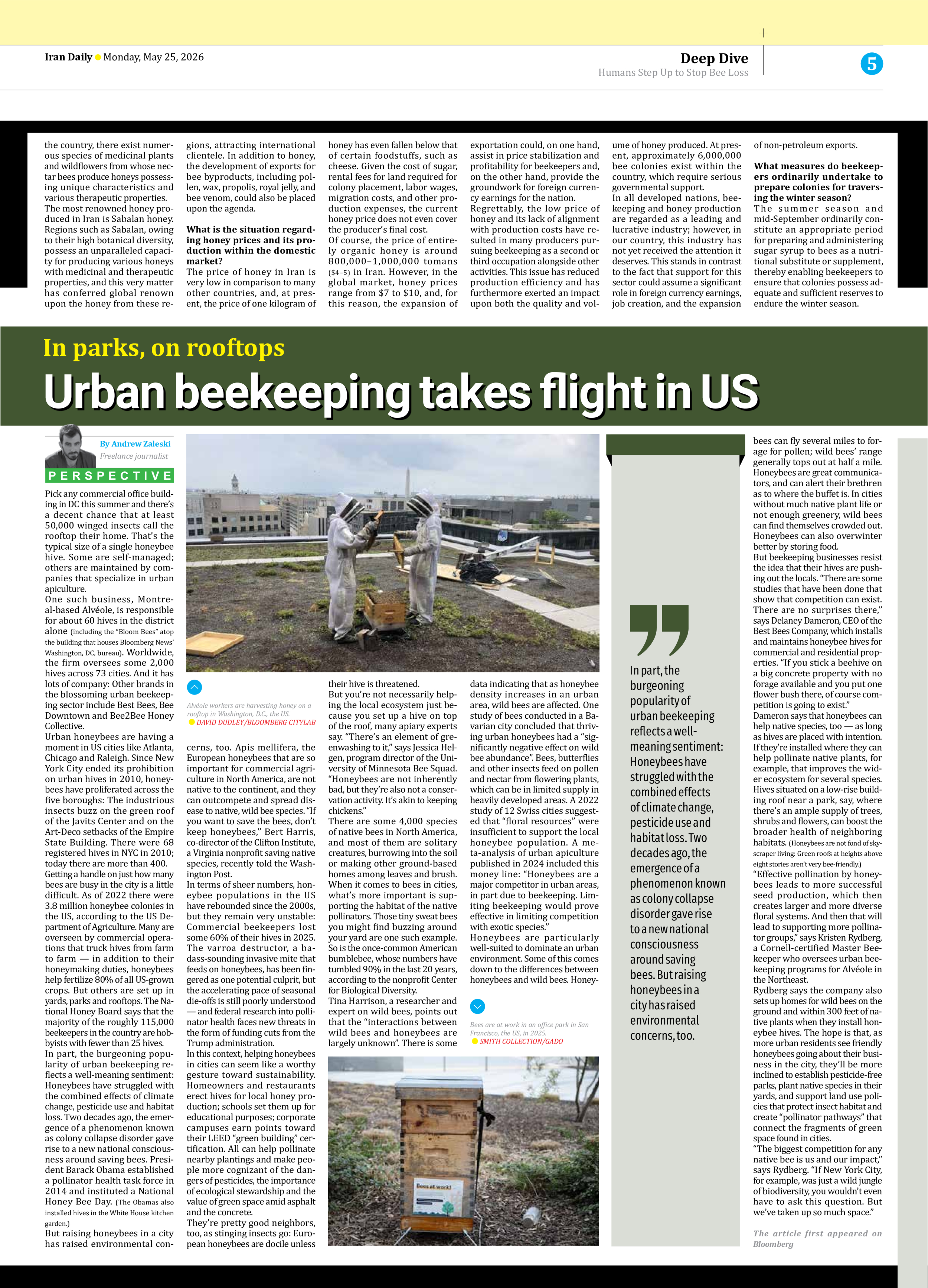
One such business, Montreal-based Alvéole, is responsible for about 60 hives in the district alone (including the “Bloom Bees” atop the building that houses Bloomberg News’ Washington, DC, bureau). Worldwide, the firm oversees some 2,000 hives across 73 cities. And it has lots of company: Other brands in the blossoming urban beekeeping sector include Best Bees, Bee Downtown and Bee2Bee Honey Collective.
Urban honeybees are having a moment in US cities like Atlanta, Chicago and Raleigh. Since New York City ended its prohibition on urban hives in 2010, honeybees have proliferated across the five boroughs: The industrious insects buzz on the green roof of the Javits Center and on the Art-Deco setbacks of the Empire State Building. There were 68 registered hives in NYC in 2010; today there are more than 400.
Getting a handle on just how many bees are busy in the city is a little difficult. As of 2022 there were 3.8 million honeybee colonies in the US, according to the US Department of Agriculture. Many are overseen by commercial operations that truck hives from farm to farm — in addition to their honeymaking duties, honeybees help fertilize 80% of all US-grown crops. But others are set up in yards, parks and rooftops. The National Honey Board says that the majority of the roughly 115,000 beekeepers in the country are hobbyists with fewer than 25 hives.
In part, the burgeoning popularity of urban beekeeping reflects a well-meaning sentiment: Honeybees have struggled with the combined effects of climate change, pesticide use and habitat loss. Two decades ago, the emergence of a phenomenon known as colony collapse disorder gave rise to a new national consciousness around saving bees. President Barack Obama established a pollinator health task force in 2014 and instituted a National Honey Bee Day. (The Obamas also installed hives in the White House kitchen garden.)
But raising honeybees in a city has raised environmental concerns, too. Apis mellifera, the European honeybees that are so important for commercial agriculture in North America, are not native to the continent, and they can outcompete and spread disease to native, wild bee species. “If you want to save the bees, don’t keep honeybees,” Bert Harris, co-director of the Clifton Institute, a Virginia nonprofit saving native species, recently told the Washington Post.
In terms of sheer numbers, honeybee populations in the US have rebounded since the 2000s, but they remain very unstable: Commercial beekeepers lost some 60% of their hives in 2025. The varroa destructor, a badass-sounding invasive mite that feeds on honeybees, has been fingered as one potential culprit, but the accelerating pace of seasonal die-offs is still poorly understood — and federal research into pollinator health faces new threats in the form of funding cuts from the Trump administration.
In this context, helping honeybees in cities can seem like a worthy gesture toward sustainability. Homeowners and restaurants erect hives for local honey production; schools set them up for educational purposes; corporate campuses earn points toward their LEED “green building” certification. All can help pollinate nearby plantings and make people more cognizant of the dangers of pesticides, the importance of ecological stewardship and the value of green space amid asphalt and the concrete.
They’re pretty good neighbors, too, as stinging insects go: European honeybees are docile unless their hive is threatened.
But you’re not necessarily helping the local ecosystem just because you set up a hive on top of the roof, many apiary experts say. “There’s an element of greenwashing to it,” says Jessica Helgen, program director of the University of Minnesota Bee Squad. “Honeybees are not inherently bad, but they’re also not a conservation activity. It’s akin to keeping chickens.”
There are some 4,000 species of native bees in North America, and most of them are solitary creatures, burrowing into the soil or making other ground-based homes among leaves and brush. When it comes to bees in cities, what’s more important is supporting the habitat of the native pollinators. Those tiny sweat bees you might find buzzing around your yard are one such example. So is the once-common American bumblebee, whose numbers have tumbled 90% in the last 20 years, according to the nonprofit Center for Biological Diversity.
Tina Harrison, a researcher and expert on wild bees, points out that the “interactions between wild bees and honeybees are largely unknown”. There is some data indicating that as honeybee density increases in an urban area, wild bees are affected. One study of bees conducted in a Bavarian city concluded that thriving urban honeybees had a “significantly negative effect on wild bee abundance”. Bees, butterflies and other insects feed on pollen and nectar from flowering plants, which can be in limited supply in heavily developed areas. A 2022 study of 12 Swiss cities suggested that “floral resources” were insufficient to support the local honeybee population. A meta-analysis of urban apiculture published in 2024 included this money line: “Honeybees are a major competitor in urban areas, in part due to beekeeping. Limiting beekeeping would prove effective in limiting competition with exotic species.”
Honeybees are particularly well-suited to dominate an urban environment. Some of this comes down to the differences between honeybees and wild bees. Honeybees can fly several miles to forage for pollen; wild bees’ range generally tops out at half a mile. Honeybees are great communicators, and can alert their brethren as to where the buffet is. In cities without much native plant life or not enough greenery, wild bees can find themselves crowded out. Honeybees can also overwinter better by storing food.
But beekeeping businesses resist the idea that their hives are pushing out the locals. “There are some studies that have been done that show that competition can exist. There are no surprises there,” says Delaney Dameron, CEO of the Best Bees Company, which installs and maintains honeybee hives for commercial and residential properties. “If you stick a beehive on a big concrete property with no forage available and you put one flower bush there, of course competition is going to exist.”
Dameron says that honeybees can help native species, too — as long as hives are placed with intention. If they’re installed where they can help pollinate native plants, for example, that improves the wider ecosystem for several species. Hives situated on a low-rise building roof near a park, say, where there’s an ample supply of trees, shrubs and flowers, can boost the broader health of neighboring habitats. (Honeybees are not fond of skyscraper living: Green roofs at heights above eight stories aren’t very bee-friendly.)
“Effective pollination by honeybees leads to more successful seed production, which then creates larger and more diverse floral systems. And then that will lead to supporting more pollinator groups,” says Kristen Rydberg, a Cornell-certified Master Beekeeper who oversees urban beekeeping programs for Alvéole in the Northeast.
Rydberg says the company also sets up homes for wild bees on the ground and within 300 feet of native plants when they install honeybee hives. The hope is that, as more urban residents see friendly honeybees going about their business in the city, they’ll be more inclined to establish pesticide-free parks, plant native species in their yards, and support land use policies that protect insect habitat and create “pollinator pathways” that connect the fragments of green space found in cities.
“The biggest competition for any native bee is us and our impact,” says Rydberg. “If New York City, for example, was just a wild jungle of biodiversity, you wouldn’t even have to ask this question. But we’ve taken up so much space.”
The article first appeared on Bloomberg