







Iran’s leadership stability, military power altering US strategy
While the Trump administration confronts the most severe crises of credibility and efficaciousness within foreign policy, its 12-Day and Ramadan wars with Iran have fundamentally changed the security and economic equations of the United States. In an interview with Farid Marjai, an Iranian foreign policy and international relations expert based in America, an examination of Washington’s strategic discombobulation vis-à-vis Iran has been undertaken. In this interview, Marjai, referencing that Donald Trump has deviated from his professed foreign policy doctrines — the paramount one of which was the avoidance of initiating troublesome conflicts — emphatically asserts that the White House, in this dossier, finds itself ensnared within an impasse; a condition wherein the exhibition of Iran’s asymmetrical proficiencies, the perpetuation of war management, and the closure of the Strait of Hormuz have reconfigured Washington’s strategic calculations. A translation of this interview’s transcript follows below.
The United States has, within less than one and a half years, experienced two wars (the 12-day and the Ramadan war) with Iran. Given that American society is generally fatigued by the unending entanglements of the Middle East, how does the public opinion in America perceive their nation’s entry into this war?
MARJAI: Indeed, the public opinion is a very important matter. The reality is that the American public has become weary of war; particularly the Iraq, Libya, and Afghanistan conflicts, none of which yielded successful outcomes for this country. A segment of the populace perceives that these wars have imposed heavy financial costs; expenditures that could have been allocated toward development, medical treatment, and welfare matters, yet this issue is not that well-documented or well-articulated.
Nevertheless, one must consider that this fatigue is not one of perpetual and everlasting war and will endure only for a limited duration. We observed this same pattern during the Vietnam War era; subsequent to the defeat and extensive bloodshed in Vietnam, American culture remained under the influence of that event for a period, but later, the power system endeavored to extricate itself from this condition, calling it the “Vietnam Syndrome”.
Therefore, one can sum up that the American public is discontented with this war because, during the past one or two decades, it has been directly engaged with it. However, in actuality, one must consider another dimension; American public opinion does not materialize within a vacuum and is profoundly oriented toward the mainstream media, which are powerful and fabricate public opinion. Noam Chomsky, in his numerous writings, elucidates that the media construct paradigms and serve that power bloc and the ruling system; whether that power belongs to bankers and capitalists, or the influence of the Israeli lobby. In reality, the Neo-Conservatives have, for the past 30 to 40 years, pursued a project according to which America must always be prepared for war. This “America, prepared for war,” can support Israel.
Thus, if this has been their objective, they have attempted to establish an associated political culture. And one must consider that the majority of the American or British populace lack access to alternative media, news, or narratives, and only the monopolistic narration of the dominant media prevails. In comparison, for example, you witness in Iran, West Asia, or Latin America alternative media that present divergent narratives relative to the established media.
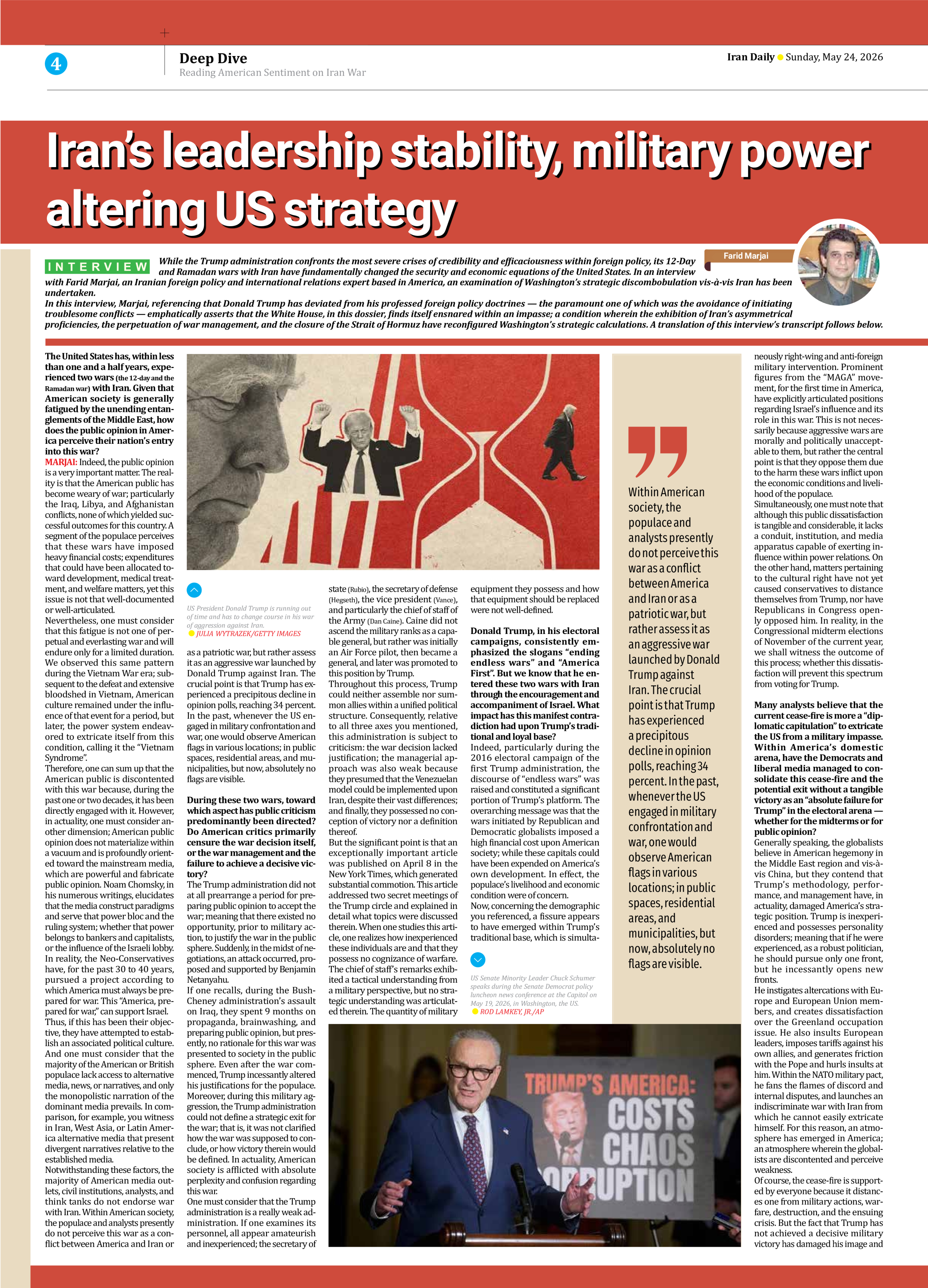
Notwithstanding these factors, the majority of American media outlets, civil institutions, analysts, and think tanks do not endorse war with Iran. Within American society, the populace and analysts presently do not perceive this war as a conflict between America and Iran or as a patriotic war, but rather assess it as an aggressive war launched by Donald Trump against Iran. The crucial point is that Trump has experienced a precipitous decline in opinion polls, reaching 34 percent. In the past, whenever the US engaged in military confrontation and war, one would observe American flags in various locations; in public spaces, residential areas, and municipalities, but now, absolutely no flags are visible.
During these two wars, toward which aspect has public criticism predominantly been directed? Do American critics primarily censure the war decision itself, or the war management and the failure to achieve a decisive victory?
The Trump administration did not at all prearrange a period for preparing public opinion to accept the war; meaning that there existed no opportunity, prior to military action, to justify the war in the public sphere. Suddenly, in the midst of negotiations, an attack occurred, proposed and supported by Benjamin Netanyahu.
If one recalls, during the Bush-Cheney administration’s assault on Iraq, they spent 9 months on propaganda, brainwashing, and preparing public opinion, but presently, no rationale for this war was presented to society in the public sphere. Even after the war commenced, Trump incessantly altered his justifications for the populace. Moreover, during this military aggression, the Trump administration could not define a strategic exit for the war; that is, it was not clarified how the war was supposed to conclude, or how victory therein would be defined. In actuality, American society is afflicted with absolute perplexity and confusion regarding this war.
One must consider that the Trump administration is a really weak administration. If one examines its personnel, all appear amateurish and inexperienced; the secretary of state (Rubio), the secretary of defense (Hegseth), the vice president (Vance), and particularly the chief of staff of the Army (Dan Caine). Caine did not ascend the military ranks as a capable general, but rather was initially an Air Force pilot, then became a general, and later was promoted to this position by Trump.
Throughout this process, Trump could neither assemble nor summon allies within a unified political structure. Consequently, relative to all three axes you mentioned, this administration is subject to criticism: the war decision lacked justification; the managerial approach was also weak because they presumed that the Venezuelan model could be implemented upon Iran, despite their vast differences; and finally, they possessed no conception of victory nor a definition thereof.
But the significant point is that an exceptionally important article was published on April 8 in the New York Times, which generated substantial commotion. This article addressed two secret meetings of the Trump circle and explained in detail what topics were discussed therein. When one studies this article, one realizes how inexperienced these individuals are and that they possess no cognizance of warfare. The chief of staff’s remarks exhibited a tactical understanding from a military perspective, but no strategic understanding was articulated therein. The quantity of military equipment they possess and how that equipment should be replaced were not well-defined.
Donald Trump, in his electoral campaigns, consistently emphasized the slogans “ending endless wars” and “America First”. But we know that he entered these two wars with Iran through the encouragement and accompaniment of Israel. What impact has this manifest contradiction had upon Trump’s traditional and loyal base?
Indeed, particularly during the 2016 electoral campaign of the first Trump administration, the discourse of “endless wars” was raised and constituted a significant portion of Trump’s platform. The overarching message was that the wars initiated by Republican and Democratic globalists imposed a high financial cost upon American society; while these capitals could have been expended on America’s own development. In effect, the populace’s livelihood and economic condition were of concern.
Now, concerning the demographic you referenced, a fissure appears to have emerged within Trump’s traditional base, which is simultaneously right-wing and anti-foreign military intervention. Prominent figures from the “MAGA” movement, for the first time in America, have explicitly articulated positions regarding Israel’s influence and its role in this war. This is not necessarily because aggressive wars are morally and politically unacceptable to them, but rather the central point is that they oppose them due to the harm these wars inflict upon the economic conditions and livelihood of the populace.
Simultaneously, one must note that although this public dissatisfaction is tangible and considerable, it lacks a conduit, institution, and media apparatus capable of exerting influence within power relations. On the other hand, matters pertaining to the cultural right have not yet caused conservatives to distance themselves from Trump, nor have Republicans in Congress openly opposed him. In reality, in the Congressional midterm elections of November of the current year, we shall witness the outcome of this process; whether this dissatisfaction will prevent this spectrum from voting for Trump.
Many analysts believe that the current cease-fire is more a “diplomatic capitulation” to extricate the US from a military impasse. Within America’s domestic arena, have the Democrats and liberal media managed to consolidate this cease-fire and the potential exit without a tangible victory as an “absolute failure for Trump” in the electoral arena — whether for the midterms or for public opinion?
Generally speaking, the globalists believe in American hegemony in the Middle East region and vis-à-vis China, but they contend that Trump’s methodology, performance, and management have, in actuality, damaged America’s strategic position. Trump is inexperienced and possesses personality disorders; meaning that if he were experienced, as a robust politician, he should pursue only one front, but he incessantly opens new fronts.
He instigates altercations with Europe and European Union members, and creates dissatisfaction over the Greenland occupation issue. He also insults European leaders, imposes tariffs against his own allies, and generates friction with the Pope and hurls insults at him. Within the NATO military pact, he fans the flames of discord and internal disputes, and launches an indiscriminate war with Iran from which he cannot easily extricate himself. For this reason, an atmosphere has emerged in America; an atmosphere wherein the globalists are discontented and perceive weakness.
Of course, the cease-fire is supported by everyone because it distances one from military actions, warfare, destruction, and the ensuing crisis. But the fact that Trump has not achieved a decisive military victory has damaged his image and prestige. Many analysts even feel that, strategically, Iran has gained a slight upper hand in this war.
Therefore, as you indicated, the Democrats, liberals, and even those situated in the (political) center perceive weakness and anxiety within the Trump administration, and, of course, the reflection of this matter influences public opinion. Nevertheless, in the elections, the most profound crisis that the war has engendered for America, namely the economic crisis and the cost of living for the populace, will be raised, and the Democrats shall concentrate upon it.
A few days ago, one of the prominent figures of the Neo-Conservative current; Mr. Robert Kagan (spouse of Mrs. Victoria Nuland), wrote an article in The Atlantic that generated substantial commotion and was staggering. He characterized the war and Trump’s action as a defeat and weakness for America, and believes that post-war conditions can no longer return to the pre-war state. The adoption of such a position by a Neo-Conservative and supporter of Israel was truly astonishing.
In your estimation, will the Democratic Party seek to exploit the critical atmosphere against Trump engendered by this war in the midterm elections?
Without any doubt, in the forthcoming elections, the Democratic Party will exploit the chaos and lack of planning in Trump’s foreign policy. This disarray is not only manifest in strategic disorder in relations with Europe, but also includes a lack of direction in initiating an aimless war with Iran in the region, a war that has thus far produced no result.
A number of Senators, including a Democratic Senator from Connecticut and Senator Bernie Sanders, have declared that the cost of the war for America will be far greater than the Trump administration’s estimates. The Democrats emphasize that at a time when the populace requires health insurance, employment, and infrastructural reconstruction, these capitals should have been expended domestically, rather than being squandered on adventurism in a war that has held no meaning for the people.
But the more important point is that, due to inflation and price increases, the Democrats will concentrate their primary focus upon the war’s impact on the nation’s economy and the populace’s livelihood; a factor that constitutes the most significant indicator in elections.
Israel provoked, encouraged, and accompanied America in both wars. Has this matter created a fissure within American public opinion, which previously perceived Israel as a strategic ally?
The vast majority of American society is unaware of the reality that Israel provoked and encouraged America toward war. The populace was induced to believe that the war’s objective was to prevent Iran’s acquisition of nuclear weapons or to halt Tehran’s support for terrorism in the region; the same stereotypical narratives repeated for years.
Perhaps the societal body is unaware that a successful agreement named the JCPOA existed, and that Trump, through his withdrawal from that deal, engendered the crisis; a matter about which American public awareness is exceedingly minuscule. Israel’s role in the war decision is primarily raised in news agencies outside the United States. Of course, a political minority within society is cognizant of Israel’s scheme, but, due to power relations, they have acquiesced to it and have not reached a new stage of confrontation regarding Israel.
Given the role of Netanyahu and Israeli lobbies in instigating this war, can one assert that the traditional narrative in Washington (that “Israel is the executive arm of American interests in the Middle East”) has been shattered, and that Washington has now effectively become the executive arm of the interests of Israeli radicals?
The main body of American society possesses little awareness of the existence of Israeli lobbies, and, therefore, in the absence of such awareness, no particular sensitivity toward this matter develops. Most people cannot even articulate the names of these institutions nor are they informed of their existence. For example, in Iran, we recognize AIPAC or the Washington Institute for Near East Policy, but the American populace does not possess such recognition. Of course, the powerful political class and academics have complete awareness of the Israeli lobby, and some intellectuals and university professors speak about it.
But individuals who themselves belong to the powerful political class, whether in the media or in Congress, perceive their professional position as contingent upon comprehensive support for Israel. Whether America is an instrument of Israel or Israel is an instrument of America is a matter that is not widely raised in the public sphere.
The social and political conditions in America have evolved such that this country displays complete and total support for Israel, even if this support contravenes American national interests; of course, this matter is consistently justified. Perhaps one could say that a degree of cynicism toward the person of Benjamin Netanyahu has now developed within the political class, but this cynicism has not reached a level that would affect the overall American-Israeli relationship.
One must consider that many billionaires possess particular orientations and do not maintain a neutral stance; they vigorously support Israel; among them, Sheldon Adelson, who owned casinos, and Larry Ellison, who is part of the new digital architecture and has now created a media empire.
As another example, Marco Rubio, who is now secretary of state, was propped up in his youth in Florida by two Zionist billionaires named Norman Braman and Larry Ellison and was elevated to the position of Florida Senator. Such is the manner in which power relations are constituted.
Among the Democratic elites and even segments of the Republicans (such as the old conservative movement), has a voice been raised calling for a reexamination of the unconditional relationship with Israel due to the repercussions of this war and, prior to it, Israel’s conduct in Gaza?
One could say that, although voices from civil society, a few activists, artists, and student protesters have been raised in criticism of Israel, opposition to Israel does not occur within the Democratic and traditional conservative mainstream because the power relations in the United States have been constituted in this manner. Criticisms are directed more at Trump and his administration since criticizing Trump is safer for any individual within the system.
It should be recalled that President Obama could not secure Congressional ratification of the JCPOA, but the more important point is that many of the Democrats themselves in Congress did not support Obama’s JCPOA. Only a few individuals such as Bernie Sanders, Zohran Mamdani, Ms. Rashida Tlaib, and Ms. Ilhan Omar have now raised serious discussions about the Iran war, but this matter did not become a social issue within the entire system.
It is recalled that during the two years of the historical catastrophe in Gaza, the Democrats and those same old conservatives remained silent in the face of that historical catastrophe and genocide. An example of this condition is the New York City mayoral election a few months ago; after Israel’s genocide in Gaza, during the electoral debates, the five candidates were asked what the first thing they would do as mayor would be. Four candidates answered: travel to Israel. Only Zohran Mamdani said that he would remain in New York and will not go to Israel.
In conclusion, a sociological point must be recalled: one cannot view the developments in America through the lens of Iran’s historical experience and awareness, or that of the Global South. Rather, one must regard the developments of this country based upon the power relations within American society.
The Pentagon and American security institutions (the Deep State) are generally opposed to endless wars, and recent reports also indicate that the military establishment opposed the recent war. Did what transpired lead to the weakening of the position of security institutions in America, or, conversely, could the result of this adventurism serve their interests?
This matter depends on the case. The senior military officials of the Pentagon did not concur with the war against Iran, and this opposition was reflected because they did not perceive a correct strategy in that war. Concurrently, Trump’s Secretary of Defense Pete Hegseth, who is a neophyte, amateur, and boastful individual, has retired a number of army commanders.
But another process also exists; some of the individuals who retire from the Pentagon subsequently go to work for the arms lobby, securing highly profitable positions there. The arms lobby, or the “military-industrial complex,” is exceedingly powerful in the country and in Congress. They sometimes support war because their weaponry is utilized in war. In the present conflict with Iran, a portion of the arsenals has been depleted, and, consequently, weapons manufacturing corporations receive additional contracts. Some weapons manufacturing corporations are listed on the stock exchange, and when people purchase shares in these corporations, they unconsciously benefit from this condition.
The general public’s attention is more directed toward the White House and Congress than toward the Pentagon or the Deep State because the Pentagon is expected merely to be subordinate to the administration’s orders and decisions.
One of Iran’s momentous achievements in these two wars has been the demonstration of proficiency in a “medium-duration asymmetrical war” against the American-Israeli coalition. Have the American political and military elites concluded that Iran’s deterrent model is no longer defeatable through military force, and, if so, in which direction will they proceed in confronting Iran?
In my opinion, even before the war commenced, the political elites and powerholders perceived conflict with Iran as crisis-ridden and futile. Now that the war has occurred and Iran’s proficiency in this asymmetrical war has been demonstrated, this conclusion opposing war has certainly been consolidated and fortified.
In this asymmetrical war, Iran’s military capability was deployed really fast, merely hours subsequent to the surprise attacks in the 12-day and Ramadan wars. The missile and drone forces did not cease operations until the cease-fire was declared. Although the army’s leadership and military commanders were eliminated on the first day of the Ramadan war, war management nevertheless continued. All these factors have led to this conclusion. Therefore, American political elites in the future shall certainly not select the military force option. They shall either arrive at an agreement with Iran that constitutes a win-win accord, or they shall revert once again to the pressure of comprehensive sanctions as a coercive instrument, employing it to engender pressure within Iran.
War exacts a cost. Given the disruptions created in the energy supply chain and the direct military expenditures, what has been the impact of these two wars upon America’s domestic economy?
Unexpectedly, the war transformed from a geographical domain into an arena within the energy and economic spheres. Before the war (the military aggression), no one considered the strategic importance of the Strait of Hormuz to such an extent. The International Energy Agency (IEA) has reported the largest supply shock in the history of the oil and energy industry.
It has once again been proven the degree to which various sectors of the global economy are interconnected. The increase in the prices of oil, gasoline, and fertilizer has had a profound impact upon the global economy. Initially, the Trump administration claimed that America is self-sufficient in oil and would not be influenced by the global oil market, but the experience of this war demonstrated very rapidly that an increase in the global price of oil leads to an increase in the price of gasoline in America as well. Since the price of gasoline and fuel affects the transportation of goods, consequently, the prices of consumer goods have also increased in the American market.
The price increases in America have perpetuated inflation, a matter that has directly overshadowed the populace’s livelihood. If citizens’ incomes and salaries do not increase commensurately with inflation, there’s the real threat of economic recession.
In this regard, Donald Trump has selected an individual named Kevin Warsh for the chairmanship of America’s central bank (the Federal Reserve). Trump had previously also always pressured the former central bank chairman to reduce interest rates. Now, Warsh finds himself in a singular position and must choose between acceding to Trump’s partisan directives and pursuing what he deems salutary for the nation’s economy.
The interview first appeared in
Persian on IRNA.