







The Parsis of India
An opportunity for Iran’s cultural diplomacy, soft power
By Golnaz Saeedi
International affairs researcher
The Parsi community of India are descendants of a historic migration following the fall of the Sassanian Empire. They are not only bearers of a segment of Iran’s cultural, religious, and civilisational memory but have also emerged as one of the most successful diasporic communities of Iranian origin in the Indian subcontinent. Despite centuries of geographical separation from their ancestral homeland, this community has maintained profound ties to the spiritual, linguistic, and ritual heritage of Iran.
In the current regional and international context, the Islamic Republic of Iran can leverage the cultural, economic, and social capital of the Parsis to devise a novel strategy for enhancing its soft power, cultural diplomacy, and the representation of Islamic-Iranian civilisation in South Asia. This article analyses the opportunities available to Iran by focusing on the Parsi community’s cultural elements, civilisational symbols, and economic stature, with the aim of deepening transnational bonds and fostering purposeful engagement with this distinguished community.
The findings suggest that a discerning and non-instrumentalist revival of these ties could elevate the regional standing of Islamic Iran while advancing cultural, scientific, and economic objectives within the framework of public diplomacy.
A civilizational bond
with Islamic Iran
The Parsis of India are descendants of a historic migration triggered by religious and social pressures following the collapse of the Sassanian Empire and the spread of Islam in Iran. Around the 8th century CE, they sought refuge in western India. According to the traditional narrative known as the Qissa-i Sanjan, a group of Zoroastrians from southern Iran crossed the Persian Gulf and settled in Sanjan, Gujarat, after securing asylum from a local ruler. In exchange for sanctuary, they pledged respect for local customs, thereby securing their right to reside.
Despite centuries of geographical separation, this migrant community has demonstrated remarkable fidelity to Iran’s religious, linguistic, and cultural traditions, preserving a fragment of Iranian-Islamic civilisational memory in India. Though adhering to Zoroastrianism, the Parsis’ cultural and linguistic elements remain vessels of Islamic-Iranian civilisational concepts. Notions such as Asha (truth/righteousness), “Good Thoughts, Good Words, Good Deeds,” and reverence for nature, alongside the preservation of Sassanian architectural motifs and rituals, reflect the enduring spirit of Iranian culture.
While Gujarati and English dominate daily use, the community’s familiarity with Persian and Avestan vocabulary, and their employment of Avestan alphabet (din dabire) for religious texts, underscores their linguistic ties to Iran. Terms like “Atashkadeh” (fire temple), “Namaz” (prayer), “Fravashi” (divine spirit), and “Ahura” remain vibrant in their cultural lexicon.
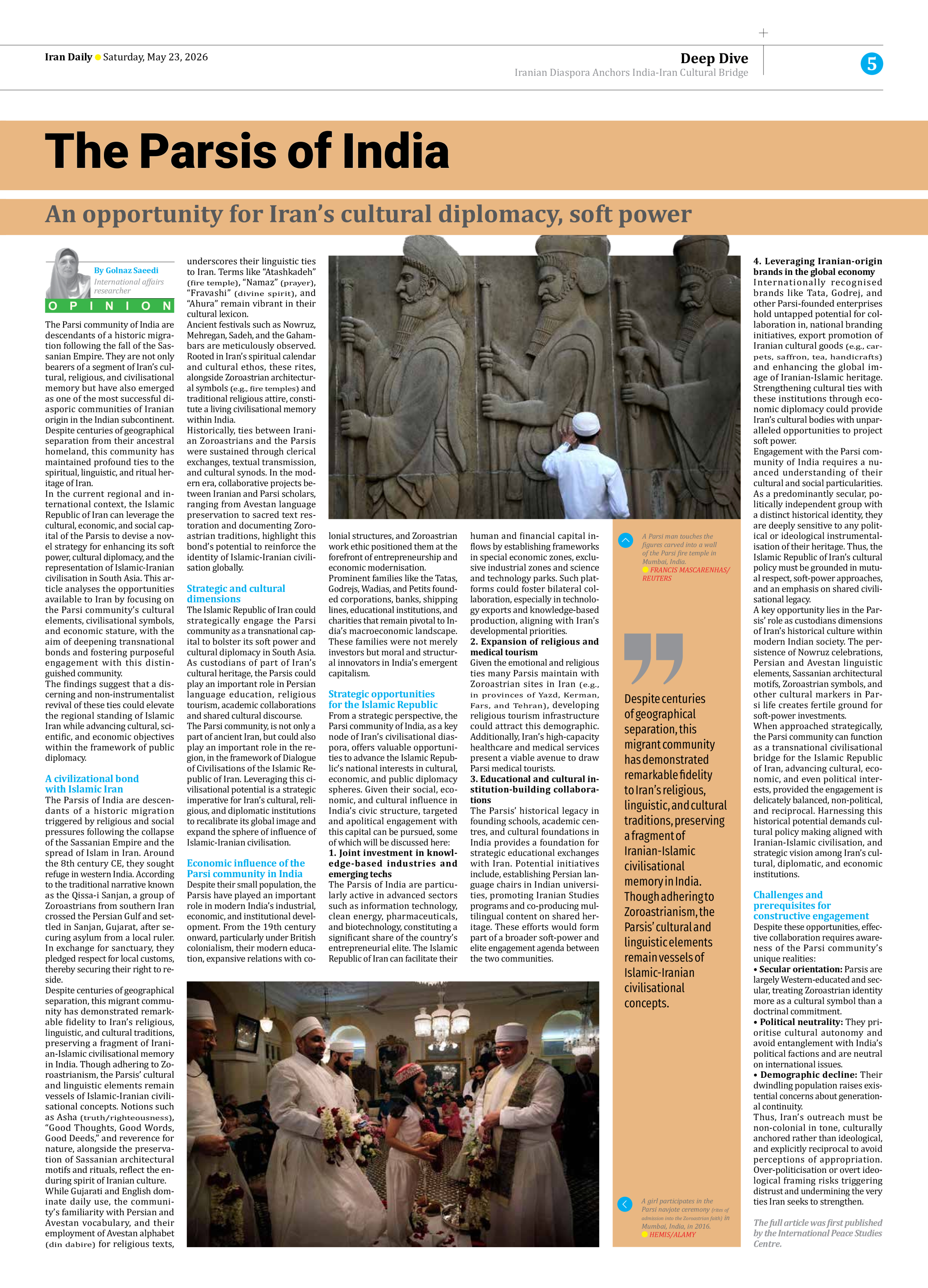
Ancient festivals such as Nowruz, Mehregan, Sadeh, and the Gahambars are meticulously observed. Rooted in Iran’s spiritual calendar and cultural ethos, these rites, alongside Zoroastrian architectural symbols (e.g., fire temples) and traditional religious attire, constitute a living civilisational memory within India.
Historically, ties between Iranian Zoroastrians and the Parsis were sustained through clerical exchanges, textual transmission, and cultural synods. In the modern era, collaborative projects between Iranian and Parsi scholars, ranging from Avestan language preservation to sacred text restoration and documenting Zoroastrian traditions, highlight this bond’s potential to reinforce the identity of Islamic-Iranian civilisation globally.
Strategic and cultural dimensions
The Islamic Republic of Iran could strategically engage the Parsi community as a transnational capital to bolster its soft power and cultural diplomacy in South Asia. As custodians of part of Iran’s cultural heritage, the Parsis could play an important role in Persian language education, religious tourism, academic collaborations and shared cultural discourse.
The Parsi community, is not only a part of ancient Iran, but could also play an important role in the region, in the framework of Dialogue of Civilisations of the Islamic Republic of Iran. Leveraging this civilisational potential is a strategic imperative for Iran’s cultural, religious, and diplomatic institutions to recalibrate its global image and expand the sphere of influence of Islamic-Iranian civilisation.
Economic influence of the Parsi community in India
Despite their small population, the Parsis have played an important role in modern India’s industrial, economic, and institutional development. From the 19th century onward, particularly under British colonialism, their modern education, expansive relations with colonial structures, and Zoroastrian work ethic positioned them at the forefront of entrepreneurship and economic modernisation.
Prominent families like the Tatas, Godrejs, Wadias, and Petits founded corporations, banks, shipping lines, educational institutions, and charities that remain pivotal to India’s macroeconomic landscape. These families were not merely investors but moral and structural innovators in India’s emergent capitalism.
Strategic opportunities
for the Islamic Republic
From a strategic perspective, the Parsi community of India, as a key node of Iran’s civilisational diaspora, offers valuable opportunities to advance the Islamic Republic’s national interests in cultural, economic, and public diplomacy spheres. Given their social, economic, and cultural influence in India’s civic structure, targeted and apolitical engagement with this capital can be pursued, some of which will be discussed here:
1. Joint investment in knowledge-based industries and emerging techs
The Parsis of India are particularly active in advanced sectors such as information technology, clean energy, pharmaceuticals, and biotechnology, constituting a significant share of the country’s entrepreneurial elite. The Islamic Republic of Iran can facilitate their human and financial capital inflows by establishing frameworks in special economic zones, exclusive industrial zones and science and technology parks. Such platforms could foster bilateral collaboration, especially in technology exports and knowledge-based production, aligning with Iran’s developmental priorities.
2. Expansion of religious and medical tourism
Given the emotional and religious ties many Parsis maintain with Zoroastrian sites in Iran (e.g., in provinces of Yazd, Kerman, Fars, and Tehran), developing religious tourism infrastructure could attract this demographic. Additionally, Iran’s high-capacity healthcare and medical services present a viable avenue to draw Parsi medical tourists.
3. Educational and cultural institution-building collaborations
The Parsis’ historical legacy in founding schools, academic centres, and cultural foundations in India provides a foundation for strategic educational exchanges with Iran. Potential initiatives include, establishing Persian language chairs in Indian universities, promoting Iranian Studies programs and co-producing multilingual content on shared heritage. These efforts would form part of a broader soft-power and elite engagement agenda between the two communities.
4. Leveraging Iranian-origin brands in the global economy
Internationally recognised brands like Tata, Godrej, and other Parsi-founded enterprises hold untapped potential for collaboration in, national branding initiatives, export promotion of Iranian cultural goods (e.g., carpets, saffron, tea, handicrafts) and enhancing the global image of Iranian-Islamic heritage. Strengthening cultural ties with these institutions through economic diplomacy could provide Iran’s cultural bodies with unparalleled opportunities to project soft power.
Engagement with the Parsi community of India requires a nuanced understanding of their cultural and social particularities. As a predominantly secular, politically independent group with a distinct historical identity, they are deeply sensitive to any political or ideological instrumentalisation of their heritage. Thus, the Islamic Republic of Iran’s cultural policy must be grounded in mutual respect, soft-power approaches, and an emphasis on shared civilisational legacy.
A key opportunity lies in the Parsis’ role as custodians dimensions of Iran’s historical culture within modern Indian society. The persistence of Nowruz celebrations, Persian and Avestan linguistic elements, Sassanian architectural motifs, Zoroastrian symbols, and other cultural markers in Parsi life creates fertile ground for soft-power investments.
When approached strategically, the Parsi community can function as a transnational civilisational bridge for the Islamic Republic of Iran, advancing cultural, economic, and even political interests, provided the engagement is delicately balanced, non-political, and reciprocal. Harnessing this historical potential demands cultural policy making aligned with Iranian-Islamic civilisation, and strategic vision among Iran’s cultural, diplomatic, and economic institutions.
Challenges and prerequisites for constructive engagement
Despite these opportunities, effective collaboration requires awareness of the Parsi community’s unique realities:
• Secular orientation: Parsis are largely Western-educated and secular, treating Zoroastrian identity more as a cultural symbol than a doctrinal commitment.
• Political neutrality: They prioritise cultural autonomy and avoid entanglement with India’s political factions and are neutral on international issues.
• Demographic decline: Their dwindling population raises existential concerns about generational continuity.
Thus, Iran’s outreach must be non-colonial in tone, culturally anchored rather than ideological, and explicitly reciprocal to avoid perceptions of appropriation. Over-politicisation or overt ideological framing risks triggering distrust and undermining the very ties Iran seeks to strengthen.
The full article was first published by the International Peace Studies Centre.