







The man Iran doesn’t know yet
Story of one of quietest extraordinary journeys in sport
Senior research officer at Chennai Centre for China Studies
Iran has produced world-class athletes for decades, yet many of their stories have remained largely unseen outside the country.
There is a version of an athlete’s story that the world prefers to tell. The prodigy identified early. The system that wraps itself around talent like scaffolding — coaches, funding, facilities, a clear road from promise to profession. The kind of story that feels inevitable in hindsight.
Moein Shafaghi’s story is not that one.
He is 29 years old, from Talesh in Gilan province, a city far removed from the polished machinery of professional sport. He came to kabaddi through a single sentence from his brother, with no background in the game, no formal pathway into it, and no certainty that it would lead anywhere at all. Today, he is one of the most respected international players in the Pro Kabaddi League — a competition watched by millions across India, the country where the sport was born.
The distance between those two realities is what this story is about.
The sport he gave everything to first
Before kabaddi, there was wrestling. Ten years of it. Not as a hobby or an after-school activity, but as a complete commitment — the kind that shapes a person down to their bones.
In Iran, wrestling is more than a sport. It is tied deeply to identity, history, and family pride. To dedicate yourself to it the way Moein did is to build your entire life around discipline and sacrifice. Early mornings. Endless training. Physical punishment. Mental exhaustion. Competition woven into everyday existence. He gave it everything he had.
What he received in return, through no fault of his own, was a road that eventually ended. Not because he failed the sport, but because the system around him failed to carry him further. In a smaller city without the infrastructure — something that talent alone cannot replace — opportunities eventually disappear. A young athlete can train with absolute dedication and still find himself staring at a ceiling with nowhere left to go.
Leaving wrestling broke him. He has admitted that openly, without trying to romanticize it. Athletes are often taught to project constant forward momentum, but Moein speaks honestly about the grief of walking away from the sport that defined him for a decade. And despite everything, he still says: “Wrestling will always remain deeply connected to the identity and culture of Iranian people. It is a sport that lives in our blood.”
A word from his brother
Kabaddi entered his life quietly. No dramatic discovery. No scout. No cinematic turning point. Just a word from his brother — a suggestion that pointed him toward something new.
He followed it. He arrived in kabaddi in his 20s with a wrestler’s body, a decade of discipline, and absolutely no certainty that any of it would lead anywhere. No established pathway. No financial security. No network inside the sport. Only the physical and mental foundations wrestling had built inside him.
That stubbornness would become the most valuable thing he owned.
The years nobody saw
What followed was not a breakthrough. It was survival.
Years of unstable income. Financial struggle was so constant it stopped feeling temporary and simply became part of daily life. Injuries that stole time he could not afford to lose. A sport unfamiliar to many around him. Opposition from family members, including his father, who could not understand why he was leaving wrestling for something so uncertain.
Facing opposition from people you love carries its own kind of weight. It does not break you all at once. It builds quietly, in the hours when doubt becomes louder than belief. Moein questioned himself. He has spoken honestly about that too. There were moments where exhaustion felt more realistic than hope. Moments where belief looked dangerously close to delusion. Whether the sacrifices meant anything. Whether the road ahead actually existed.
Still, he continued.
Not because it became easier. Nothing about Moein Shafaghi’s journey has been easy. Even the smallest forms of progress had to be fought for. No momentum arrived naturally. Every step demanded persistence. Professional sport is exhausting in ways that performance alone can never fully explain. The audience sees those 40 minutes on the mat. They do not see the years of uncertainty, isolation, recovery, or quiet suffering that make those 40 minutes possible. Moein walked every metre of that road carrying pain, doubt, and the kind of humiliation professional sport rarely admits exists.
The body keeps score of everything a career demands, and Moein Shafaghi’s body has been carrying that record for years. Wrestling left its marks first. A decade in that sport deposits itself into joints, bones, and accumulated damage long before anyone notices. Kabaddi added its own cost. More injuries. More recovery. More physical punishment. Broken teeth — the kind of damage most people associate with combat sports rather than a mat game — and yet here it is.
Then there is the wrist. Broken, and still unrepaired. Not healed. Unrepaired.
The distinction matters because this is not a story about recovery. It is about continuing despite damage that still exists. Match after match. Season after season. In a league that demands everything from a body already asking for rest. And yet he steps onto the mat anyway.
The crowd does not see the wrist. They do not see the accumulated damage beneath the performance. They simply see a player competing with professionalism, composure, and complete commitment to his team.
That is part of what makes him remarkable.
The PKL did not discover him — he arrived
By the time Tamil Thalaivas selected him for Season 11 of the Pro Kabaddi League, Moein Shafaghi was not raw talent waiting to be developed. He was already fully formed through years of invisible labour and survival.
The PKL did not discover him. He arrived.
The league was not a gift. It was the destination at the end of a road that, by every practical measure, should have gone nowhere.
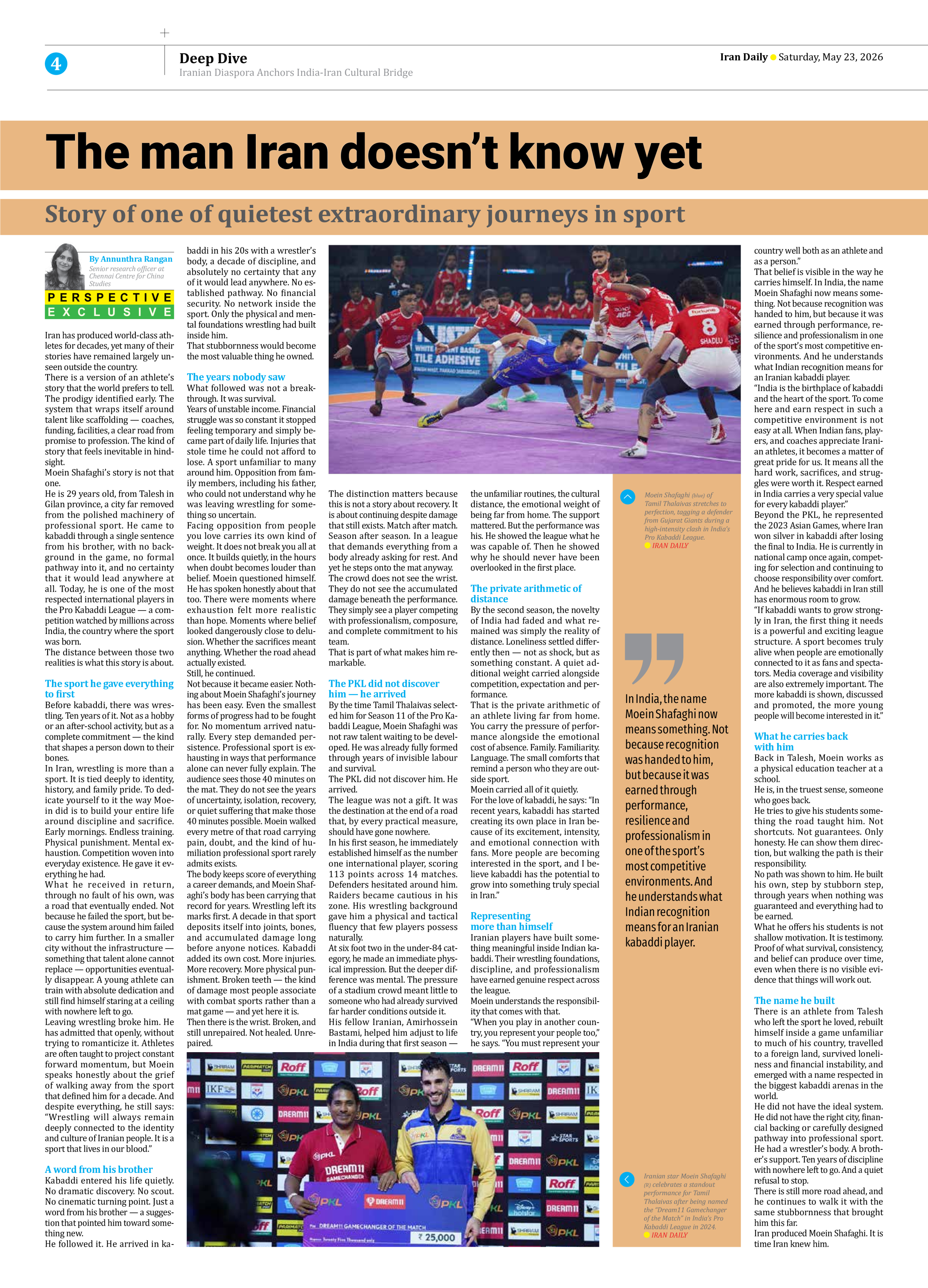
In his first season, he immediately established himself as the number one international player, scoring 113 points across 14 matches. Defenders hesitated around him. Raiders became cautious in his zone. His wrestling background gave him a physical and tactical fluency that few players possess naturally.
At six foot two in the under-84 category, he made an immediate physical impression. But the deeper difference was mental. The pressure of a stadium crowd meant little to someone who had already survived far harder conditions outside it.
His fellow Iranian, Amirhossein Bastami, helped him adjust to life in India during that first season — the unfamiliar routines, the cultural distance, the emotional weight of being far from home. The support mattered. But the performance was his. He showed the league what he was capable of. Then he showed why he should never have been overlooked in the first place.
The private arithmetic of distance
By the second season, the novelty of India had faded and what remained was simply the reality of distance. Loneliness settled differently then — not as shock, but as something constant. A quiet additional weight carried alongside competition, expectation and performance.
That is the private arithmetic of an athlete living far from home. You carry the pressure of performance alongside the emotional cost of absence. Family. Familiarity. Language. The small comforts that remind a person who they are outside sport.
Moein carried all of it quietly.
For the love of kabaddi, he says: “In recent years, kabaddi has started creating its own place in Iran because of its excitement, intensity, and emotional connection with fans. More people are becoming interested in the sport, and I believe kabaddi has the potential to grow into something truly special in Iran.”
Representing
more than himself
Iranian players have built something meaningful inside Indian kabaddi. Their wrestling foundations, discipline, and professionalism have earned genuine respect across the league.
Moein understands the responsibility that comes with that.
“When you play in another country, you represent your people too,” he says. “You must represent your country well both as an athlete and as a person.”
That belief is visible in the way he carries himself. In India, the name Moein Shafaghi now means something. Not because recognition was handed to him, but because it was earned through performance, resilience and professionalism in one of the sport’s most competitive environments. And he understands what Indian recognition means for an Iranian kabaddi player.
“India is the birthplace of kabaddi and the heart of the sport. To come here and earn respect in such a competitive environment is not easy at all. When Indian fans, players, and coaches appreciate Iranian athletes, it becomes a matter of great pride for us. It means all the hard work, sacrifices, and struggles were worth it. Respect earned in India carries a very special value for every kabaddi player.”
Beyond the PKL, he represented the 2023 Asian Games, where Iran won silver in kabaddi after losing the final to India. He is currently in national camp once again, competing for selection and continuing to choose responsibility over comfort.
And he believes kabaddi in Iran still has enormous room to grow.
“If kabaddi wants to grow strongly in Iran, the first thing it needs is a powerful and exciting league structure. A sport becomes truly alive when people are emotionally connected to it as fans and spectators. Media coverage and visibility are also extremely important. The more kabaddi is shown, discussed and promoted, the more young people will become interested in it.”
What he carries back
with him
Back in Talesh, Moein works as a physical education teacher at a school.
He is, in the truest sense, someone who goes back.
He tries to give his students something the road taught him. Not shortcuts. Not guarantees. Only honesty. He can show them direction, but walking the path is their responsibility.
No path was shown to him. He built his own, step by stubborn step, through years when nothing was guaranteed and everything had to be earned.
What he offers his students is not shallow motivation. It is testimony. Proof of what survival, consistency, and belief can produce over time, even when there is no visible evidence that things will work out.
The name he built
There is an athlete from Talesh who left the sport he loved, rebuilt himself inside a game unfamiliar to much of his country, travelled to a foreign land, survived loneliness and financial instability, and emerged with a name respected in the biggest kabaddi arenas in the world.
He did not have the ideal system. He did not have the right city, financial backing or carefully designed pathway into professional sport. He had a wrestler’s body. A brother’s support. Ten years of discipline with nowhere left to go. And a quiet refusal to stop.
There is still more road ahead, and he continues to walk it with the same stubbornness that brought him this far.
Iran produced Moein Shafaghi. It is time Iran knew him.