







US blockade fails to halt Iranian 1.4m bpd crude exports in April: IEA
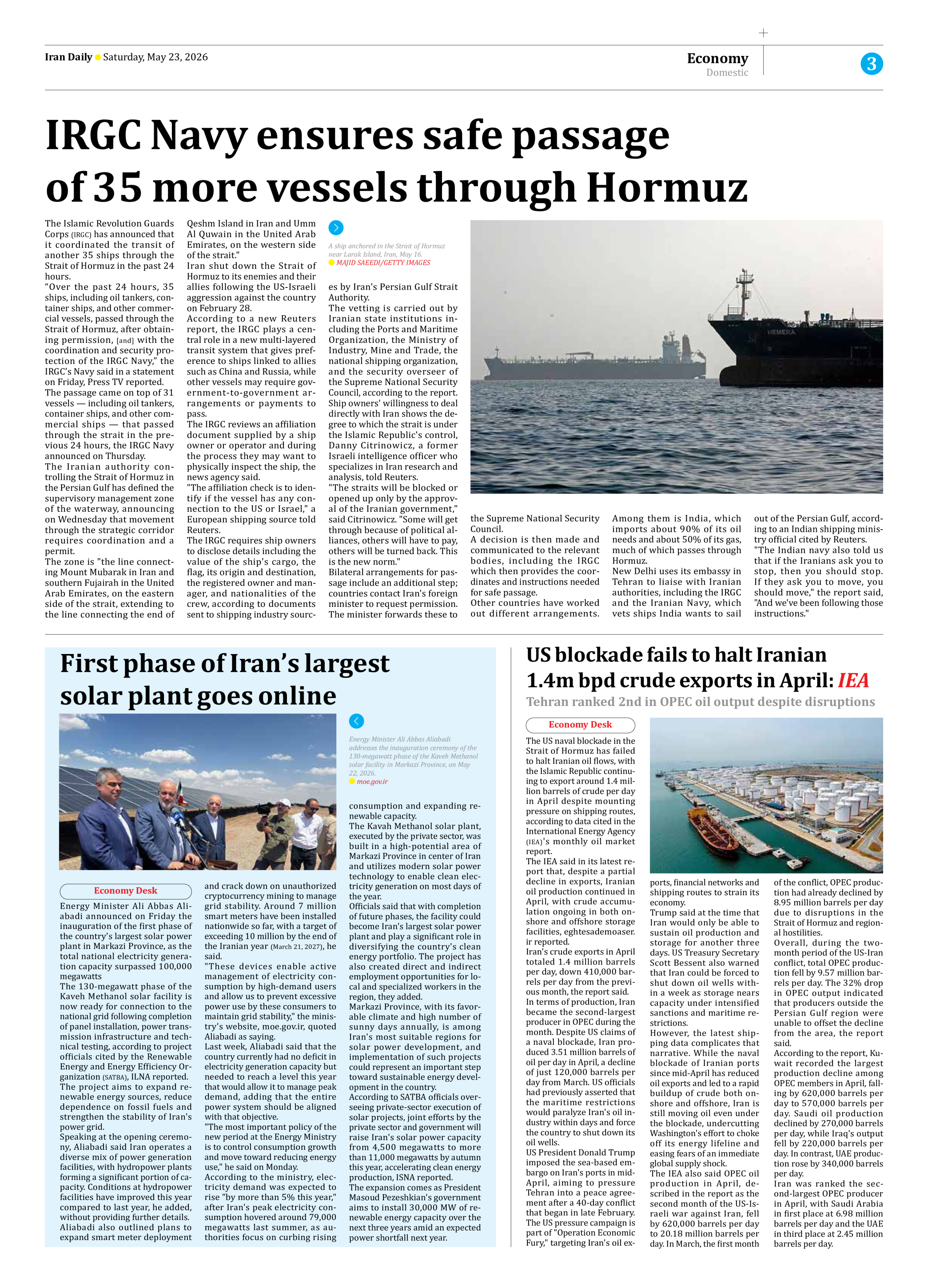
The US naval blockade in the Strait of Hormuz has failed to halt Iranian oil flows, with the Islamic Republic continuing to export around 1.4 million barrels of crude per day in April despite mounting pressure on shipping routes, according to data cited in the International Energy Agency (IEA)'s monthly oil market report.
The IEA said in its latest report that, despite a partial decline in exports, Iranian oil production continued in April, with crude accumulation ongoing in both onshore and offshore storage facilities, eghtesademoaser.ir reported.
Iran's crude exports in April totaled 1.4 million barrels per day, down 410,000 barrels per day from the previous month, the report said.
In terms of production, Iran became the second-largest producer in OPEC during the month. Despite US claims of a naval blockade, Iran produced 3.51 million barrels of oil per day in April, a decline of just 120,000 barrels per day from March. US officials had previously asserted that the maritime restrictions would paralyze Iran's oil industry within days and force the country to shut down its oil wells.
US President Donald Trump imposed the sea-based embargo on Iran's ports in mid-April, aiming to pressure Tehran into a peace agreement after a 40-day conflict that began in late February. The US pressure campaign is part of "Operation Economic Fury," targeting Iran's oil exports, financial networks and shipping routes to strain its economy.
Trump said at the time that Iran would only be able to sustain oil production and storage for another three days. US Treasury Secretary Scott Bessent also warned that Iran could be forced to shut down oil wells within a week as storage nears capacity under intensified sanctions and maritime restrictions.
However, the latest shipping data complicates that narrative. While the naval blockade of Iranian ports since mid-April has reduced oil exports and led to a rapid buildup of crude both onshore and offshore, Iran is still moving oil even under the blockade, undercutting Washington's effort to choke off its energy lifeline and easing fears of an immediate global supply shock.
The IEA also said OPEC oil production in April, described in the report as the second month of the US-Israeli war against Iran, fell by 620,000 barrels per day to 20.18 million barrels per day. In March, the first month of the conflict, OPEC production had already declined by 8.95 million barrels per day due to disruptions in the Strait of Hormuz and regional hostilities.
Overall, during the two-month period of the US-Iran conflict, total OPEC production fell by 9.57 million barrels per day. The 32% drop in OPEC output indicated that producers outside the Persian Gulf region were unable to offset the decline from the area, the report said.
According to the report, Kuwait recorded the largest production decline among OPEC members in April, falling by 620,000 barrels per day to 570,000 barrels per day. Saudi oil production declined by 270,000 barrels per day, while Iraq's output fell by 220,000 barrels per day. In contrast, UAE production rose by 340,000 barrels per day.
Iran was ranked the second-largest OPEC producer in April, with Saudi Arabia in first place at 6.98 million barrels per day and the UAE in third place at 2.45 million barrels per day.