







US Senate anti-war vote signals early fractures in Republican strategic calculus
By Delaram Ahmadi
Staff writer
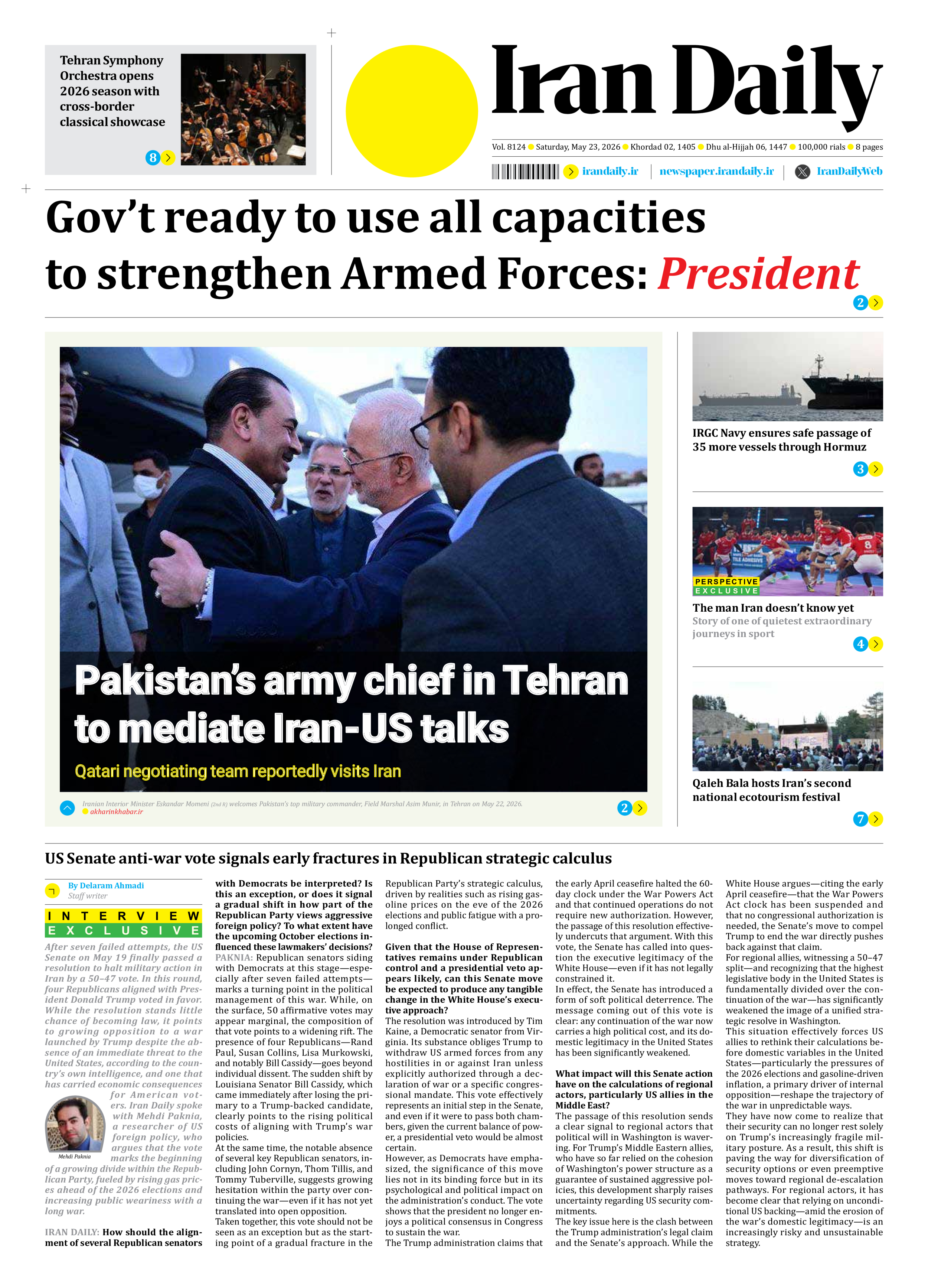
After seven failed attempts, the US Senate on May 19 finally passed a resolution to halt military action in Iran by a 50–47 vote. In this round, four Republicans aligned with President Donald Trump voted in favor. While the resolution stands little chance of becoming law, it points to growing opposition to a war launched by Trump despite the absence of an immediate threat to the United States, according to the country’s own intelligence, and one that has carried economic consequences for American voters. Iran Daily spoke with Mehdi Paknia, a researcher of US foreign policy, who argues that the vote marks the beginning of a growing divide within the Republican Party, fueled by rising gas prices ahead of the 2026 elections and increasing public weariness with a long war.
IRAN DAILY: How should the alignment of several Republican senators with Democrats be interpreted? Is this an exception, or does it signal a gradual shift in how part of the Republican Party views aggressive foreign policy? To what extent have the upcoming October elections influenced these lawmakers’ decisions?
PAKNIA: Republican senators siding with Democrats at this stage—especially after seven failed attempts—marks a turning point in the political management of this war. While, on the surface, 50 affirmative votes may appear marginal, the composition of that vote points to a widening rift. The presence of four Republicans—Rand Paul, Susan Collins, Lisa Murkowski, and notably Bill Cassidy—goes beyond individual dissent. The sudden shift by Louisiana Senator Bill Cassidy, which came immediately after losing the primary to a Trump-backed candidate, clearly points to the rising political costs of aligning with Trump’s war policies.
At the same time, the notable absence of several key Republican senators, including John Cornyn, Thom Tillis, and Tommy Tuberville, suggests growing hesitation within the party over continuing the war—even if it has not yet translated into open opposition.
Taken together, this vote should not be seen as an exception but as the starting point of a gradual fracture in the Republican Party’s strategic calculus, driven by realities such as rising gasoline prices on the eve of the 2026 elections and public fatigue with a prolonged conflict.
Given that the House of Representatives remains under Republican control and a presidential veto appears likely, can this Senate move be expected to produce any tangible change in the White House’s executive approach?
The resolution was introduced by Tim Kaine, a Democratic senator from Virginia. Its substance obliges Trump to withdraw US armed forces from any hostilities in or against Iran unless explicitly authorized through a declaration of war or a specific congressional mandate. This vote effectively represents an initial step in the Senate, and even if it were to pass both chambers, given the current balance of power, a presidential veto would be almost certain.
However, as Democrats have emphasized, the significance of this move lies not in its binding force but in its psychological and political impact on the administration’s conduct. The vote shows that the president no longer enjoys a political consensus in Congress to sustain the war.
The Trump administration claims that the early April ceasefire halted the 60-day clock under the War Powers Act and that continued operations do not require new authorization. However, the passage of this resolution effectively undercuts that argument. With this vote, the Senate has called into question the executive legitimacy of the White House—even if it has not legally constrained it.
In effect, the Senate has introduced a form of soft political deterrence. The message coming out of this vote is clear: any continuation of the war now carries a high political cost, and its domestic legitimacy in the United States has been significantly weakened.
What impact will this Senate action have on the calculations of regional actors, particularly US allies in the Middle East?
The passage of this resolution sends a clear signal to regional actors that political will in Washington is wavering. For Trump’s Middle Eastern allies, who have so far relied on the cohesion of Washington’s power structure as a guarantee of sustained aggressive policies, this development sharply raises uncertainty regarding US security commitments.
The key issue here is the clash between the Trump administration’s legal claim and the Senate’s approach. While the White House argues—citing the early April ceasefire—that the War Powers Act clock has been suspended and that no congressional authorization is needed, the Senate’s move to compel Trump to end the war directly pushes back against that claim.
For regional allies, witnessing a 50–47 split—and recognizing that the highest legislative body in the United States is fundamentally divided over the continuation of the war—has significantly weakened the image of a unified strategic resolve in Washington.
This situation effectively forces US allies to rethink their calculations before domestic variables in the United States—particularly the pressures of the 2026 elections and gasoline-driven inflation, a primary driver of internal opposition—reshape the trajectory of the war in unpredictable ways.
They have now come to realize that their security can no longer rest solely on Trump’s increasingly fragile military posture. As a result, this shift is paving the way for diversification of security options or even preemptive moves toward regional de-escalation pathways. For regional actors, it has become clear that relying on unconditional US backing—amid the erosion of the war’s domestic legitimacy—is an increasingly risky and unsustainable strategy.