







Trump’s cult of personality an impediment to diplomacy
The daily, nay hourly, fluctuations in the approach of Donald Trump, the president of the United States, toward Iran, toward war, and toward the process of negotiations have saturated these concepts and processes, more than ever before, with an aura of ambiguity and befuddlement. Trump, during this juncture and according to the testimony of numerous analysts, politicians, and even officials from allied nations, finds himself ensnared within a maelstrom of prior erroneous decisions and future — not that favorable — probabilities; and although he himself alleges that he experiences no pressure upon his determinations, the realities on the ground recount something divergent from this conviction and claim of his. The American president, in order to contend with this narrative, endeavors, through the projection of the challenge toward Iran, to flee from the reality latent therein; yet this flight will not prove feasible even with the recommencement of hostilities against Iran, for the reason that he desires Tehran’s submission, whereas Tehran has exceedingly robust foundations in the refusal of any submission before exorbitant demands. For the purpose of examining and analyzing the dimensions of the American president’s personality and approach, an interview has been conducted with Jalal Sadatian, an international relations analyst and former Iranian diplomat, the translation of which you will read below.
The president of the United States both speaks of the possibility of an agreement with Iran and describes Iran’s stances and proposals as devoid of sincerity; to what extent can this behavioral contradiction be evaluated as a component of a strategy of psychological pressure and negotiation from a superior position?
SADATIAN: Donald Trump, as a businessman, believes that he can implement and obtain results, within this matter of negotiation with Iran, through the same methodologies he employs in commercial transactions. Furthermore, the utilization of these methodologies can, on certain occasions, also exert an influence upon the energy issue. In fact, on one occasion, through these statements, he was able to control energy prices; however, they subsequently resumed an ascending trajectory.
At present, the proposition of these utterances serves the same purpose of gaining control over energy prices because one of the serious pressures exerted upon him, both within the United States and upon other areas, such as Asia and Europe, is the energy issue. This subject not only affects diesel and gasoline but also, consequently, other commodities, including agricultural materials; and it is even said that agricultural products have encountered price increases. Therefore, he imagines that, through these methodologies, he can influence prices; although, as a rule, these influences have been exceedingly limited.
Another point is that he possesses a particular procedure and personal characteristic, which we denominate a “cult of personality,” and he, from a personality standpoint, cannot accept defeat. Ultimately, a type of defeat has materialized for him; a defeat to which not only we, as the Islamic Republic, but also numerous analysts and political and international activists attest in their interviews and commentaries. Even some retired figures who have held responsibilities at various levels across the world have made this claim. This matter imposes pressure upon him because he has achieved none of his intended objectives. Furthermore, insinuations are raised suggesting that he, due to being caught in the Epstein case, has been placed under pressure by the Zionist lobby and by Netanyahu personally, and has been provoked by him.
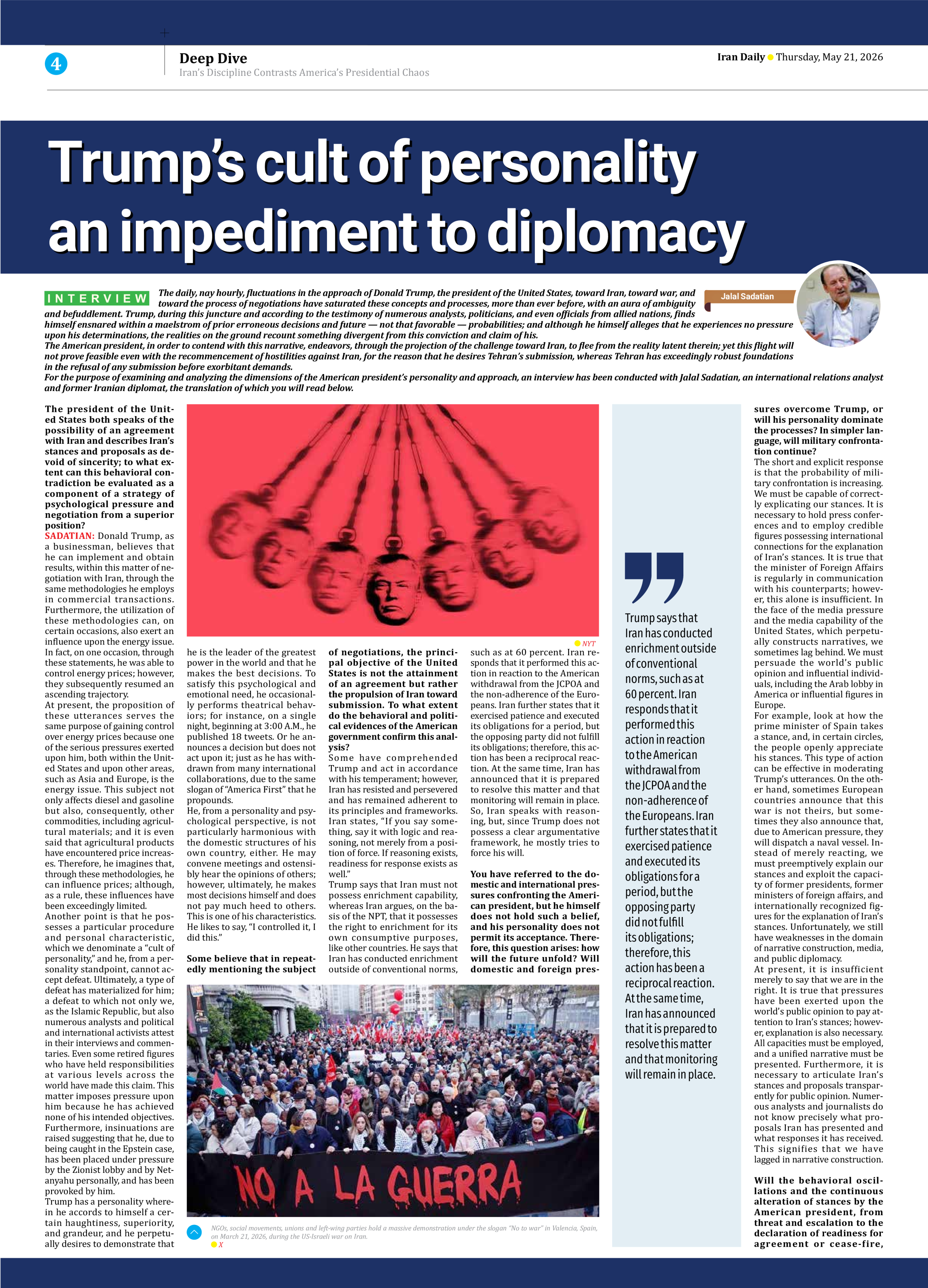
Trump has a personality wherein he accords to himself a certain haughtiness, superiority, and grandeur, and he perpetually desires to demonstrate that he is the leader of the greatest power in the world and that he makes the best decisions. To satisfy this psychological and emotional need, he occasionally performs theatrical behaviors; for instance, on a single night, beginning at 3:00 A.M., he published 18 tweets. Or he announces a decision but does not act upon it; just as he has withdrawn from many international collaborations, due to the same slogan of “America First” that he propounds.
He, from a personality and psychological perspective, is not particularly harmonious with the domestic structures of his own country, either. He may convene meetings and ostensibly hear the opinions of others; however, ultimately, he makes most decisions himself and does not pay much heed to others. This is one of his characteristics. He likes to say, “I controlled it, I did this.”
Some believe that in repeatedly mentioning the subject of negotiations, the principal objective of the United States is not the attainment of an agreement but rather the propulsion of Iran toward submission. To what extent do the behavioral and political evidences of the American government confirm this analysis?
Some have comprehended Trump and act in accordance with his temperament; however, Iran has resisted and persevered and has remained adherent to its principles and frameworks. Iran states, “If you say something, say it with logic and reasoning, not merely from a position of force. If reasoning exists, readiness for response exists as well.”
Trump says that Iran must not possess enrichment capability, whereas Iran argues, on the basis of the NPT, that it possesses the right to enrichment for its own consumptive purposes, like other countries. He says that Iran has conducted enrichment outside of conventional norms, such as at 60 percent. Iran responds that it performed this action in reaction to the American withdrawal from the JCPOA and the non-adherence of the Europeans. Iran further states that it exercised patience and executed its obligations for a period, but the opposing party did not fulfill its obligations; therefore, this action has been a reciprocal reaction. At the same time, Iran has announced that it is prepared to resolve this matter and that monitoring will remain in place. So, Iran speaks with reasoning, but, since Trump does not possess a clear argumentative framework, he mostly tries to force his will.
You have referred to the domestic and international pressures confronting the American president, but he himself does not hold such a belief, and his personality does not permit its acceptance. Therefore, this question arises: how will the future unfold? Will domestic and foreign pressures overcome Trump, or will his personality dominate the processes? In simpler language, will military confrontation continue?
The short and explicit response is that the probability of military confrontation is increasing. We must be capable of correctly explicating our stances. It is necessary to hold press conferences and to employ credible figures possessing international connections for the explanation of Iran’s stances. It is true that the minister of Foreign Affairs is regularly in communication with his counterparts; however, this alone is insufficient. In the face of the media pressure and the media capability of the United States, which perpetually constructs narratives, we sometimes lag behind. We must persuade the world’s public opinion and influential individuals, including the Arab lobby in America or influential figures in Europe.
For example, look at how the prime minister of Spain takes a stance, and, in certain circles, the people openly appreciate his stances. This type of action can be effective in moderating Trump’s utterances. On the other hand, sometimes European countries announce that this war is not theirs, but sometimes they also announce that, due to American pressure, they will dispatch a naval vessel. Instead of merely reacting, we must preemptively explain our stances and exploit the capacity of former presidents, former ministers of foreign affairs, and internationally recognized figures for the explanation of Iran’s stances. Unfortunately, we still have weaknesses in the domain of narrative construction, media, and public diplomacy.
At present, it is insufficient merely to say that we are in the right. It is true that pressures have been exerted upon the world’s public opinion to pay attention to Iran’s stances; however, explanation is also necessary. All capacities must be employed, and a unified narrative must be presented. Furthermore, it is necessary to articulate Iran’s stances and proposals transparently for public opinion. Numerous analysts and journalists do not know precisely what proposals Iran has presented and what responses it has received. This signifies that we have lagged in narrative construction.
Will the behavioral oscillations and the continuous alteration of stances by the American president, from threat and escalation to the declaration of readiness for agreement or cease-fire, fundamentally permit decision-making, negotiation, and agreement?
The reality is that not many indications of rationality are observed. Was Iran not negotiating with the United States during the 12-day war? Then why did the United States attack Fordow, Isfahan, and Natanz? While technical negotiations were supposed to continue, why were the attacks carried out? Does war not possess rules and frameworks? What logic and framework do attacks on educational centers, medical facilities, residential places, and historical monuments follow? It is natural that these actions engender mistrust.
Iran endeavors, through diplomacy and regional consultations, including Mr. Araghchi’s travels to Pakistan, to moderate these contradictory behaviors. Trump, even within the United States, has repeatedly circumvented Congress. At present, as well, he endeavors to preserve his war powers without regard for legal restrictions. Although the Democrats seek to restrict these powers, they have not yet succeeded.
Therefore, even if a certain rationality exists within the domestic structure of the United States, the behavior of American presidents and their disregard for rules and commitments have created mistrust. There exists no definitive guarantee that, if a promise is made, it will certainly be fulfilled. No such guarantee exists, neither at the international level nor within the United States.
Nevertheless, if the objective is the avoidance of war and the preservation of achievements, there is no recourse except to continue the path of diplomacy and to arrive at a type of agreement; an agreement wherein concessions are granted and concessions are received, so that the country’s infrastructure, the lives of the people, and further damages may be protected. At present, the “neither war nor peace” situation has disrupted the lives of many inside Iran; due, for instance, to internet problems and the damages inflicted upon professions dependent upon international communications. For this reason, efforts are underway by various officials, including the government, the Supreme National Security Council, Mr. Qalibaf, and Mr. Araghchi, to return the people’s living conditions to a normal state as quickly as possible, while preserving achievements. It is true that the opposing party is not particularly trustworthy; however, ultimately, there exists no other way except to move along this same path of diplomacy.
The full interview first appeared in Persian on IRNA.