







Eco-tourism expansion aims to revive rural economies, preserve cultural identity
Iran is stepping up investment in rural tourism and eco-lodges as part of a broader strategy to revive village economies, strengthen national unity and safeguard Iranian-Islamic cultural identity, Cultural Heritage, Tourism and Handicrafts Minister Reza Salehi-Amiri said on Tuesday.
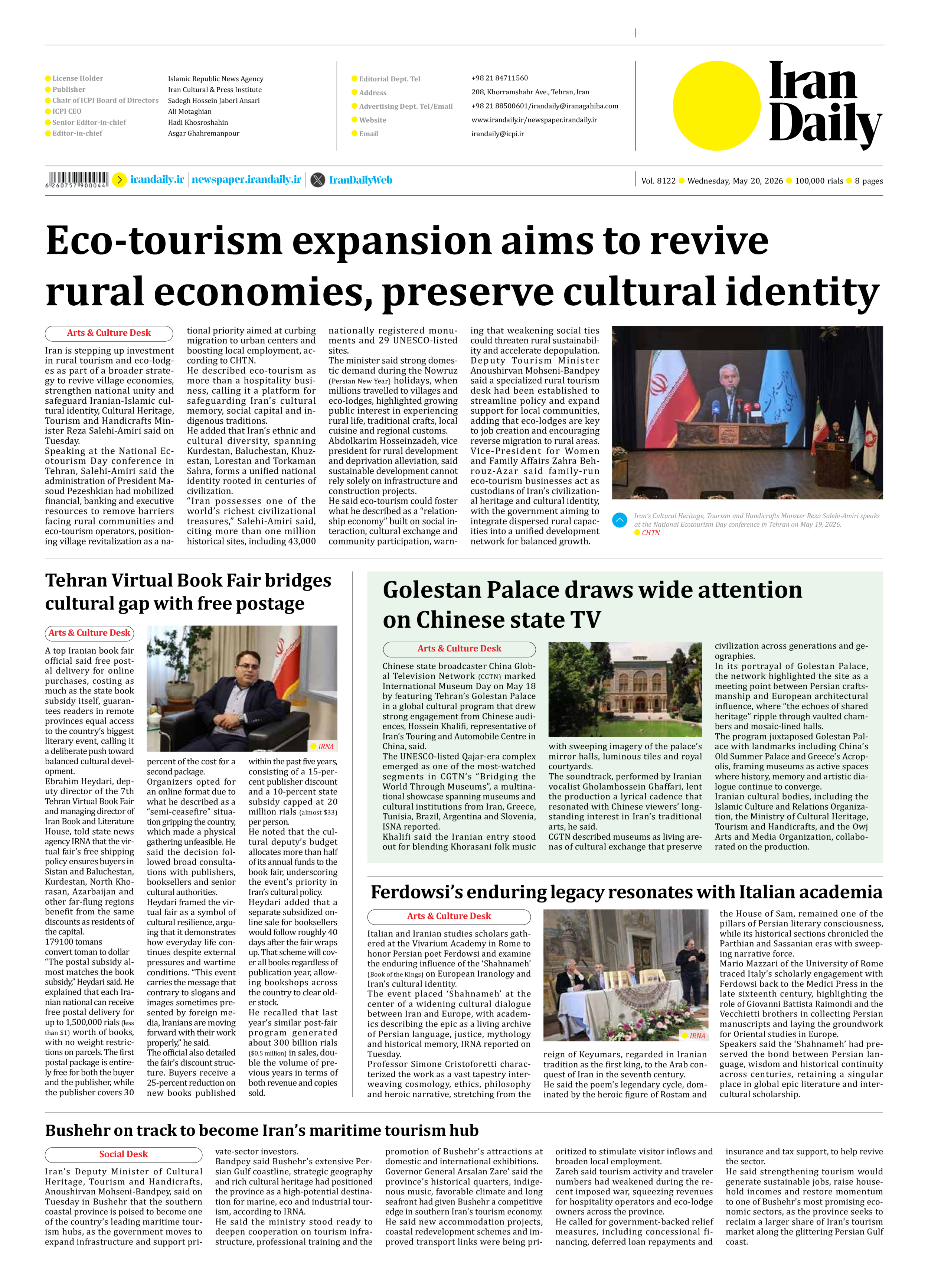
Speaking at the National Ecotourism Day conference in Tehran, Salehi-Amiri said the administration of President Masoud Pezeshkian had mobilized financial, banking and executive resources to remove barriers facing rural communities and eco-tourism operators, positioning village revitalization as a national priority aimed at curbing migration to urban centers and boosting local employment, according to CHTN.
He described eco-tourism as more than a hospitality business, calling it a platform for safeguarding Iran’s cultural memory, social capital and indigenous traditions.
He added that Iran’s ethnic and cultural diversity, spanning Kurdestan, Baluchestan, Khuzestan, Lorestan and Torkaman Sahra, forms a unified national identity rooted in centuries of civilization.
“Iran possesses one of the world’s richest civilizational treasures,” Salehi-Amiri said, citing more than one million historical sites, including 43,000 nationally registered monuments and 29 UNESCO-listed sites.
The minister said strong domestic demand during the Nowruz (Persian New Year) holidays, when millions travelled to villages and eco-lodges, highlighted growing public interest in experiencing rural life, traditional crafts, local cuisine and regional customs.
Abdolkarim Hosseinzadeh, vice president for rural development and deprivation alleviation, said sustainable development cannot rely solely on infrastructure and construction projects.
He said eco-tourism could foster what he described as a “relationship economy” built on social interaction, cultural exchange and community participation, warning that weakening social ties could threaten rural sustainability and accelerate depopulation.
Deputy Tourism Minister Anoushirvan Mohseni-Bandpey said a specialized rural tourism desk had been established to streamline policy and expand support for local communities, adding that eco-lodges are key to job creation and encouraging reverse migration to rural areas.
Vice-President for Women and Family Affairs Zahra Behrouz-Azar said family-run eco-tourism businesses act as custodians of Iran’s civilizational heritage and cultural identity, with the government aiming to integrate dispersed rural capacities into a unified development network for balanced growth.