







Zanjan’s museums preserve centuries of history, culture
Zanjan Province is home to 12 museums spanning various fields, serving as valuable repositories of the region’s rich cultural and historical heritage. Officials say preserving and maintaining these treasures requires greater attention and support.
The International Council of Museums (ICOM), operating under UNESCO, designated May 18 as International Museum Day during its 12th General Assembly held in Moscow in 1977.
Since then, museums around the world have marked the occasion annually by discussing key issues facing the sector, while museum experts and the public engage in dialogue about the challenges confronting these institutions. Special ceremonies are also held at several renowned museums worldwide, according to IRNA.
International Museum Day provides an opportunity to strengthen global scientific and cultural cooperation among museums through coordinated international initiatives and joint programs aimed at promoting cultural understanding.
A museum is defined as a place for collecting, preserving, studying, and exhibiting cultural or natural heritage for the purposes of education, research, appreciation, and public enjoyment.
Today, museums are widely recognized as institutions that showcase the history, civilization, culture, and hidden stories of nations spanning thousands of years.
Speaking to IRNA, Mohammadreza Mohammadpour, Deputy Head of Zanjan Province’s Cultural Heritage, Tourism and Handicrafts Organization, highlighted the importance of museums in society.
“Museums play a unique and enduring role in human societies through the preservation and promotion of cultural heritage,” he said.
“Museums are among the few institutions safeguarding the legacy of past generations. Every historical object, though silent, tells countless stories and serves as an authentic document of art, culture, and history.”
Referring to International Museum Day and Cultural Heritage Week, observed in Iran from May 18 to May 24, Mohammadpour stressed the need for a large museum complex in Zanjan featuring sections dedicated to archaeology, anthropology, contemporary arts, and traditional occupations.
“The province lacks such a specialized facility, and the issue has long been neglected at the national level due to funding shortages and other constraints,” he said.
According to Mohammadpour, the large number of archaeological and anthropological artifacts stored in provincial repositories demonstrates the need for a major museum meeting international standards.
He added that the current site displaying unique artifacts such as the Salt Men is a historic house lacking the facilities and standards of a modern museum.
Addressing the impact of museums on tourism, Mohammadpour said cooperation among historical sites, museums, hotels, and travel agencies strengthens tourism networks and increases visitor numbers.
“Museums work closely with tourism agencies to attract visitors and pay special attention to tourism development,” he said.
He explained that the strategic location of a museum enhances the image of a region and supports the growth of tourism and leisure industries.
Research on sustainable tourism development has highlighted the importance of heritage attractions, historical monuments, and museums, he added, noting that stronger museum marketing strategies can significantly contribute to broader tourism promotion.
Mohammadpour emphasized that museums reflect the culture and lifestyle of local communities while illustrating the diversity of human societies.
“Regional museums introduce the culture and heritage of local residents and promote tourism by highlighting indigenous and regional characteristics,” he said.
He warned that shortcomings in this sector could undermine efforts to introduce local culture, customs, and traditions.
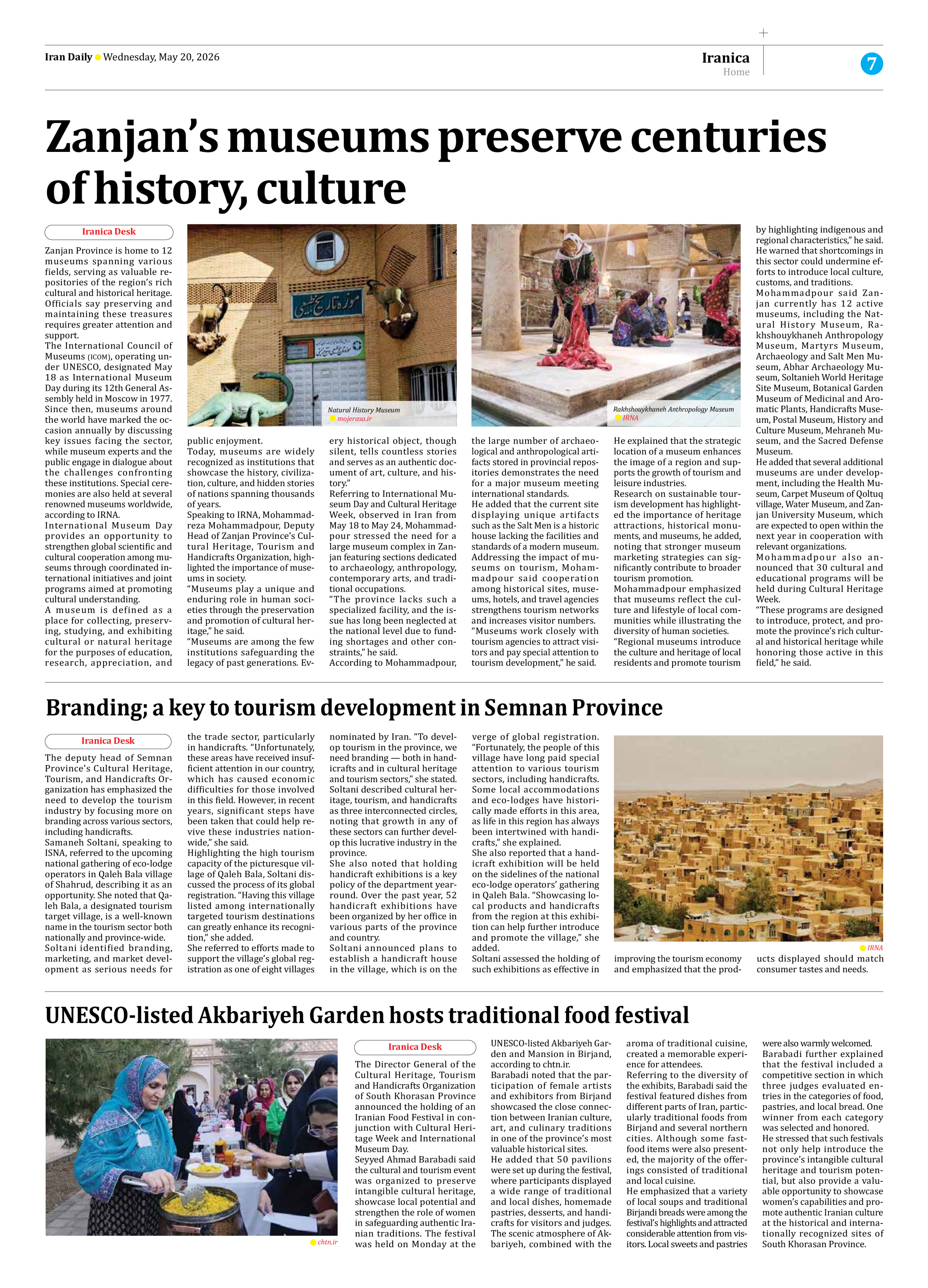
Mohammadpour said Zanjan currently has 12 active museums, including the Natural History Museum, Rakhshouykhaneh Anthropology Museum, Martyrs Museum, Archaeology and Salt Men Museum, Abhar Archaeology Museum, Soltanieh World Heritage Site Museum, Botanical Garden Museum of Medicinal and Aromatic Plants, Handicrafts Museum, Postal Museum, History and Culture Museum, Mehraneh Museum, and the Sacred Defense Museum.
He added that several additional museums are under development, including the Health Museum, Carpet Museum of Qoltuq village, Water Museum, and Zanjan University Museum, which are expected to open within the next year in cooperation with relevant organizations.
Mohammadpour also announced that 30 cultural and educational programs will be held during Cultural Heritage Week.
“These programs are designed to introduce, protect, and promote the province’s rich cultural and historical heritage while honoring those active in this field,” he said.