







Dip in European status leaves Team Melli leaning on domestic league
When the Iranian Football Federation confirmed in April that the Persian Gulf Pro League season – postponed since February 28 due to the country’s military conflict with the United States and Israel – would not resume before the upcoming FIFA World Cup, fans and pundits expected Team Melli head coach Amir Qalenoei to build his team around overseas players for the global event in North America.
Last week’s announcement of the provisional 30-man squad, however, proved otherwise.
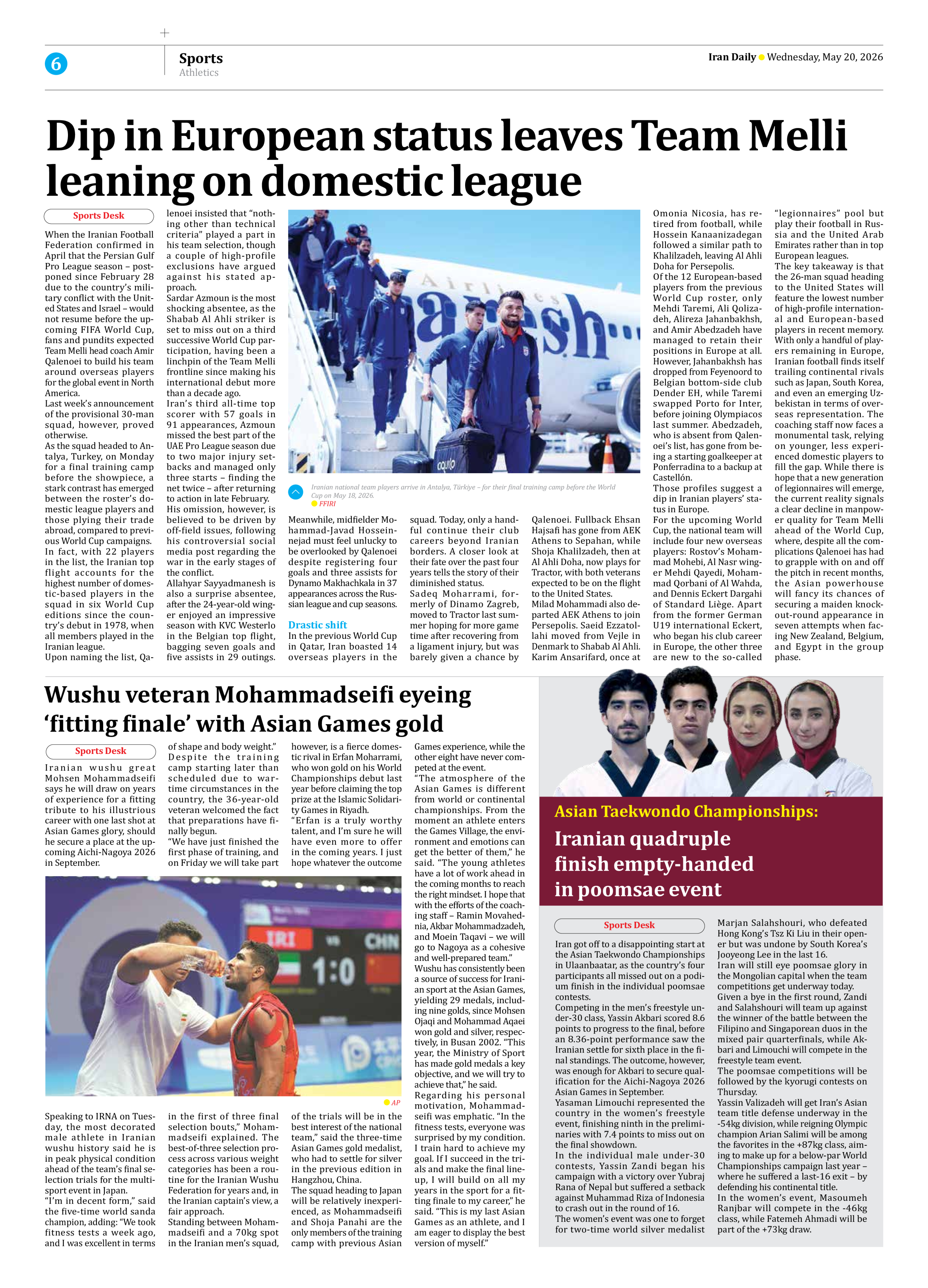
As the squad headed to Antalya, Turkey, on Monday for a final training camp before the showpiece, a stark contrast has emerged between the roster’s domestic league players and those plying their trade abroad, compared to previous World Cup campaigns.
In fact, with 22 players in the list, the Iranian top flight accounts for the highest number of domestic-based players in the squad in six World Cup editions since the country’s debut in 1978, when all members played in the Iranian league.
Upon naming the list, Qalenoei insisted that “nothing other than technical criteria” played a part in his team selection, though a couple of high-profile exclusions have argued against his stated approach.
Sardar Azmoun is the most shocking absentee, as the Shabab Al Ahli striker is set to miss out on a third successive World Cup participation, having been a linchpin of the Team Melli frontline since making his international debut more than a decade ago.
Iran’s third all-time top scorer with 57 goals in 91 appearances, Azmoun missed the best part of the UAE Pro League season due to two major injury setbacks and managed only three starts – finding the net twice – after returning to action in late February.
His omission, however, is believed to be driven by off-field issues, following his controversial social media post regarding the war in the early stages of the conflict.
Allahyar Sayyadmanesh is also a surprise absentee, after the 24-year-old winger enjoyed an impressive season with KVC Westerlo in the Belgian top flight, bagging seven goals and five assists in 29 outings. Meanwhile, midfielder Mohammad-Javad Hosseinnejad must feel unlucky to be overlooked by Qalenoei despite registering four goals and three assists for Dynamo Makhachkala in 37 appearances across the Russian league and cup seasons.
Drastic shift
In the previous World Cup in Qatar, Iran boasted 14 overseas players in the squad. Today, only a handful continue their club careers beyond Iranian borders. A closer look at their fate over the past four years tells the story of their diminished status.
Sadeq Moharrami, formerly of Dinamo Zagreb, moved to Tractor last summer hoping for more game time after recovering from a ligament injury, but was barely given a chance by Qalenoei. Fullback Ehsan Hajsafi has gone from AEK Athens to Sepahan, while Shoja Khalilzadeh, then at Al Ahli Doha, now plays for Tractor, with both veterans expected to be on the flight to the United States.
Milad Mohammadi also departed AEK Athens to join Persepolis. Saeid Ezzatollahi moved from Vejle in Denmark to Shabab Al Ahli. Karim Ansarifard, once at Omonia Nicosia, has retired from football, while Hossein Kanaanizadegan followed a similar path to Khalilzadeh, leaving Al Ahli Doha for Persepolis.
Of the 12 European-based players from the previous World Cup roster, only Mehdi Taremi, Ali Qolizadeh, Alireza Jahanbakhsh, and Amir Abedzadeh have managed to retain their positions in Europe at all. However, Jahanbakhsh has dropped from Feyenoord to Belgian bottom-side club Dender EH, while Taremi swapped Porto for Inter, before joining Olympiacos last summer. Abedzadeh, who is absent from Qalenoei’s list, has gone from being a starting goalkeeper at Ponferradina to a backup at Castellón.
Those profiles suggest a dip in Iranian players’ status in Europe.
For the upcoming World Cup, the national team will include four new overseas players: Rostov’s Mohammad Mohebi, Al Nasr winger Mehdi Qayedi, Mohammad Qorbani of Al Wahda, and Dennis Eckert Dargahi of Standard Liège. Apart from the former German U19 international Eckert, who began his club career in Europe, the other three are new to the so-called “legionnaires” pool but play their football in Russia and the United Arab Emirates rather than in top European leagues.
The key takeaway is that the 26-man squad heading to the United States will feature the lowest number of high-profile international and European-based players in recent memory. With only a handful of players remaining in Europe, Iranian football finds itself trailing continental rivals such as Japan, South Korea, and even an emerging Uzbekistan in terms of overseas representation. The coaching staff now faces a monumental task, relying on younger, less experienced domestic players to fill the gap. While there is hope that a new generation of legionnaires will emerge, the current reality signals a clear decline in manpower quality for Team Melli ahead of the World Cup, where, despite all the complications Qalenoei has had to grapple with on and off the pitch in recent months, the Asian powerhouse will fancy its chances of securing a maiden knockout-round appearance in seven attempts when facing New Zealand, Belgium, and Egypt in the group phase.